
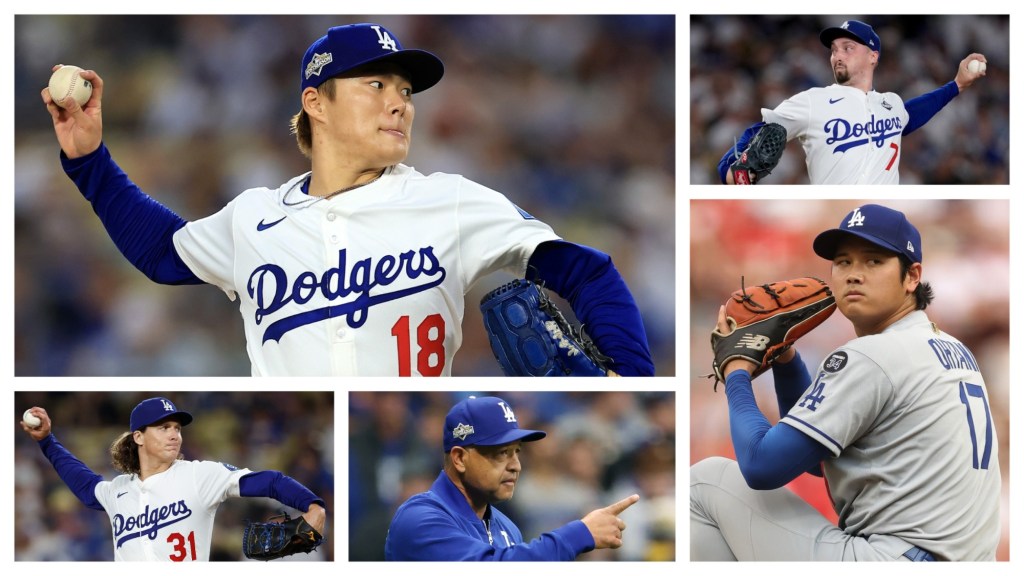
GLENDALE, Ariz. — In 1970, the Baltimore Orioles won 108 games and the American League pennant while using a total of six starting pitchers. Two of them (Mike Cuellar and Dave McNally) each made 40 starts. A third (Hall of Famer Jim Palmer) made 39. All three pitched at least 296 innings that season.
“Yeah, we won’t be doing that,” Dodgers president of baseball operations Andrew Friedman said.
No one will. Dinosaurs no longer roam the earth.
But the Dodgers will take a modern equivalent of that rotation into the 2026 season. Led by World Series MVP Yoshinobu Yamamoto, Tyler Glasnow and Shohei Ohtani with two-time Cy Young Award winner Blake Snell joining sometime into the season, the Dodgers have the best group of starting pitchers in baseball with depth provided by a group of young pitchers looking to make their mark – Roki Sasaki, Emmet Sheehan, Justin Wrobleski, River Ryan (eventually) and Gavin Stone (when he returns from shoulder surgery).
“I think we are breaking camp with the most talented group of pitchers one through 20 that we have ever had,” Friedman said. “Obviously, last September-October we got real exposure to how talented our starting staff was and how they kind of keyed off one another. We’re looking forward to them going out and being a huge part of our success this year.”
A year ago, the Dodgers’ starting pitchers were indeed a huge part of their success – in October. During the season, Yamamoto was the rock of the rotation, leading the team in starts (30) and innings pitched (173⅔).
But Snell, Glasnow and Sasaki each spent weeks on the injured list before returning for the postseason run, creating the impression that the Dodgers exaggerate if not outright manufacture injuries to their pitchers and use the IL as a waiting room where they can rest up and be closer to full strength for the postseason.
Dodgers manager Dave Roberts gets angry at the suggestion.
“You don’t think we’d want Snell to open the season right now? It’s so not true,” he said. “We don’t like not having our starters pitch.”
Friedman shakes his head at the suggestion, eagerly “refuting” the idea that the Dodgers pre-plan IL breaks for their pitchers.
“That is a misperception,” he said. “I think people assume that we have a plan of when such-and-such pitcher is going to miss time. It’s going to be this month and this pitcher is going to miss time the next month.
“There are obviously fatigue injuries and there are acute injuries. Acute injuries are hard to do much about. But with fatigue-based injuries we can at least be on top of more with communication with the pitcher, tracking things closely to do everything we can to get them to pitch as many games as they can in ’26 and also be in the best position to help us win a World Series if we’re fortunate enough to qualify for the playoffs.”
Last year, Yamamoto was the first pitcher to start 30 games for the Dodgers since Julio Urias (31) in 2022. Only one other pitcher in the past three seasons made as many as 25 starts (Stone in 2024). So, ideally, how much would the Dodgers like to use their starters during the regular season?
“I think getting 25 to 28 starts is a good outcome and more than that is obviously a great outcome,” Friedman said. “But what we are trying to thread the needle on is doing everything we can to put ourselves in position to win the division, get a bye and have the arrow pointing up as much as we can with our pitching staff heading into October.”
A pitcher hasn’t won a Cy Young Award making fewer than 28 starts (in a full season) since Clayton Kershaw in 2014 – when he made 27. The past 20 Cy winners (discounting 60-game 2020 season) have averaged 31.55 starts during their award-winning seasons.
Roberts proclaimed Yamamoto, Ohtani and Glasnow as Cy Young contenders this spring. Yamamoto finished third in the National League voting last season. But the Dodgers’ gameplan to avoid overworking them during the season could hinder their contender status for the individual award.
“I don’t think it impedes it,” Roberts said. “I still think you can make 25 to 28 starts and still win a Cy Young. I would think 25 is totally fair. Yoshi and Shohei and Glas – I would expect them to make 25 starts. I really would. Things are going to happen and once they start pitching might we have to pull back as we have with certain pitchers in the past? Sure. But looking out, that’s what we’re planning on. We’re not planning on giving them a respite.”
In a world where Paul Skenes still exists in the National League, it might be difficult to put up Cy Young Award-winning numbers in four to seven starts fewer than last year’s winner.
“I think they’re certainly more than capable,” Friedman said of the Dodgers’ core four of Yamamoto, Glasnow, Ohtani and Snell (even with a late start). “How many starts they go, if they’re able to go wire to wire, are all things that are going to fall out during the season. In an ideal world, they go wire to wire and are in a good position going into October. That’s our ideal. And if that were to happen I think those guys are all well-positioned as strong Cy Young contenders.”
Ohtani has made it clear winning a Cy Young is on his vision board as he returns to full health as a pitcher this season. He acknowledges that “it doesn’t hurt to rest more” but “my intent is to be in the rotation under normal rest, normal circumstances.”
“I would never want to sacrifice our chance of winning and performing in the postseason. So I think that’s really the No. 1 goal in my mind,” Ohtani said this spring. “Just because I want to try to win the Cy Young and throw more innings, that’s not necessarily the priority over winning a championship.”
Ohtani has made 25 starts in a season just once. He started 28 times for the Angels in 2022 – and finished fourth in the American League Cy Young voting, his only Top 10 finish to date.
“I do see that as an important benchmark as a starting pitcher, ideally in a situation where everybody makes 25 starts. That’s the ideal situation,” Ohtani said. “But it’s hard to find that nowadays. You find one (on each of the) 30 teams, that’s how rare it is. So what I think is more important is to just be flexible, adjustable, and making sure that we’re having the goal in mind rather than the starts that we need to make.”