
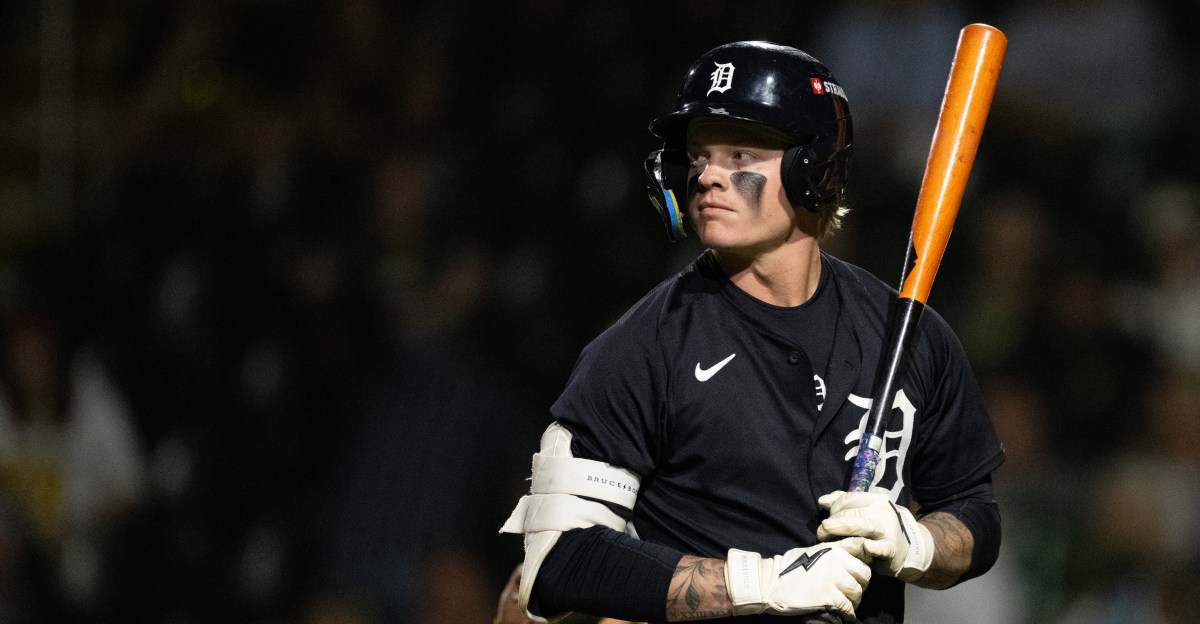
Max Clark was never going to make the Opening Day roster, and no doubt wasn’t thrilled with some of his work in spring camp, but none of that matters now. The precocious 21-year-old center fielder broke out in a big way in 2025, and is well ahead of pace to reach the major leagues. It may take him until the second half of the season, but Clark will almost certainly play in the major leagues this year and unless Parker Meadows turns things around at the plate this year, Clark is the odds on favorite to be the Tigers starting center fielder in 2027 and for many years to come.
The Tigers, somewhat controversially, selected Clark as the third overall pick in the 2024 amateur draft. The Franklin, Indiana prep star was certainly projected to go roughly that high, but in the process the Tigers passed on Florida outfielder Wyatt Langford, who then went to the Texas Rangers instead. Langford reached the majors in his first pro season in 2024 and had an excellent rookie campaign, then backed it up with 22 homers and a 4.1 fWAR season as a right-handed hitter corner outfielder in 2025. Clark has a solid chance of outpacing Langford in time, but it certainly would’ve benefited the Tigers to have a right-handed power-hitting corner outfield on the roster for their two postseason runs.
On the other hand, the Tigers saved roughly $650,000 in signing Clark underslot, while Langford cost the Rangers an overslot bonus of $8 million. The Tigers could’ve signed Kevin McGonigle either way, but those savings made it possible without completing punting on the rest of the draft. Of course, none of that has anything to do with Max Clark.
Clark was very well known on the high school circuit, playing in many showcases and USA Baseball tournaments. He was a notable high school receiver, and in baseball won the Indiana Gatorade Player of the Year award when he was still just a sophomore. He won the national version of the award as a junior as well, and then was named Gatorade’s overall national Player of the Year in any sport as a senior. He also led the 18U National Team to a gold medal at the 2022 WBSC World Cup, hitting a game-tying home run against Canada and then recording three hits in the finals over Chinese Taipei. His gregarious, coachable nature, combined with his work ethic and baseball intelligence, have always drawn high makeup grades from coaches and scouts.
On draft day, what Clark brought to the table was an advanced hit tool and high end speed and athleticism, with the potential to approach average power. There was some question about the raw power projections, as Clark’s 5’11” frame was already pretty well muscled. However, he’s proven that wrong already by building himself up with another 10-15 pounds of good muscle since draft day, checking in at 205 pounds officially. He’s pretty close to average raw power now, and in 2025 he learned to use it to better effect in games.
Clark handled Single-A ball with ease in 2024, after getting a brief run of 11 games post-draft the summer prior. He ran into a little more trouble at the High-A level, struggling some with left-handed pitching, but he also started pulling the ball in the air more as the season progressed after spraying a lot of line drives to the opposite field in the first half. He hit seven homers in Lakeland, and added two more in a 34 game stint in West Michigan to end the year. He also racked up 29 stolen bases on the year, and continued to show excellent plate discipline. His strikeouts did spike with the Whitecaps, but the season ended before he really had much time to adjust back.
Heading into 2025, the goals were pretty straightforward. Clark needed to shore up his performance against left-handed pitching, improve his reads and routes in the outfield, and continue working toward his average power projections. He managed all of it, walking 19.2 percent of the time with the Whitecaps with a strikeout rate of just 17 percent and cracking seven home runs in 68 games. His power is still heavily tilted toward his work against right-handed pitching, but he walked as much as he struck out against southpaws and made plenty of hard contact. After a solid start in April and May, he really picked up the pace by mid-June and tore the cover off the ball in July. That earned him a promotion to Erie alongside fellow top prospects Kevin McGonigle and Josue Briceño.
Clark stumbled a bit in his first few weeks in Erie, but the adjustments came more quickly this time and he smacked another seven homers in 43 games for the SeaWolves, and cut his strikeout rate down even a bit from his marks in West Michigan. He stole 19 bases on the year total, and more importantly, his jumps and route running in centerfield really started to come together over the course of the season. People tended to overlook this element because of his speed, but he really wasn’t that good a center fielder in 2024. His speed made up for a lot, but throughout the 2025 season projections of plus center field defense looked far closer to present reality than they did the year prior.
Clark entered camp this spring tracking like an above average center fielder with a pretty good arm who gets on base a ton and grinds out at-bats, likely to contribute something like 15 HR/25 SB a season throughout his prime years. And there is still room for improvement without anything crazy required. He’s started to scratch away at that 108 mph exit level scouts use as the average raw power mark, indicating that the raw power is close to MLB average levels. While he’s probably lost a step from the double-plus speed he had in high school due to adding more muscle, he’s still a better than plus runner who covers a lot of ground in the outfield and is much more polished these days.
Reports from the back fields suggest that Clark has continued to beat up on even upper level pitching in minor league camp, and the Tigers were confident enough in his bat to send him straight to Toledo to begin the year in Triple-A. While Kevin McGonigle is the prodigy in terms of hitting, getting to Triple-A just after your 21st birthday is still a very advanced pace and another feather in Clark’s cap.
It’s worth remembering that he’s a bit younger than McGonigle and Briceño. There’s still power and defensive upside left to unlock in his game, and he’s already pretty good. Clark spent the offseason working hard to maximize it, taking a lot of BP breaking balls and working against left-hander’s angles to improve his ability to create better bat paths to drive those pitches, rather than just taking them or trying to serve them for singles.
Of course we would be remiss if we didn’t get into Clark’s social media presence, and the minor, albeit ridiculous storm of nonsense that briefly followed him early in camp. Since he was a notable young player in high school, Clark has been documenting his life and training for social media, and has 384 thousand followers on Tik Tok and another 452 thousand on Instagram. From taking his young fanbase behind the scenes at events, to training content, to general lifestyle vlogging, Clark has built himself into a major social media presence in youth baseball.
This is still fairly uncommon in baseball, particularly in America, though that will presumably be changing fast in the years to come. Not only does it irritate some people, it also makes Clark a target of a certain brand of ragebait merchant around the internet. He got a dose of what’s coming after losing a pair of fly balls in the sun while playing left field in game back in early March. Of course, we see a few of these every spring, but as mention of him is already guaranteed to attract tons of views, criticism of him was a popular way to pile up clicks for a week or so, but it went fully on into some pretty grotesque character assassination in some quarters as well. While Clark rebutted criticism of his jewelry, his eyeblack, and much more importantly, his character and commitment to his game, the very fact that he felt the need to defend himself that way illustrated the problem. He’s going to need a little thicker skin at the major league level, where every mistake is already heavily scrutinized.
On the plus side, just the fact of his long-term social media presence no doubt helps with this. He’s heard most of this stuff before, and that does help to innoculate one to unfair criticism. He’s not at all shy about standing out, and fair or unfair, it’s just the reality of the situation that he’s going to remain a target. There’s just a steeper learning curve in terms of perception and fan criticism at the MLB level. Fortunately, from everything I’ve seen, Clark is a very smart, hard-working player who lives in the gym and is baseball obsessed to a degree you don’t see from many young players. He’s unlikely to be distracted from his goals.
MLB teams typically do not like players saying too much, and Clark may have to become a little less of an open book, at least until he’s established at the big league level. We’ll see how he navigates all of this, but there is no shortage of smarts, work ethic, or confidence here, and he’s just an impressive kid all around. I suspect in a few years time as the next generation starts taking over the game, this will just seem like a weird subject to even come up in a scouting report.
The Tigers have already announced that Clark will start the season in Triple-A. Look for him to play plenty of center field, but also to work some in the corners to help improve his positional flexibility. He may take over center field in Comerica Park at some point, but he also may be playing the corners alongside Meadows, who, assuming he puts 2025 behind him, remains the somewhat superior defender, while Clark’s more accurate arm plays in right field well.
For now, Clark just needs to keep refining his all around game. He’ll see a few more crafty lefties at the Triple-A level, and they’re still the type most likely to give him some trouble by junkballing him with good command. He handles velocity pretty well already, and his breaking ball recognition is good. He’s close, but sometimes those last short steps to the major leagues can take a while. One way or the other, he’ll almost certainly play in the major leagues at 21, and compete for an everyday job next season. He’s tracking like an above average hitter and center fielder, and if he can tune things up a little more and maximize his power production he’ll be a regular All-Star in the years to come.