
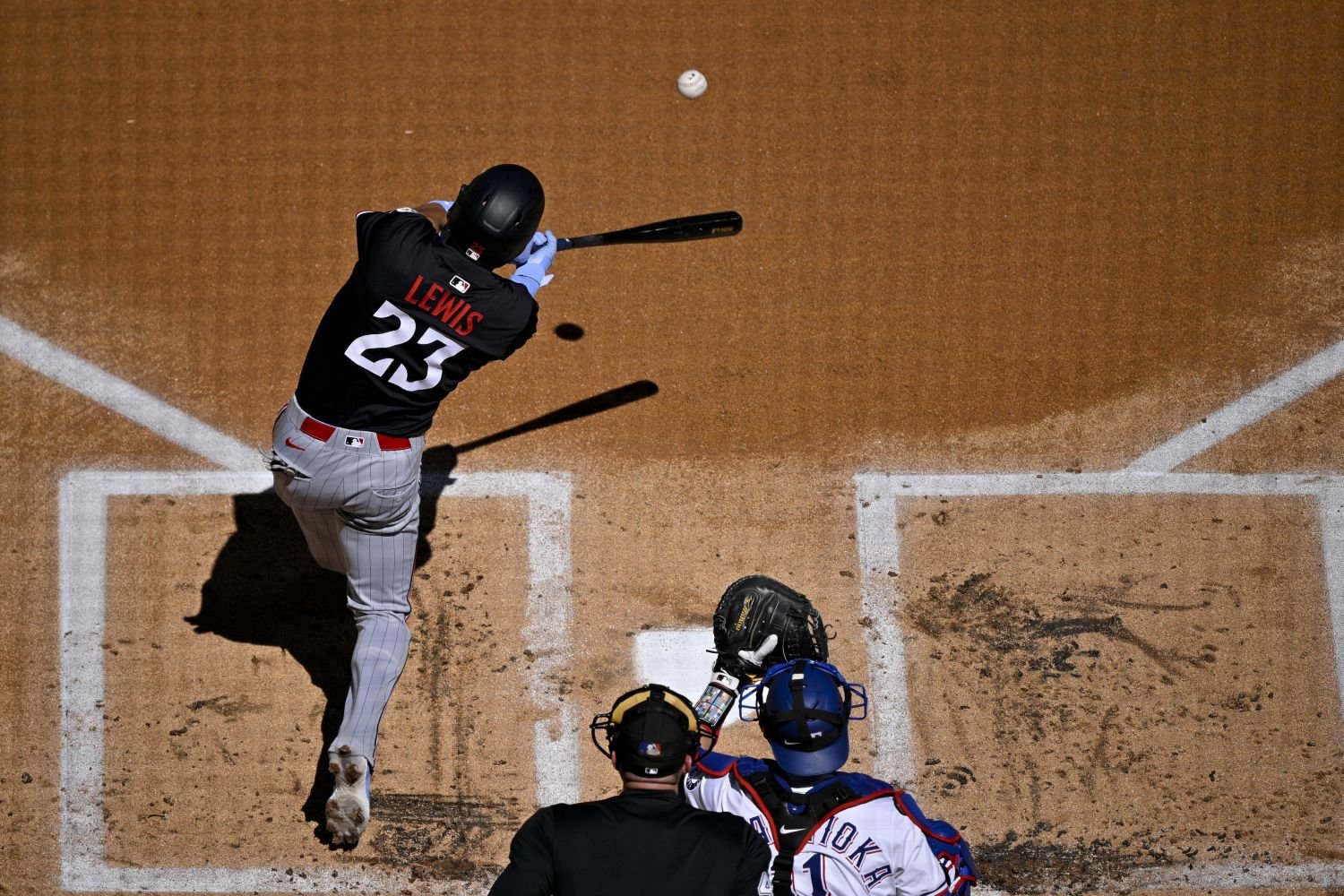
When Royce Lewis was selected first overall in the 2017 MLB Draft, the expectation was simple. He was supposed to be a future superstar and the face of the Twins franchise. Alas, his journey in professional baseball has been anything but a smooth ascent to the firmament. Multiple ACL tears and a lengthy injury history have interrupted his development at nearly every turn, forcing him to spend more time rehabbing than refining his game.
Even so, the flashes have always been there. The moments that remind you exactly why he went No. 1 overall have not been hard to find, especially when the lights were brightest. That’s the version of Lewis everyone has been waiting to see over a full season, which is why this spring has drawn some attention for the wrong reasons.
In 45 at-bats this spring, Lewis batted .133/.160/.289, with 2 home runs, 2 stolen bases, 2 walks and 11 strikeouts. The surface-level production was rough, and even when you look a little deeper, the contact quality offered little reassurance.
Lewis did post a reasonably strong 107.4 MPH 90th-percentile exit velocity, but his average exit velocity was just 88.7 MPH and he hit just over 35% of his balls in play at 95 MPH or higher. For a player whose value comes from the damage he can do when he connects, that lack of consistent authority stands out.
It’s also worth noting that this has not come against top-tier pitching. According to Baseball Reference’s opponent quality metric, Lewis faced a 7.9 out of 10 level of competition this spring, with 10 representing a typical major-league pitcher. In simple terms, much of his playing time came against minor-league arms, rather than big leaguers, which only adds to the concern one feels at first glance.
That’s really where this conversation starts. It’s fair to ask whether these struggles are simply a rough stretch or something more meaningful, but the answer depends on how much weight you want to give a handful of spring at-bats.
There are several reasons to believe this was basically a fluke. The most obvious place to start is his batting average on balls in play, which was an atrocious .114. That number isn’t just low; it’s essentially impossible to sustain. Even hitters who are consistently overmatched don’t run a mark that low over time, which means some level of correction is inevitable as the sample grows.
Beyond that, there are still signs that the underlying impact ability has not disappeared. Lewis produced a 13.5% barrel rate this spring, according to Statcast, which tells us that his high EV90 wasn’t fueled by hammering the ball into the ground. That figure would have placed him comfortably above the league average last season, and suggests that when he does square the ball up, the quality of contact is still there.
The disconnect comes from the inconsistency in getting to that contact. His overall exit velocity and strikeout rate point to a hitter who is not consistently on time or fully comfortable in the box. That would not be unusual, given the context of his offseason.
Lewis made adjustments to both his stance and approach over the winter, and that type of change often comes with an adjustment period. Even established hitters can look out of sync in spring training when they are working through mechanical tweaks, especially when the focus is on process, rather than immediate results. Pile the question of sample size on top of these considerations, and it’s easy to downplay the problem.
Lewis has already shown that he can perform at a high level against major-league pitching, and he has done it in meaningful moments. The raw talent that made him the top pick in the draft is still present, and the underlying metrics suggest that his ability to impact the baseball has not disappeared. As we’ve already documented, though, there are reasons beyond the stat line to be concerned, too.
What matters more is how he looks once the games begin to count, when the focus shifts from adjustments to execution. For now, the results are not pretty, but they’re also not especially predictive.
It is fair to acknowledge the slow start, and it’s reasonable to monitor how he looks early in the season. At the same time, the combination of a tiny sample, an unsustainably low BABIP, and ongoing adjustments makes it difficult to treat this as anything more than a temporary lull. If you have to choose between the two, view this as an unimportant (though not strictly encouraging) spring blip. As the season begins, though, he sure hasn’t answered the questions that hung over him all winter.