
Coming off a franchise-record win total and an NLCS loss to the Dodgers, the 2019 Brewers turned toward youth in the rotation. That sentence applies again in 2026, too. Back then, it made perfect sense, with a trio of high-upside arms in Corbin Burnes, Freddy Peralta and Brandon Woodruff leading the young staff. The parallels are obvious, but the Brewers hope for a smoother start this time. While 2019 ended with a crushing Wild Card loss to eventual champion Washington, the early returns from two-thirds of the young group were rocky.
Milwaukee’s front office had bet on the trio’s potential based on performance, development and skill sets. None had contributed much as starters the year prior, but their relief work—particularly in the postseason—showed flashes of real brilliance in 2018.
Burnes (24 years old, 38 IP pre-2019):
2.61 ERA, 1.00 WHIP in 2018
2.00 ERA, 0.56 WHIP in nine postseason games
Baseball America No. 46 overall prospect (pre-2018) and top Brewers farmhand
Peralta (23 years old, 78.1 IP pre-2019):
2.65 ERA, 0.96 WHIP in first half of 2018
Three shutout innings in NLCS Game 4
Sub-2.70 ERA in 141 minor-league innings
Woodruff (26 years old, 85.1 IP pre-2019):
2.03 ERA in 26.2 relief innings
20 K, 3 BB, 2.19 ERA (1.13 FIP) in four playoff outings
Baseball America No. 61 prospect (pre-2018) with big minor-league performances
You can see the vision. With a full offseason and spring to develop them, the Brewers hoped the upside would outweigh the risk. But the plan unraveled early—because baseball is hard, and development is never linear. Particularly for young pitchers, there is an ebb and flow to finding your way. With Peralta as the most experienced of the three at the big-league level (he had only 153 service days), maybe the organization was a little too confident.
Burnes’s first four starts yielded 11 home runs in 17.2 innings and a 10.70 ERA. He spent most of the year shuttling between Milwaukee and the minors, posting a 7.70 ERA in 31.1 relief innings with the Brewers.
Peralta fared only slightly better, sporting an 8.31 ERA in his first five starts before settling into a relief role (4.01 ERA in 49.1 IP). He didn’t allow an earned run over his final five outings (6.1 IP), all in September, with 12 strikeouts, two wins, a hold and just one walk.
Woodruff was the lone bright spot as a starter. He wasn’t dominant, but his May (1.36 ERA, 0.73 WHIP) was phenomenal, and he battled admirably in June and July to earn a 3.75 ERA to that point in the season. An oblique injury slowed him, but he returned to deliver four critical innings in the Wild Card Game.
We know what these three became, but 2019 remains a reminder: expectations should stay realistic, and pitching development isn’t linear. The Brewers quickly turned to their depth that year, and they’ve built similar coverage for 2026.
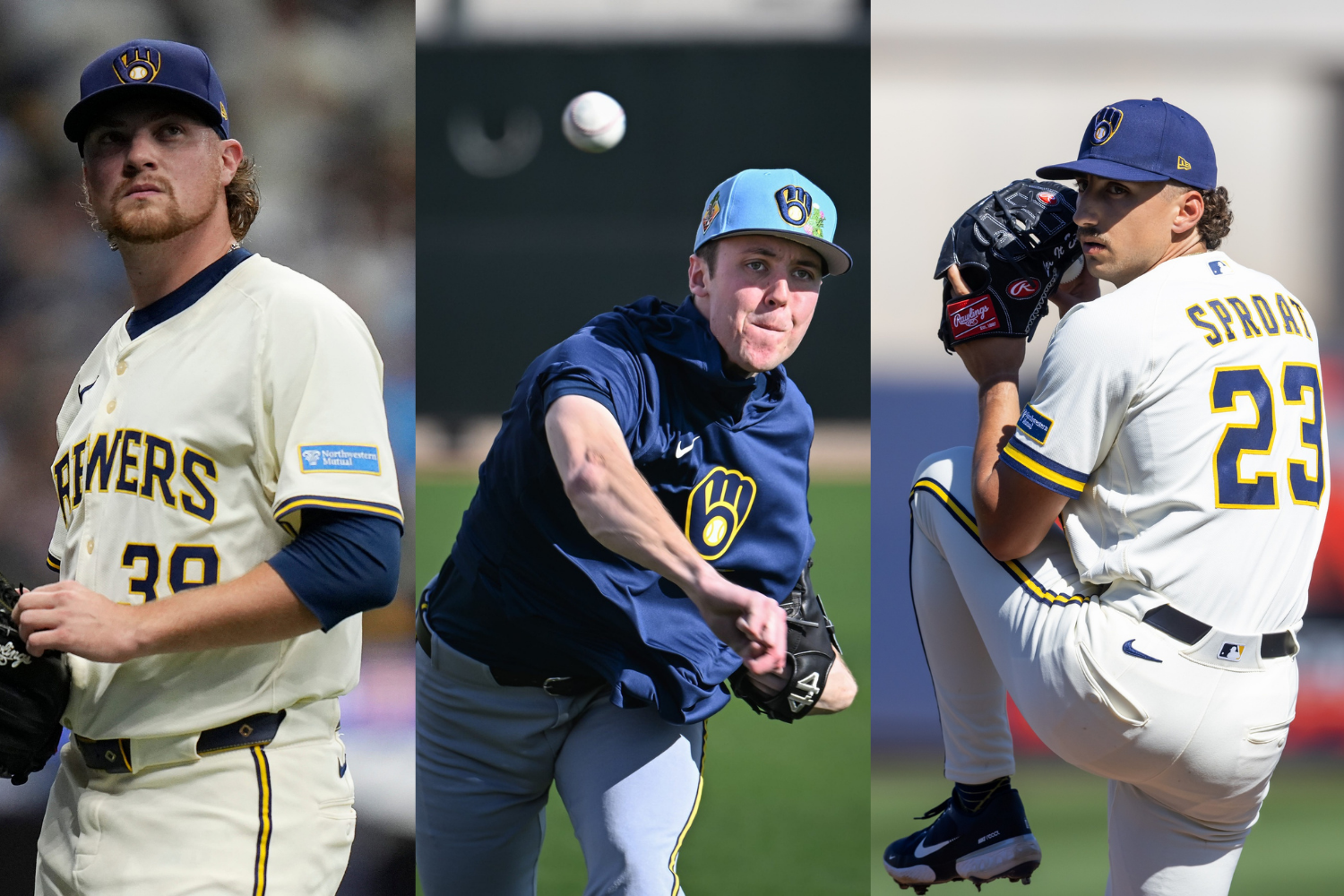
So how do the new arms compare? Milwaukee will open the season with four relatively young and inexperienced starters: Jacob Misiorowski (24 years old), Kyle Harrison (24), Brandon Sproat (25) and Chad Patrick (27). Some have more big-league innings than the 2019 group entering that season, and Patrick is the oldest.
Harrison, despite his age, has nearly 200 MLB innings and probably doesn’t fit the “inexperienced” label. But the loose comparisons still line up: a Brandon (Sproat vs. Woodruff), a No. 39 with a nasty cutter (Patrick vs. Burnes), and an excitable youngster coming off a postseason breakout (Misiorowski vs. Peralta). Of course, the optimism for this group has concrete support, not just a comparison to the trio of the past.
Misiorowski is one of baseball’s most electric young arms. His small 2025 sample included a dazzling postseason: 1.50 ERA (2.30 FIP) in 12 innings with 16 strikeouts and just three walks—highlighted by five dominant frames against the Dodgers. Patrick impressed early last year, with a 2.62 ERA (3.09 FIP) in his first 68.2 innings as a starter. After a midseason stumble, he stabilized in the bullpen and shined in October, striking out 11 with one walk in nine playoff innings—including five massive outs in NLDS Game 5. Sproat, Baseball America’s No. 81 prospect, is the least experienced, with just 22 service days. But his stuff is real, and despite a 4.79 ERA in his four MLB starts, his 2.80 FIP suggests more to come—especially with Milwaukee’s defense behind him.
As usual, the Brewers’ season will hinge on youth and pitching. The talent is undeniable, but expecting no growing pains on their way to great heights is unfair. Maybe these guys are different. Maybe Milwaukee’s modern pitching infrastructure helps smooth the bumps.
Or maybe it gets messy, and the depth gets tested. That’s not inherently bad—just uncertain. So, do these young starters follow a path similar to Woodruff, Peralta and Burnes? Or do they carve their own track—be it better or worse? The team’s chances to win the pennant this time around depend heavily on the answer to that question.