
Opening Day is the philosopher’s holiday, for it’s much more about questions than answers. We won’t instantly have complete insight into the 2026 Chicago Cubs after Thursday’s season opener; we’ll merely have a lone game of data to which to cling as we scramble to reinforce our prior beliefs. Even a week or a month from now, answers about who and what this team is will be elusive; that’s the nature of a 162-game marathon. Thus, Opening Day is primarily about agreeing on which questions matter most. Here are five things Cubs fans should watch and wonder about, beginning Thursday and stretching slowly across the spring and summer.
1. Will the Cubs Get Edward Cabrera Right?
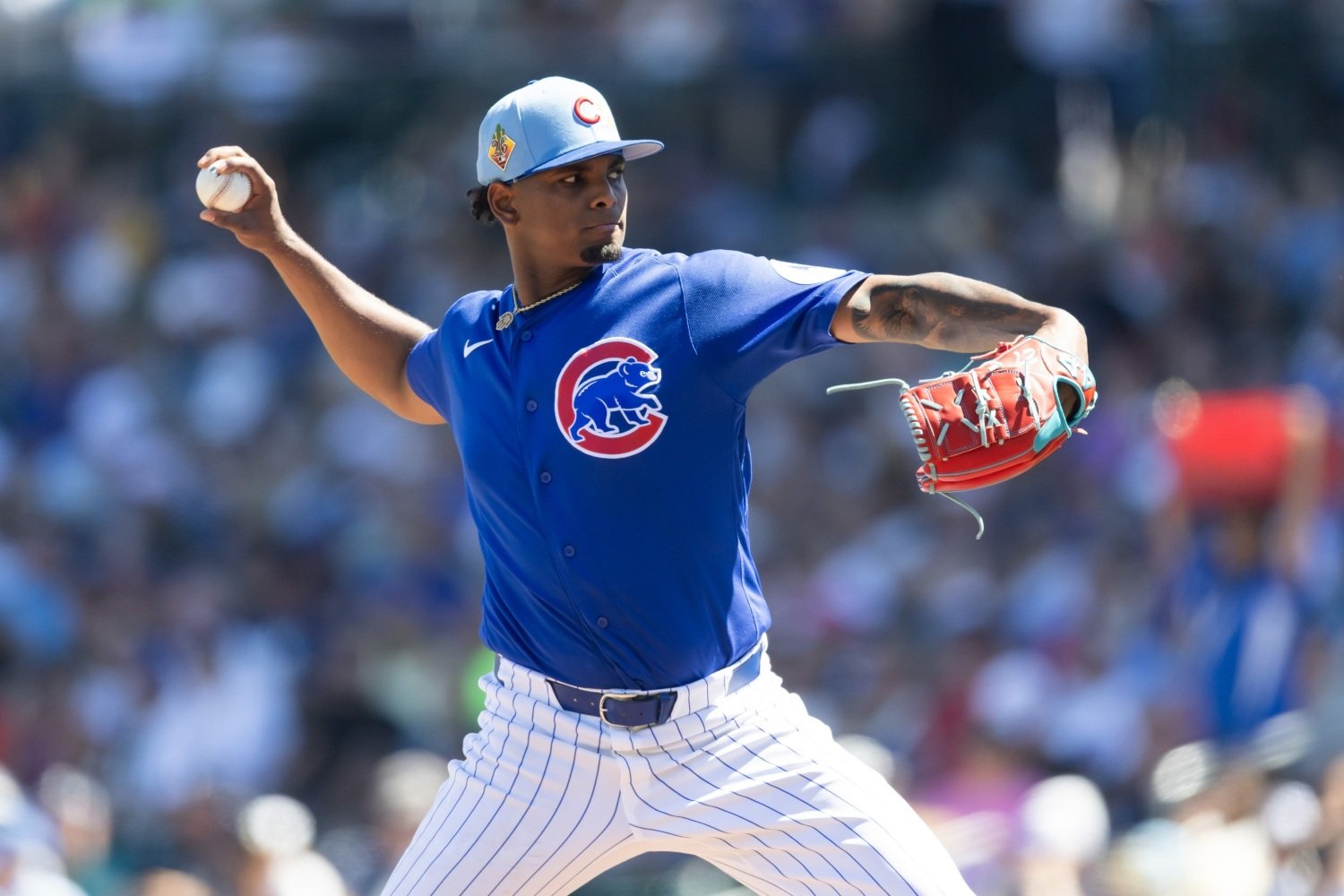
At the risk of triggering many Cubs fans who lived through the unhappy denouement of the last miniature Cubs dynasty, the player who looms as a warning against full-fledged enthusiasm about Cabrera is former high-profile, electric-armed acquisition Tyler Chatwood. The Cubs front office was very excited to get ahold of Chatwood, but his awful command compromised his awesome raw stuff. Cabrera should be better than Chatwood was, but tapping into the best version of him means getting some key developmental dilemmas just right.
The good version of Cabrera is neck-and-neck with Cade Horton for the title of ace in this rotation, and could strike out 250 batters. The bad version runs into so many problems with his suboptimal fastball shape and average-minus command that his ERA balloons toward 5.00, even if he stays healthy. The Cubs spent the spring trying to help him find the version of his fastball that can set up the rest of his arsenal, but we won’t know how successful that experiment was for some time.
2. Which Version of Pete Crow-Armstrong‘s Offensive Profile is the Real Deal?
He’s officially the face of the franchise, now. He’s one of the best defenders in baseball. He’s only 24 years old. Crow-Armstrong is the Cub with transformational, superstar potential—but ultimately, he had a .287 OBP last year. His lack of plate discipline became a real and serious problem; we don’t yet know whether he can be a consistently effective hitter.
All the power-speed dynamism he’s demonstrated makes Crow-Armstrong the centerpiece of this lineup, if he’s the best version of himself. That version of him has to be one with a more consistent plan in the batter’s box, though.
3. Does Dansby Swanson Have Time Left at Shortstop?
The Cubs have to be pleased to have gotten three years into a seven-year pact with Swanson without having to even consider moving him off the position they signed him to play. He’s been a consistently above-average shortstop and the anchor of a team defense that lies at the heart of their overall team-building philosophy.
But that can’t last forever. Regular shortstops who stay at that position into their mid-30s are virtually unheard-of in the modern game, and Swanson is now 32. He’ll still play there this season, but whether he can remain a plus glove is a very fair question—and a very important one, to this year’s team.
4. Can Matt Shaw Handle His New Role?
It was a highly productive spring for Shaw, who learned to play the outfield and showed off a blessedly simplified setup in the batter’s box. The Cubs need that to translate to the games that count, but the challenge ahead of Shaw is even greater than the one behind him. He’ll be finding his playing time one game at a time this season, but he’s an important part of the team’s plans. Without sturdy contributions from him on both sides of the runs ledger, the lineup’s depth won’t match that of the Brewers. If Shaw takes a big step forward, though, he could be a catalyst for the ascendancy of the whole club.
Here’s the problem: For any player, succeeding while moving between positions and sitting at least one or two days a week is difficult. For a young guy who’s shown shaky pitch recognition and whose mechanics are always in danger of unproductive digression, it’s doubly so. Shaw has to prove himself unusually good at a tricky balancing act.
5. Will the Bullpen Be as Good as Its Less Proven Previous Editions?
By Jed Hoyer standards, the Cubs made big investments in the bullpen this winter. It was an overhaul of the relief corps, and one that leaves them with few optionable arms. On the other hand, they have lots of proven dudes out there, in Phil Maton, Hunter Harvey, Caleb Thielbar, Hoby Milner, and Jacob Webb. It’s a group the team should be able to count on not to implode, as some recent acquisitions have (Héctor Neris, Ryan Pressly), but the upside is a bit limited. Even acknowledging the emergence of Daniel Palencia as a true relief ace, the team needs someone to take an unexpected step forward in order to get a championship-caliber performance from this pen.
That makes Ben Brown a pivotal arm. Relegated to the pen by a healthy and deep starting rotation, Brown has a chance to be that wipeout multi-inning reliever that has so often been the signature of Craig Counsell‘s bullpen management. But Brown still carries real risk, and the team still needs someone from the rest of the mix (perhaps Harvey, whose stuff stands out from the crowd) to have something better than their average outcome this year.
This team has 100-win upside, and should be over .500 even in a relatively unlucky world. They’re a legitimate threat to the hegemony of the Brewers in the NL Central. They still face some big questions on Opening Day, but the answers to those questions look likely to be positive.