
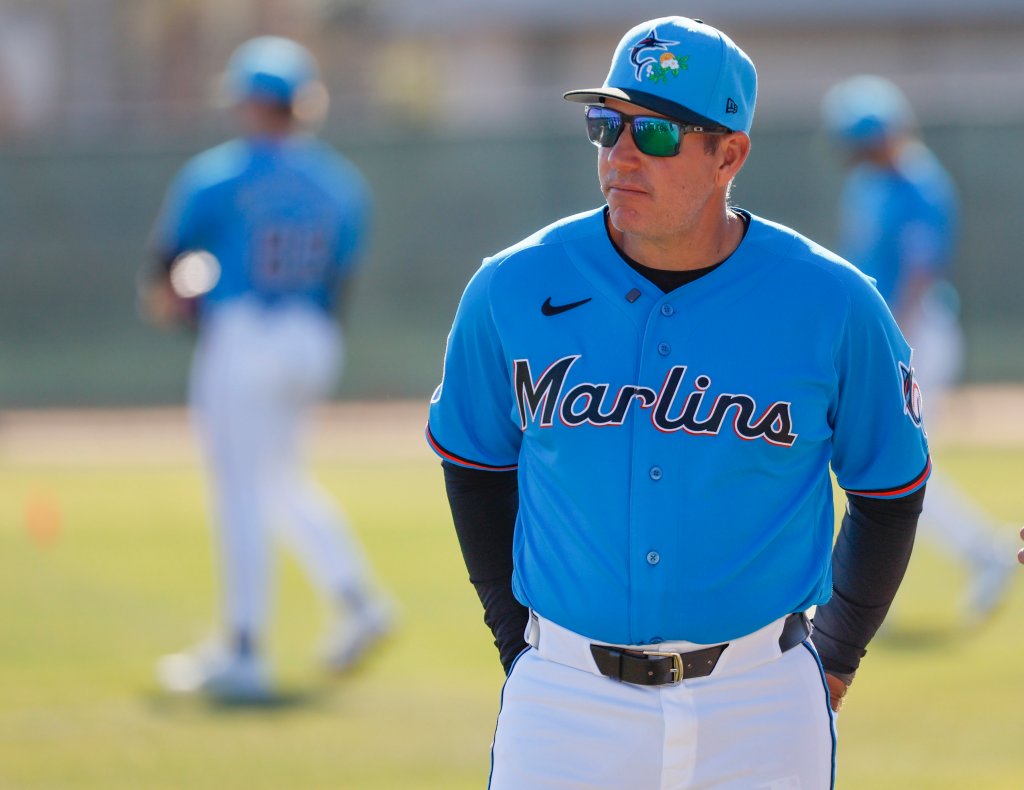
MIAMI — There is no official announcement for these things, no magical line that’s crossed or number that says it’s all working in a good way. Miami Marlins manager Clayton McCullough can’t do anything more than sit in the dugout on the eve of Opening Day and say what he expects this year after a surprising 2025 season.
“I expect this (team) to be better,’’ he said Thursday, ahead of Friday’s season-opener at home. “I don’t know what that means our won-loss record is going to be or how to measure the season. I think that we certainly have a lot more than we did (last Opening Day).”
The Marlins don’t spend big money or have big names other than Opening Day starter Sandy Alcantara. But their plan is working. That’s what needs to be said as another season starts. It doesn’t mean they’re off to the playoffs by any stretch or will become the talk of baseball.
Consider their minor-league system was ranked 29th or a dead-last 30th by all baseball publications before Peter Bendix’s first season as president of baseball operations in 2024. It enters this season ranked eighth by Baseball America, 10th by ESPN and 11th by MLB Pipeline.
Only one Marlins prospect was among Baseball America’s top 60 in 2024, too. Five Marlins players enter this season among Baseball America’s top 55 prospects, including left-handed pitcher Thomas White (18th), who starts in the minors, and starting right-fielder Owen Caissie (43rd).
They’ve won enough trades and under-the-radar moves that a core lineup involves All-Star (and injured) Kyle Stowers, second baseman Otto Lopez, shortstop Xavier Edwards and center fielder Jacob Marsee. That will be added to this season by new additions like Caissie and perhaps minor-league catcher Joe Mack, depending on how Agustin Ramirez develops.
“There’s a lot more clarity starting this year,’’ McCullough said.
You don’t have to trust the Marlins’ 79-83 record last year, considering they had a minus-89 run differential. You don’t have to give up your hard-earned distrust of them, either. But look how the other teams viewed the Marlins recently.
Four of the nine Marlins coaches were hired away and promoted by other teams this offseason. Assistant pitching coach Alon Leichman, for instance, is in Friday’s other dugout as Colorado’s pitching coach.
The Marlins’ novel move at the end of last season of calling pitches from the dugout with good data will be continued this season. Colorado and the New York Mets will copy it, too.
Then there was Aaron Leanhardt, the MIT-trained scientist whose invention of the “torpedo bat” became a story last season.
Add all that up and you see the Marlins are getting the right people inside this franchise. Part of that is Bendix has cleared out roughly two-thirds of Derek Jeter’s failed organization.
Still, there’s the bogeyman: Money. That’s where the Marlins have problems even if the story isn’t told right. Take owner Bruce Sherman. He has been called the poorest owner in baseball at a net worth of $500 million, a figure repeated to the point it’s accepted.
The original source of that figure appears to be a Superyachtfan.com report in 2017. Maybe it’s right. But that site isn’t exactly The Wall Street Journal. Marlins sources say he’s worth around $3 billion. Maybe they’re right. No one gets a look at Sherman’s finances.
What public records show is Sherman sold his investment company, Private Capital Management, for $1.2 billion in 2009. If he invests half that and earns a modest and reinvested 10%, that’s $2.75 billion today.
Not that it matters if he doesn’t spend it. The Marlins’ payroll ranks last in baseball, at about $82 million. But, again, the team’s sources say Sherman spent $150 million in turning their Jupiter training complex into one of baseball’s best for training, nutrition, therapy — think, for instance, of the baseball version of the Miami Dolphins winning the players’ union grades for workplace environment.
The real money problem for the Marlins’ is baseball’s larger landscape. A dozen teams have payrolls under $150 million. Five are over $300 million. The collective bargaining agreement expires after this season, and the owners are certain to push for a salary-capped ceiling and floor — something the Marlins desperately need.
Another mess: Local television money. The Marlins, like 12 other teams, had to scramble for a local TV deal after the collapse of regional sports television. Will baseball owners band together like pro basketball owners who negotiated a $76 billion deal with streaming services?
Those big-picture money issues need to work if the full Marlins plan is to work. Imagine, with a salary floor of a $150 million payroll, if they add $100 million in free agents to this young core.
That’s tomorrow. For now, there’s Opening Day. The plan is working, the one of building with prospects, and McCullough looked at this opening weekend with Colorado and said what every manager does.
“You’re not looking at what July or August looks like,’’ he said. “The goal is to win the series in front of you.”