
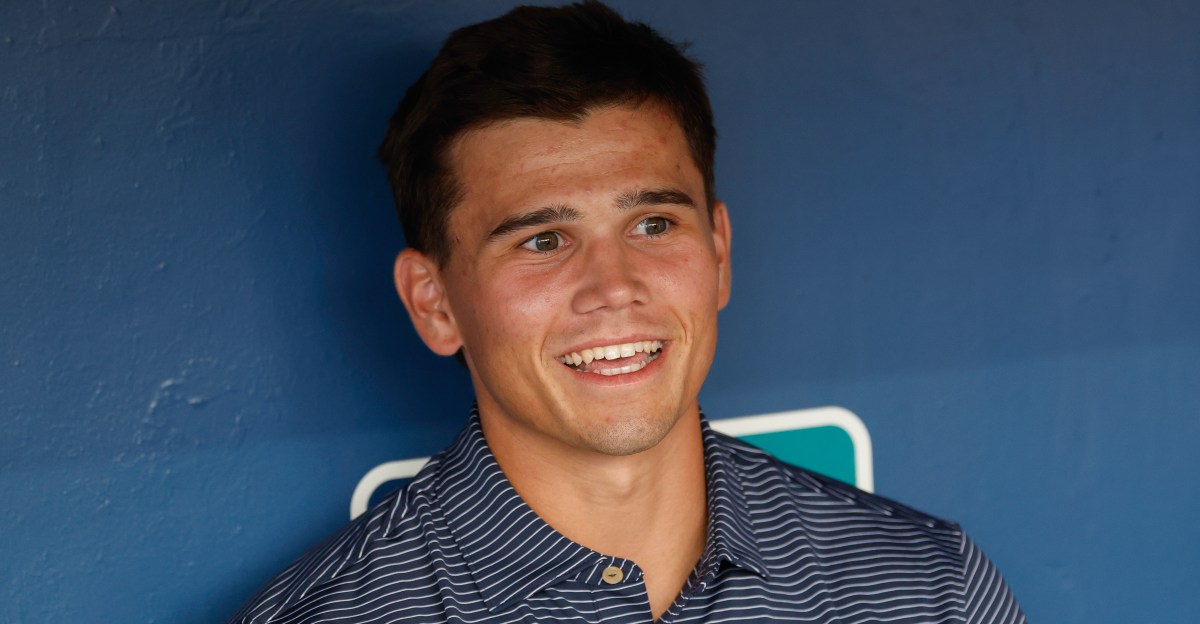
At the time of his drafting, the sentiment surrounding Luke Stevenson as a Mariner was polarized. On one hand, landing a first round catching talent with a pick they essentially received for free felt like a massive gift. On the other hand, Stevenson had an unprecedentedly low contact rate for someone getting drafted as early as he did and understandably left fans hesitant to buy in on him as a player. How would a player that struggled with his bat-to-ball skills in college fare against increasingly advanced competition?
Though it’s still incredibly early in the grand scheme of things, the start of Stevenson’s professional career has been remarkable. Through his first 100 PA’s, Stevenson has hit .280 with more walks than strikeouts, a somewhat unexpected style of offense that greatly improved his overall outlook as a prospect. Even if the contact numbers slide given a bigger sample size, the plate discipline has been unreal thus far and there should absolutely be more power on the way. His gaudy .460 OBP isn’t a realistic benchmark for him to hold over the course of a season, but if he’s anywhere near the .400 mark, Mariner fans should be thrilled.
The defense, however, surprised no one. Walking into Modesto having already caught 58 games for the Tarheels, Stevenson immediately took on the role of starting catcher for the Nuts and did so seamlessly. Playing stellar defense behind the dish and showing off an impressively accurate throwing arm, Stevenson gave us a glimpse as to why the Mariners believe in him so strongly. It’s historically atypical to call a player with his offensive skillset a “high floor” player, but in his own roundabout way, that’s exactly the label that fits him best.
The bet on Stevenson boils down to some fairly basic calculus by Scott Hunter and company: If Stevenson is able to hit even just a little bit, the path to him being a four-win player is crystal clear. Good defensive catchers make it to the big leagues, and good defensive catchers that have 25+ homer power in the big leagues make All-Star games. It’s far from a guarantee that he reaches that level of production, but the blueprint is there. A glove-first backup feels like a pretty safe fallback option for Stevenson in his current form, but if everything clicks, we’re looking at a potential starting caliber catching prospect that could take over starting catching duties if Cal Raleigh ever decides catching 200 games a season might not be best for his body. Again, no guarantees, but the limited sample is promising.
A successful 2026 for Stevenson looks a lot like his first 100 PA’s as a professional. If he can prove the contact ability he’s shown isn’t a fluke, it’s going to be tough not to move him up these ranks come mid-season. There’s little doubt he’s got the power to step on one and send it a mile out to right field, but if he’s able to avoid selling out for that and continues to work the entire scope of the field while drawing a healthy number of walks, there just won’t be a ton to his game to poke holes in. He’s a high motor, high character leader of a team that wants to “be a servant to his staff” and has enough raw talent to be just about as good as anybody in his class. Proving it on the field is the next step, but whatever his ceiling ends up looking like, his internal drive and dedication to his craft should all but assure he reaches it.