
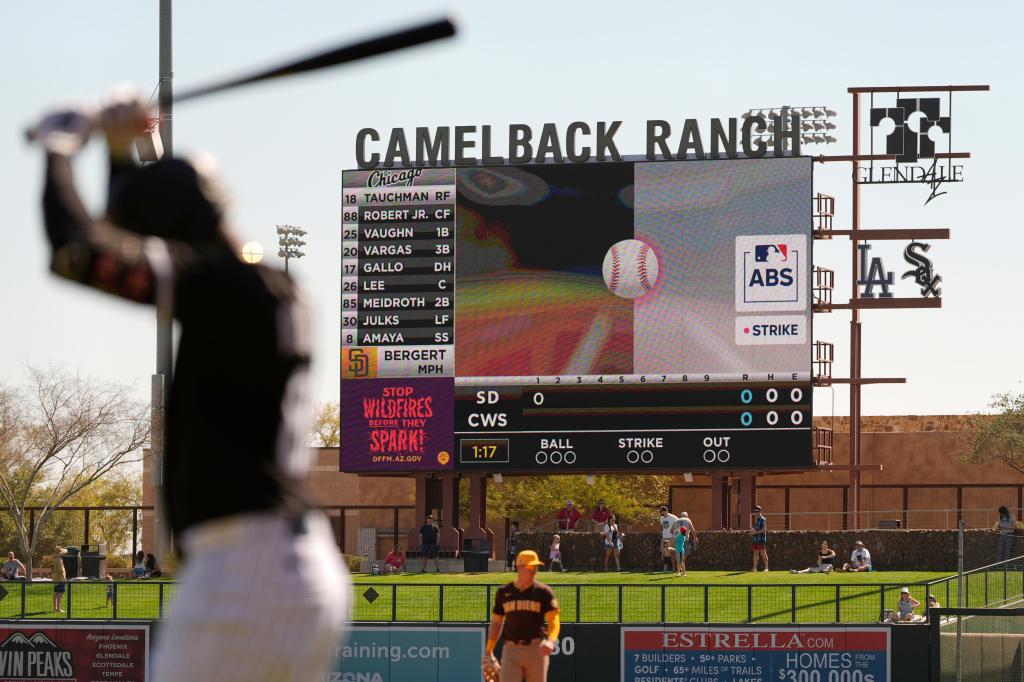
BALTIMORE — Matt Wallner looked at a pitch from Trevor Rogers that was above the strike zone, reached up and tapped his helmet. That simple action triggered a review, which appeared on the Oriole Park at Camden Yards scoreboard. An outline of the strike zone appeared, followed by a graphic showing the pitch itself.
Hawk-Eye tracking technology showed that Wallner’s instincts were right — the pitch was 2.1 inches above the zone. Home plate umpire Laz Díaz’s strike call was overturned and Wallner turned a first-pitch strike into a ball before eventually working a walk.
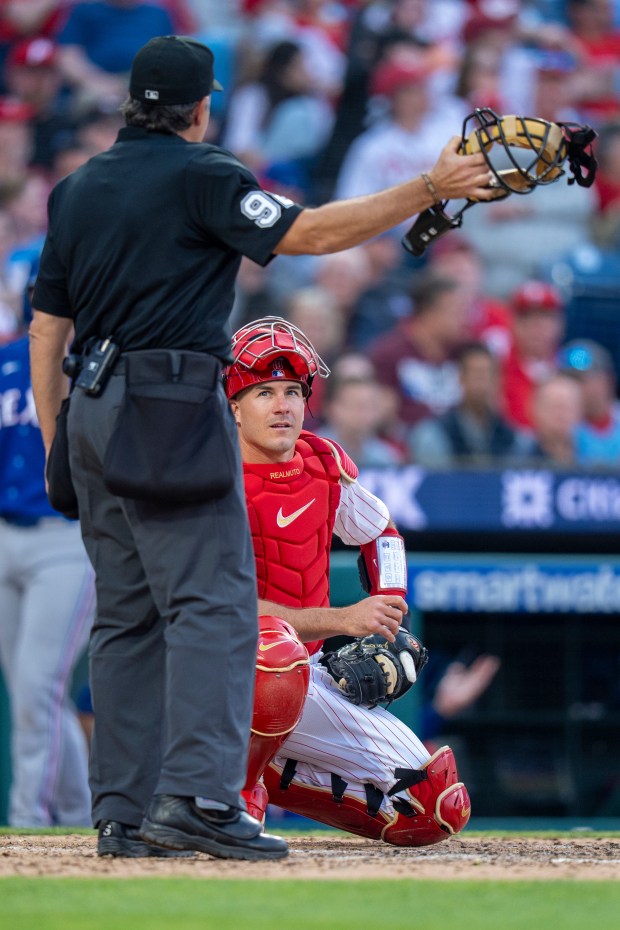 Umpire James Hoye, left, tells Philadelphia Phillies catcher J.T. Realmuto, right, that relief pitcher Zach Pop called for the ABS challenge during the seventh inning of an Opening Day game against the Texas Rangers, Thursday, March 26, 2026, in Philadelphia. (AP Photo/Chris Szagola)
That was the Twins’ first use of the Automatic-Ball Strike Challenge System in a regular-season game.
Long used in the minor leagues and introduced to major leaguers in spring training both last season and this, the ABS Challenge System gives pitchers, catchers and hitters the chance to challenge individual pitch calls. It must be done right after the pitch with no help from coaches or teammates.
As players adapt to the new system, there remains plenty to be learned about how and when to best utilize the system.
Teams have two challenges per nine-inning game. If the player is correct, his team will retain the challenge. If the umpire’s call is confirmed, the team loses that challenge.
The Twins used it four times during their Opening Day game on Thursday, winning three of their four calls. Though pitchers are allowed to challenge, don’t expect Twins pitchers to be doing so. Data from minor league games has shown that pitchers are the least successful at getting calls overturned.
“I won’t challenge. We’ve made that pretty clear since day one that pitchers won’t be challenging,” Twins starter Joe Ryan said. “The catchers are so good at that. They have the better perspective, and more reps there. So, I think that just makes all the sense in the world to just leave that up to them.”
The Twins successfully overturned 46 calls this spring, tied for second in the majors with the Colorado Rockies behind just the New York Yankees. Twins hitters were 18 for 43 (42 percent success rate). Fielders were 28 for 46 (61 percent).
Even hitters may challenge less than expected. That’s one thing that manager Derek Shelton noticed this spring.
“I think the thing I learned the most is hitters are cautious to do it. You see them react and they don’t do it,” Shelton said before Thursday’s 2-1 loss to the Orioles in the season opener. “I thought we would see hitters be more aggressive with it and they weren’t, in total, from watching.”
That wasn’t necessarily the case on Thursday, when the Twins had three hitters challenge calls — all correctly. After Wallner, Josh Bell did it in the fourth inning, overturning a 3-0 strike call into ball four. In the eighth, Ryan Jeffers challenged a strike call, overturning what would have been strike three. The extra life didn’t end up helping him as he later struck out swinging.
Bell could have challenged a pitch during his first at-bat in the second inning — a ball that was incorrectly ruled a strike — but opted against it, noting that the game situation played into the decision. He eventually struck out in that at-bat.
“That first at-bat, I just think it’s too early to pull the trigger there,” Bell said. “It just wasn’t really time. But it seemed like we hadn’t gotten anything going in the second at-bat. (Rogers is) pushing later into the game, so it was time to fire away on that.”
The player on any given team who will likely end up with the most challenges will be the starting catcher, meaning an extra responsibility will fall onto Jeffers’ plate. His success rate was second in the league this spring as he correctly identified 13 of the 20 (65 percent) pitches he challenged. Last spring, he led the majors in most successful overturns.
Jeffers has gotten used to making those calls behind the plate, but when he tapped his helmet as a hitter, it was the first time he had done so in a game. So, he was “a little bit nervous ripping it,” he said, even though he felt confident he would win the challenge.
“I was scared I was going to lose two in a row right there back-to-back,” Jeffers said.
Earlier in the game, Jeffers had lost one of the team’s challenges, calling for a Justin Topa pitch that was just outside to be reviewed. A successful call would have been the third strike of the at-bat, getting the Twins out of the seventh inning. With two challenges remaining, Jeffers thought the pitch was “probably a little off,” but tapped his helmet anyways in hopes that the pitch may have clipped the strike zone.
As the season goes on and teams further hone their strategies and learn more about the system, there’s at least one thing those around the game expect to be revealed:
“I think at the end of the day, the challenge system is going to show the world how good the umpires actually are,” Jeffers said.
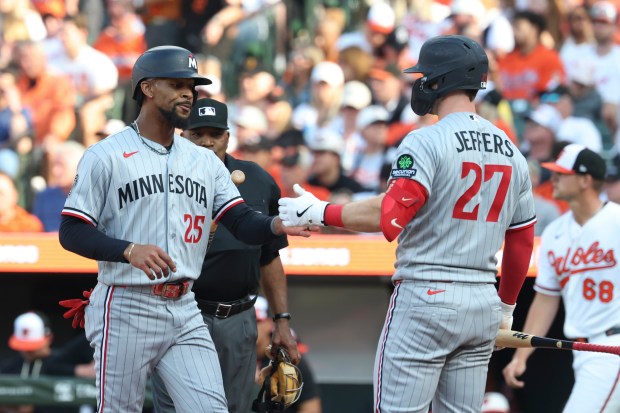 Minnesota Twins’ Byron Buxton (25) is greeted by Ryan Jeffers after scoring a run on a sacrifice fly hit by Luke Keaschall against Baltimore Orioles pitcher Tyler Wells during the eighth inning of an opening-day baseball game, Thursday, March 26, 2026, in Baltimore. (AP Photo/Terrance Williams)