
If Billboard’s No. 1 hits of 1974 are anything to go by, the America of 52 years ago was going through some stuff. By and large, the most popular songs can be arranged by one of two categories; there were the minor-key, soft-rock bumouts, of which Terry Jacks’ Seasons in the Sun remains the feel-bad exemplar, and then there were the upbeat bangers about mass-killing (The Night Chicago Died, Billy, Don’t Be a Hero and—presumably, given that everybody was engaged in the titular activity—Kung Fu Fighting.
If not for the advertising agency Campbell Ewald, ’74 would be remembered as a pop-culture buzzkill. But in giving us the “Baseball, Hot Dogs, Apple Pie and Chevrolet” campaign, the Detroit-based firm lit up our collective right-brain pleasure centers with an anthem that celebrated the irreducibly American spirit while also getting TV watchers a jones for the bench-seated splendor of the Impala station wagon. The jingle was a triumph of earworming, and nobody balked at putting baseball at the head of the conga line of signifiers.
A few months after Chevy’s campaign bowed, Catfish Hunter won his arbitration hearing against the Oakland Athletics, thereby freeing him to sign a then unheard-of five-year, $3.35 million contract with the New York Yankees. In becoming baseball’s first free agent, Hunter (with an assist from Curt Flood) changed the sport forever—so much so that the automaker’s anthem now seems comically outdated.
Football long ago displaced baseball as the national sport (with its connotations of gentle diversionary pursuits, “pastime” no longer fits the bill), and in the last quarter-century the gap between MLB and the NFL has widened to the point where even peak Evel Knievel wouldn’t attempt to transverse it while astraddle his Skycycle X-2.
There are reasons for this, just as there are reasons why you almost never have to plan your evening around the possibility of a cataclysmic outbreak of Kung Fu fighting. For one thing, those cats are no longer fast as lightning—a lot of them are in their 80s now.
Another reason is that the NFL largely has managed to sidestep the labor issues that blighted the other Big Four leagues in the 1990s. (While the 130-day lockout in 2011 threatened to derail the entire NFL season, the only game that was canceled was that summer’s Pro Football Hall of Fame scrimmage.) In some respects, it may be argued that baseball effectively surrendered the crown to its more aggro counterpart on Aug. 12, 1994, when a strike that erased 948 games poisoned the well for otherwise loyal fans. The work-stoppage resulted in the cancellation of that fall’s World Series—a high-profile erasure the likes of which had happened only once before … in 1904.
While baseball was already on the downhill slide well before the ’94 strike—the audience for the Fall Classic peaked in 1978, when the six-game Yankees-Dodgers series averaged a staggering 44.3 million viewers—the mid-’90s interruption couldn’t have come at a more disadvantageous time. When MLB closed up shop, the NFL was on an almighty tear, as the Dallas Cowboys had returned to their winning ways while the San Francisco 49ers had stuck the landing on the Montana/Walsh succession with a Young/Seifert title. And while the sun would soon set on the Eddie DeBartolo dynasty and the dominance of America’s Team, the league would soon be gifted with a worthy successor to all that eyeball-grabbing greatness with the story of a man named Brady.
MLB rallied a few years later with the steroidally overinflated McGwire-Sosa home run race in 1998, which also happened to coincide with the Yankees’ barnstorming 114-48 campaign and the Evil Empire’s 24th World Series title. But baseball’s outsized importance was still largely diminished as the NFL began sucking all the air out of the metaphorical room. Plagued by a streak of short series featuring reps from some of the smaller media markets, the average audience for the Fall Classic began landing well short of the 20 million-viewer mark, and by the time the Giants and Royals tangled in October 2014, that seven-game set managed just 13.8 million viewers per game. Four months after San Francisco clinched its third title in five years, NBC’s coverage of Super Bowl XLIX scared up 114.4 million viewers.
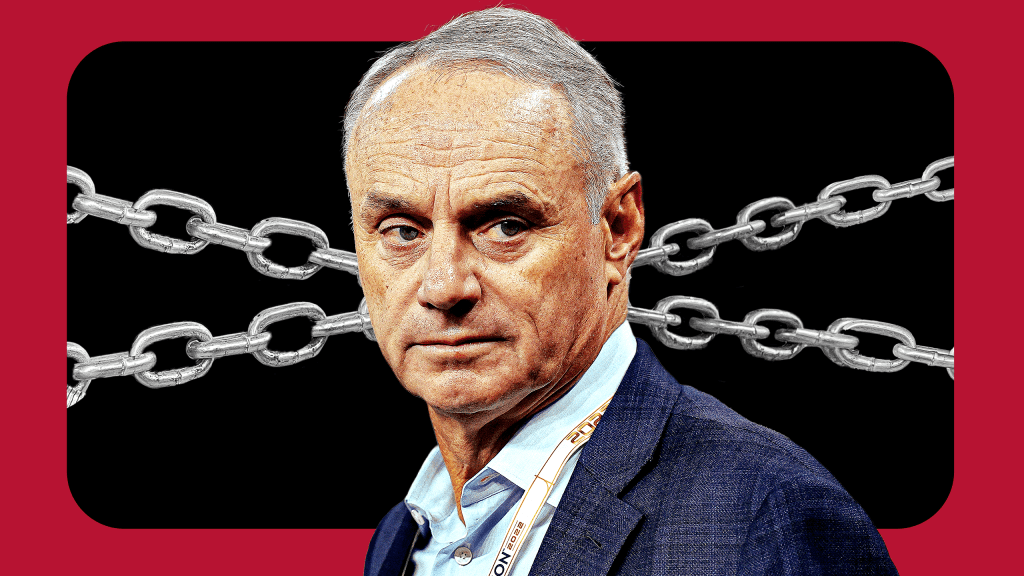
If it’s no longer permissible to compare Roger Goodell’s fiefdom with, well, anything—as was once said of Francis Albert Sinatra, it’s the NFL’s world and the rest of us just live in it—it certainly seems as if the missteps of the past are about to revisit themselves upon baseball next year.
Only instead of the flood of a players’ strike, this time the disaster will come cloaked in the fire of an owners’ lockout. And sure, hope springs eternal and all that, but the talk in baseball circles is all “when” rather than “if.” The owners are now all but resigned to an inevitable labor disruption, with many among the billionaire class having mentally written off at least half of the 2027 season.
While we’re studiously avoiding anything that might result in peeing on the electrical fence that is the salary cap dispute, the most dispiriting aspect of a lockout is that it’ll put baseball on the IL while the sport is riding the thermals of a high-flying surge in popularity. MLB is on a generational hot streak, closing out the 2025 campaign with significant viewership gains across its national TV partners, as ESPN’s final at-bat with Sunday Night Baseball was up 21%, while big-reach Fox boosted its deliveries 9%. What’s more, TBS’ non-exclusive coverage grew 29% last season—and it’s worth noting that the 2025 data wasn’t juiced by the implementation of Nielsen’s new currency—while local ratings at the RSNs improved by 2%.
Away from the tube, MLB attendance hit 71.4 million in 2025, marking the third consecutive season of growth. Any way you choose to frame it, baseball’s popularity is accelerating just as commissioner Rob Manfred gets ready to transform the sport’s entire delivery mechanism. In short, the league is in the midst of a feel-good era, and it’d be a shame (and a grave error) if the owners’ cavalier acceptance of what they perceive as an unavoidable disturbance were to undo all the gains that have been made of late.
It’s not entirely clear how many owners are practicing Calvinists, but the predestination mindset is bad news of the first order, somewhere between finding out that your ace needs Tommy John surgery and stumbling across God’s suicide note. And the prospect of everyone sort of accepting the loss of half a season or more is particularly unsettling, given how much baseball stands to lose in the wake of a lengthy power outage.
Just three seasons before MLB had to call off its first World Series in 90 years, the Minnesota Twins and Atlanta Braves staged one of the greatest Fall Classics in living memory. Per Nielsen, 35.7 million viewers tuned in per game, with the deciding frame delivering 50.3 million viewers on CBS. And while the Superstation made Ted Turner’s team all but ubiquitous and Minneapolis was no backwater, it’s worth noting that those deliveries were achieved in the absence of the Yankees and the Dodgers.
Since the strike, no World Series has come anywhere near that 1991 mark. The last time a Series served up north of 20 million viewers was in 2016, when the Cubs ended their 108-year championship drought in a seven-game set that averaged 23.4 million. Before that, you’d have to go back to 2004 to find a season that closed out with a bigger number. In exorcising their own 86-year-old demon with a sweep of the Cards, the Boston Red Sox helped Fox draw 25.4 million viewers over the course of those four nights.
If baseball now requires the dissolution of an ancient curse to make its World Series deliveries really pop, it’s running out of options. Cleveland’s still waiting on its first title in 78 years, and the people in the bleachers in Milwaukee and San Diego have been holding out for 57 trips around the sun. But even if the Guardians and Brewers force a seventh game this October, the resulting jubilation in one of those markets may not be sufficient to sustain fan enthusiasm should neither club have an opportunity to suit up in 2027.
History may not repeat, but it sure as hell has a tendency to trigger the occasional sense of déjà vu. As a new baseball season gets underway, here’s hoping that the owners’ memories are jolted by the smell of Cracker Jack® and horsehide. They may not be as sentimental as the fans who support MLB’s $13.1 billion enterprise, but the people who sign the checks should keep baseball’s inimitable magic trick in mind as the year unfolds.
The beauty of the game is in how it can overwhelm the young and old alike with moments that strike a universal chord, but in a way that somehow seems intimate and almost sacred. (Also, it gives you something you can talk about with your dad.) There are some things you simply don’t want to mess with; next thing you know, they’ll be taking our hot dogs and pie … whereupon we’ll have no choice but to resort to our most baleful forms of Kung Fu.