
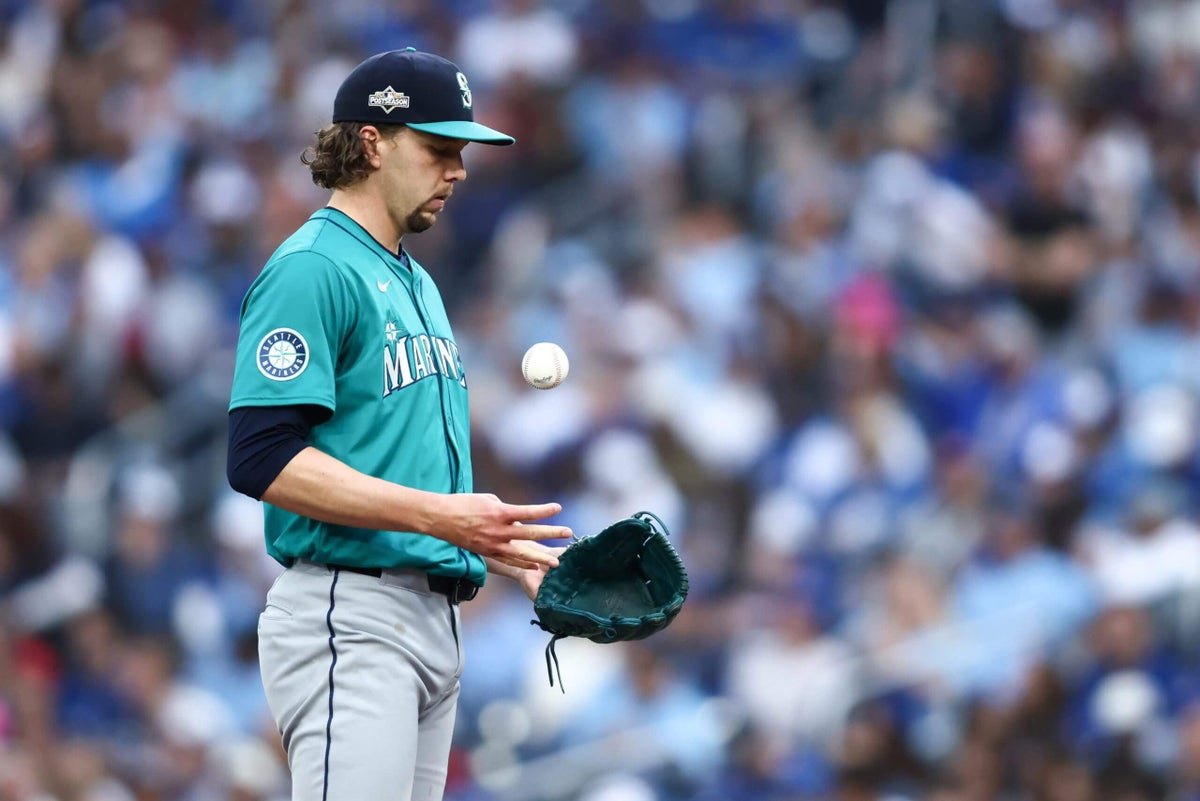
The Seattle Mariners enter this season in unfamiliar territory. The defending American League West title winners are favorites to repeat. That’s a new feeling for them. Contenders, not dark horses. Incumbents, not challengers.
Their Opening Day ace knows the feeling. He’s worked hard to shape his arsenal to become a top right-handed starter in this league. It’s been a journey to get there, but there are still steps remaining for him to conquer after he and his Mariners came within inches last season of making their first World Series in franchise history.
“It’s going to be fun,” Logan Gilbert said of the 2026 season, which begins Thursday at 7 p.m. PT at home against the Cleveland Guardians. “It’s good to know your team is back and ready to go.”
Gilbert has leaned on his team throughout his time in the Mariners organization, as he’s had help at every stage of his career refining his stuff into an arsenal that ranks among the best in baseball. Over the years, Gilbert has been open about the work he’s put in and those who have helped him reach this pinnacle.
In 2019, Logan Gilbert was in Modesto, Calif., pitching for the then-High-A Modesto Nuts. His hair was a little shorter, and he didn’t have a goatee back then. The 2018 first-round pick was dominating in the low minors, but he was already trying to see the future. Looking past the sparsely filled stands of the California League, he was talking about what it would take to be one of the best pitchers in Major League Baseball. What it would take to be the Logan Gilbert he knew he could be.
You can’t just throw two pitches in pro ball, he explained. You have to work on the other pitches even if you’re doing well.
“You keep climbing levels and then you wish you had worked on the changeup a little bit,” he continued. “I’m trying to be ahead of the curve and not wait till I have to do it. Work on it beforehand.”
Just 22 years old but with a mature outlook, Gilbert started doing something that he would do the rest of his career that season in Modesto. He watched baseball. He watched the best pitchers in the game and tried to figure out what made them so good. What struck him then was their inquisitiveness, their willingness to innovate.
“You just turn on any TV and see the No. 1 (starters) go at it and as good as you think you are … these guys are doing freakish things that are just off the charts,” he said. “So that’s when you see those guys and you know that there has to be something else you can be doing. Just try not to leave any stone unturned and especially with the new technology and all that stuff that’s coming out.”
His pitching coordinator at the time, Max Weiner, appreciated Gilbert’s ability to seek out and absorb new information.
“Our players are very growth-minded and we push them incredibly hard — there’s a huge education initiative and they’re into it,” Weiner said in 2019. “They are modern pitchers. Logan, we give him profiles of where we’d like him to go in different counts and he masters that. We give him shapes that we’d like him to accomplish. Logan accomplishes that. We’ve sent him for biomechanics testing. That looked awesome. There’s everything that we would want from a good leader, someone who’s performing and someone who’s a good teammate, he’s offering that.”
There was the willingness, but also the ability to turn theory into practice quickly.
“Logan is gonna continue to get better,” Weiner added. “We saw a really good slider in the Cape (Cod League). We didn’t see that slider in college. We asked Logan to achieve a certain shape and within a week he did that.”
Fast-forward to 2022, and Logan Gilbert is now in Peoria, Ariz., at Mariners spring training. He’s coming off the worst season of his career, his first at the game’s highest level. He got to the big leagues, and lost his most trusted pitch. Slumped shoulders as he walked off the mound made their first appearance as he searched for his big-league identity.
“(In 2021), I felt kind of weird because I didn’t have my curveball,” he admitted. “In the minors, my curve was always there for me. And I get up and I’m like missing part of what I was. So I’m trying to figure it out on the fly.”
He went to work on the pitch, stiffening his wrist and eventually finding something that worked, but it didn’t look like it was going to be the ace-maker he thought it was. And not only had he lost his vaunted curveball, but that sweeper he’d crafted — the one that metrics loved, the one that worked so well in the minor leagues — also didn’t work against big leaguers.
“I was still trying to sweep it, but it wasn’t really sweeping,” he said of his issues with the other breaking ball. “The command was terrible, that was the main thing.”
He looked to the aces of the game once again for inspiration. Justin Verlander’s power slider was a guide. But Verlander wasn’t the only one he watched.
“You see (Jacob) deGrom with his hard slider, (Zack) Wheeler with his slider, a power slider and (Clayton) Kershaw,” Gilbert said that spring. “These guys throw it exactly where they want, and it plays off the fastball. I’m gonna try to start doing what they do.”
Easy to say, and for Gilbert, easy to do. After an offseason of work following his rookie season, he arrived in 2022 spring training with the power slider he still uses today, a pitch that has all the stuff of a great slider but now much more command.
Gilbert’s improved sophomore slider
Metric20212022
Slider velo
83.4
86.9
Slider Stuff+
114
110
Slider Location+
96
109
Mariners assistant general manager Andy McKay, who was the team’s director of player development at that time, thought the key to Gilbert’s transformation was between the ears.
“From the day we signed him, Logan had the big three components of makeup, and he had them in spades,” McKay texted recently.
“1. He is very smart. 2. He is very tough 3. He works his ass off.
“And it’s not just quantity, but the quality of the work. When you have all three of these things, the only thing you need is time and reps. He had to go through that period so that he could learn what he needed to learn. Then rely on the three things above to do something about it.
“In terms of combining makeup and character, he is at the top of the scale for anyone I’ve been around in 30-plus years of doing this.”
Two years later, in 2024, Logan Gilbert was in Oakland. Now squarely in the middle of the best season of his career, he was still thinking about shapes some, but he’d come back around to a pitcher’s first obsession: velocity. Velocity on the fastball, sure. But he was also obsessed with throwing his secondaries harder.
“I never really knew how important velocity was on the curveball,” he said then. “I just thought you try to make it curve.”
He’d heard from Trent Blank, the pitching strategist for the Mariners, that 83 mph was a good goal for the curveball. Blank also said he should try to throw his splitter harder. So Gilbert worked on holding the splitter a little firmer, in his fingers a little wider. On the fastball, he was opening up a little more and letting himself rotate to create more hip/shoulder separation, which is correlated with higher velocity fastballs.
“I’ve always been pretty loose, but now I’m trying to maximize the furthest stretches I can get into,” he said.
The result that year was increased velocity on most of his pitches.
Throwing his secondaries harder led to more swings at pitches outside the zone than ever, and a better strikeout rate than ever before.
“When the velo is closer to the fastball, I see more swings,” Gilbert said. “They have to make quicker decisions.”
Not all of those velocity gains have held, but something else important happened in 2024, and it again manifested from Gilbert watching other aces around the league. Body language became important. Instead of slumping his shoulders like he did during his rookie season, he was stomping around the mound, acting more like a bulldog, more “Walter,” his game-day alter ego.
“The competing part is I used to be probably too much into making something happen or shapes or whatever, and now it’s like if I feel like I have all the pieces and I just go out and compete,” he said. “Throw hard and get it done. Try to literally be like Robbie (Ray), (Tyler) Glasnow, Blake Snell — they’re just throwing as hard as they can, trusting that their stuff’s good enough to win.”
This spring, Gilbert was reflecting on the work he’s done on his new best secondary pitch — the splitter.
On a trip to Driveline Baseball, he’d learned the grip earlier from coaches Chris Langin and Bill Hezel (now director of pitching with the Marlins).
“They taught me, and then they learned some more, and I learned some more, and we tweaked it,” he said of the process of refining his splitter, which included learning from his teammates as they tried to wrestle with the pitch.
After showing off Bryce Miller’s splitter grip, Gilbert talked about how his cues on the pitch were different.
“I want to get this index finger past the lace, anytime I feel the lace, I pull it — I try to have the ball slip, not pull out when I release it,” he said.
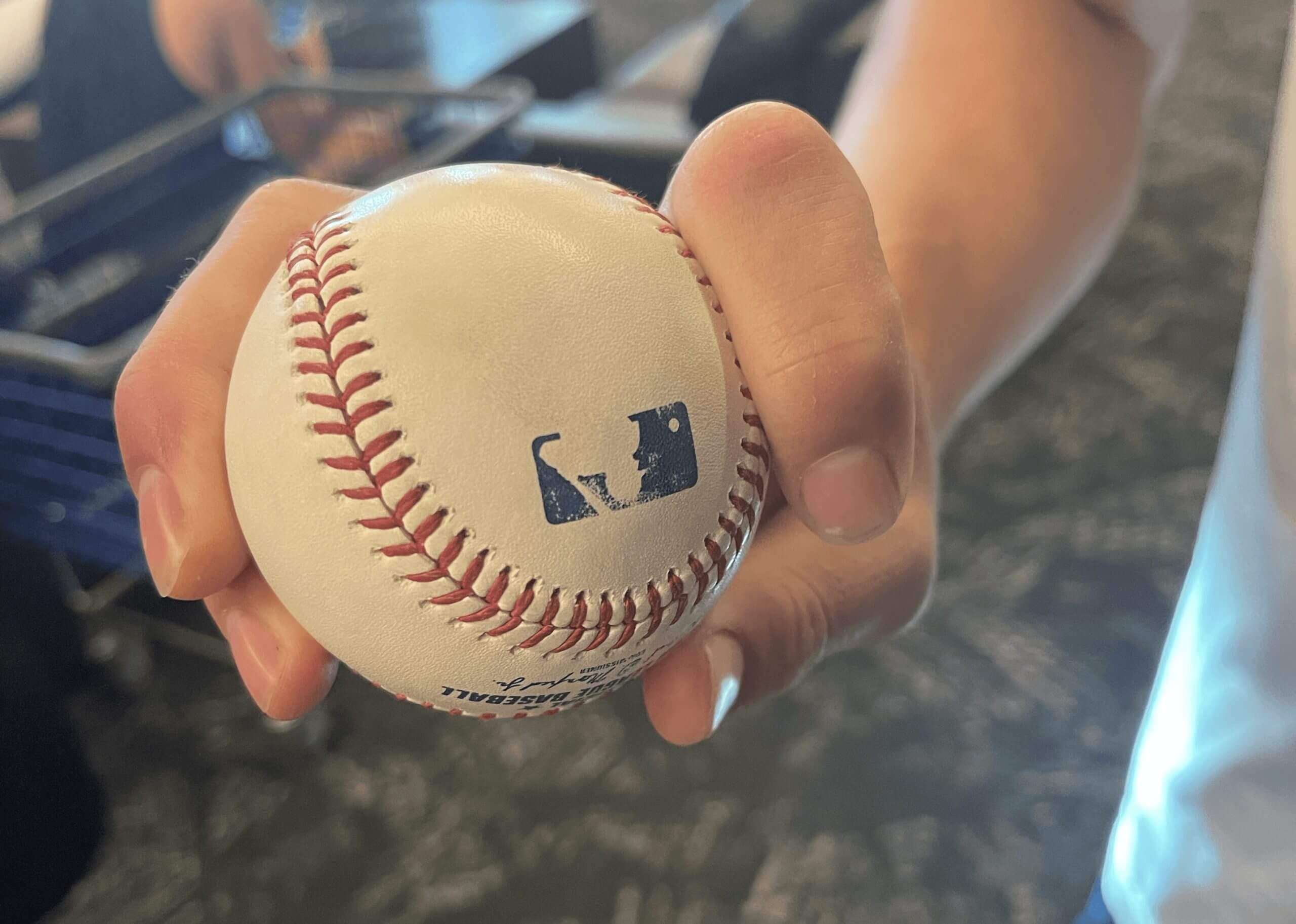
Logan Gilbert’s split-finger grip. (Eno Sarris / The Athletic)
Even if Miller and George Kirby throw the pitch slightly differently in terms of grip, having them learn the pitch at the same time has been a great resource for Gilbert. In 2022, none of the three threw a splitter. Last season, roughly 10 percent of their combined pitches were split-fingers. It’s gotten better every year — the splitter had its optimal combination of velocity and drop last year — and is now Gilbert’s best pitch by model or results.
“Someone goes and throws it well, and the next day, we’ll all steal that,” Gilbert said. “Being able to have guys around you that just deal for years and years — you learn a lot.”
Now, as he steps to the mound Thursday with all of Seattle waiting for him to dominate, he does so not only with years of work perfecting his pitches behind him, but also — thanks to watching the best pitchers in the game and listening to some great coaches — the kind of demeanor and mindset it takes to be an ace shouldering these types of expectations.
“He’s a cold-blooded killer when he steps out on the mound,” Mariners shortstop J.P. Crawford said last year. “And that’s why his name is ‘Walter’ — it’s just a scary name. No offenses to the Walters out there.”
“You try to get locked in,” Gilbert said back in 2024, with a smile. It was a rest day. Walter would be ready by game day and the smiles would be gone.