
One of the toughest balances to strike as a Fantasy player comes with the first few waiver-wire runs after the season starts. As I’m typing this, only the Angels and Astros have played even four games this season, and they’ll be joined by the Guardians and Mariners in a few hours. Four games is nothing, and most of the league hasn’t even gotten there.
That’s not even a single turn through the rotation. The league leaders in plate appearances are four separate Angels players who each have 20, or about 3% of the max total any of them are likely to reach by the end of the season.
And, of course, most of the starters we have seen on the mound so far aren’t exactly the types we’re chasing on waiver wires – we’re seeing the tops of rotations, which is mostly made up of the ranks of must-draft pitchers. We’ll get our first signs of some of our favorite sleepers in the next few days, and even that won’t be enough to change how you should view any of them (for the most part). And for hitters? Forget it. Three or four games is just nothing at all. Any reaction to what we’ve seen this weekend is very, very likely to end up being an overreaction.
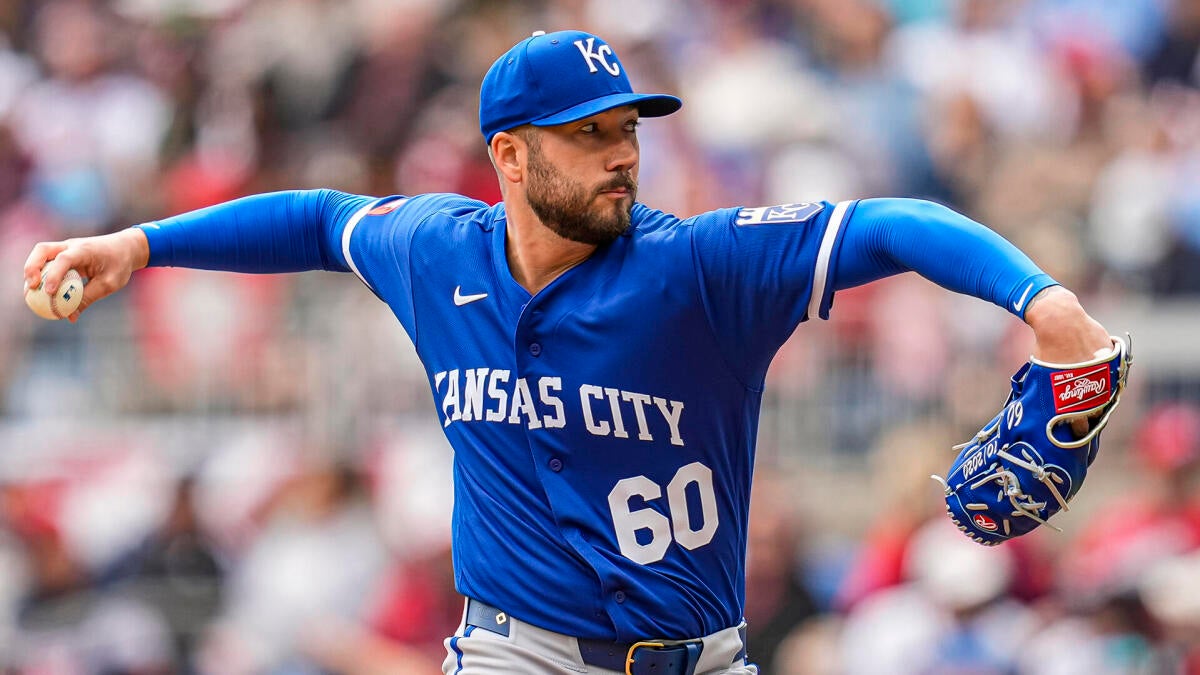
The one place where early-season changes can actually matter is in the ninth inning. Because we’re not just talking about performances here – usage is the primary thing we care about for closers, and you can react to usage changes a lot more quickly than any performance change. Though, of course, sometimes they are inextricably linked. Like with the case of Carlos Estevez, who might have already lost his job as the Royals closer after just one disastrous outing.
Estevez dealt with diminished velocity all spring, and the adrenaline of the regular season didn’t change that – his average fastball velocity was down nearly 5 mph in his debut Saturday and he predictably struggled, giving up six runs on four hits and a couple of walks to blow the game. Estevez was hit by a comebacker on his ankle during the outing, but the velocity drop predates that by several weeks, so I don’t think that’s the explanation here.
But it was an excuse for Matt Quatraro to remove him from the closer role, acknowledging that the Royals will likely try to limit him to low-leverage situations to try to get him back on track. They didn’t use Estevez at all Sunday, and I’d be surprised if we saw him in the closer’s role for a little while – and if he can’t get his stuff back to where it used to be, he may just get Wally Pipp-ed.
That Royals situation isn’t the only one we got some actionable evidence about this weekend, so before we get to the rest of the waiver wire targets, here are three closers to consider adding if you’re chasing saves.
Lucas Erceg, Royals (23%) – If not Estevez, who? I think Matt Strahm is the best pitcher in this bullpen, but when the save opportunity came up Sunday, it was Erceg who worked the ninth, with Strahm coming in for the final two outs of the seventh. Maybe next time it’ll be different, but I think the Royals were giving us a hint here, especially since Erceg set up Estevez for the previous outing. Erceg took a step back last season after breaking out in 2024, but his stuff still looks strong and he still looks good enough to get the job done if called on again. Jordan Romano, Angels (21%) – Romano got the save in the opener for the Angels and then pitched with a four-run lead Saturday, striking out two to close it out. It’s only one save, but the second situation was close enough that I think it tells us something about the Angels’ plans. Cole Sands, Twins (8%) – Justin Topa pitched a clean eighth Saturday with a three-run lead, handing it off to Sands for the first save of the season. This one still feels relatively open – Taylor Rogers had pitched Thursday, so maybe he wasn’t available? – but I’ll give Sands the edge for now, certainly. Week 2 Waiver TargetsCatcher
Francisco Alvarez, Mets (63%)
Nothing has happened to change my mind about Alvarez, which is fine, because my expectations for Alvarez were already quite high. He broke out in the second half of last season and he’s well positioned to keep it up in 2026, even opening the season with as many strikeouts as homers (one). It’s eight plate appearances, so again, what we’ve seen so far means very little. But Alvarez is one of my favorite breakout hitters for 2026, so I’ll just default to him here until someone takes his spot.
Deep league option: Jefferson Quero, Brewers (6%) – The Brewers called Quero up after Andrew Vaughn went on the IL with a fractured hamate bone. It doesn’t sound like the plan is to use Quero much right away – he’s serving as more of an emergency catcher in case they want to shift Gary Sanchez to first base or use him as a pinch-hitter – but Quero has some prospect pedigree coming off a season where he hit 11 homers and had an .839 OPS in 69 games. Let’s see if he can get some early opportunities and take advantage of them.
First Base
Munetaka Murakami, White Sox (80%)*
Okay so Murakami is more widely rostered than we typically go with for this column, but I just wanted to highlight his incredibly hot start here. He homered for the third time in as many games Sunday, and he has more walks (four) than strikeouts (three) to boot. It won’t always be this easy, and the hit tool questions here are real, even if they haven’t been an issue so far. But there is also difference-making power potential here, and until we see him fail, Murakami remains very worth being rostered. That’s how high the upside
Jake Burger, Rangers (38%)
Burger played through a wrist injury last season that ultimately required surgery, limiting him to 16 homers in 103 games. Burger has never been a guy with a well-rounded skill set, so if he isn’t hitting for power, he basically has no appeal in Fantasy. Given that, two homers in his first three games is nice to see, even if it comes with seven strikeouts. He’ll always be an all-or-nothing player, but Burger is playing everyday, so let’s see if the power comes through this time.
Deep league option: Deyvison De Los Santos, Marlins (5%) – De Los Santos has always been a lot like Burger as a prospect, but last season he ended up hitting just 12 homers in 110 games, which kinda spoiled his prospect status. But he had 40 homers as a 21-year-old just two years ago, and the Marlins called him up to replace Christopher Morel on the active roster, so in deeper leagues where you need a corner infielder, I’m interested in adding De Los Santos just to see if he can unlock some of that former upside.
Second Base
Brett Baty, Mets (44%)
Despite the signing of Bo Bichette, the Mets have treated Baty like an everyday player early on, as he has started each of their first three games, two at DH and one at first base. Baty also has experience at second and third base and was part of the competition for an outfield spot, so he might just be the Super Utility guy here, playing nearly everyday somewhere. Baty had a solid 2025 season where he really came on strong, and his versatility makes him a nice player to have around when holes inevitably crop up. Don’t be surprised if he ends up quadruple eligible by the end of the season’s first month.
Deep league option: Chase Meidroth, White Sox (17%) – The most surprising thing to happen so far this season might just have been Meidroth’s season-opening leadoff homer off Jacob Misiorowski of all pitchers. That won’t be a big part of Meidroth’s game moving forward, but it’s not unreasonable to think he could get to double-digit homers and 20 steals while hitting leadoff for the White Sox, something he has done in all three games so far this season. It’s an unexciting profile, but one we could look back on as being surprisingly useful at the end of the season.
Third Base
Jordan Lawlar, Diamondbacks (53%)
Lawlar isn’t off to a great start, having struck out three times in his first seven trips to the plate with just one hit. His margin for error is incredibly slim as he’s playing a new position on a team that does not seem totally bought in on him – I mean, how else are we to interpret the Diamondbacks going out to acquire Nolan Arenado at the position Lawlar was supposed to play. Still, I have faith in Lawlar figuring it out, and if he does, he’ll have a very Fantasy friendly skill set. I’m not giving up on him just yet.
Deep league option: Brady House, Nationals (21%) – None of the lower-rostered third basemen really did much to distinguish themselves this weekend, but there are some interesting names out there like Matt Shaw, Connor Norby, and Jonathan India who could all be interesting. I’ll focus on House, who did at least homer while starting each of the first three games for the Nationals after putting together a strong spring. I’m not sure the plate discipline will be good enough here, but he has some pop and some prospect pedigree to hang his hat on, so we’ll see if this 23-year-old can figure it out.
Shortstop
Ezequiel Tovar, Rockies (56%)
Tovar was a lone bright spot for the Rockies as they were swept to open the season, homering off Eury Perez in the season’s second game. He struggled mightily while playing through injuries last season, but we’re just two years removed from a 26-homer season, and I think he can at least get back to that. The Rockies have three games in Toronto to open this week before playing a six-game set to kick off their Coors Field schedule, and at the very least, you’ll be happy to have Tovar around at home, where he is a career .290/.326/.464 hitter.
Deep league option: Nasim Nunez, Nationals (9%) – We’re here for speed from Nunez, and he opened his season with two steals in the first three games. I’m not sure we’ll get much more than steals from him – Nunez is hitting in the bottom-third of a bad order and has a career .645 OPS in the minors, but I do think he’ll be a big help in stolen bases, with the potential for upwards of 40.
Outfield
Chase DeLauter, Guardians (83%)*
Again, DeLauter is a little more widely rostered than we usually focus on for these purposes, so I’m just including him here as a reminder to go add him in the handful of leagues where he is still rostered. He’ll slow down – hitting major-league pitching is a lot harder than he’s made it look so far – but DeLauter clearly has a phenomenal feel for hitting. He was a near-.900 OPS bat during his minor-league career and put up big numbers all spring, with an unusual combination of quality of contact and quantity of contact.
Owen Caissie, Marlins (55%)
Caissie was an obvious fit for a Marlins team in desperate need of pop, and he’s provided a big boost so far, carrying them to a win Sunday with a walkoff homer. He’s 5 for 10 to open the season with a couple of doubles, and while this is another one where things will surely get tougher moving forward – he won’t face the Rockies’ pitching staff every time out – he’s also an accomplished power hitting prospect who just needed a chance after toiling away for a few years in Triple-A. There is 30-homer upside here and he hasn’t looked overwhelmed so far.
Cam Smith, Astros (43%)
I continue to think it makes sense to just bet on the tools with Smith. He looked rough as a rookie, but he also showed plus athleticism and bat speed, a combination that hints at obvious upside. He’ll have to make more contact (28% strikeout rate as a rookie) and he’ll have to hit the ball in the air with authority more consistently, but he’s emerged as a surprisingly effective outfield defender and despite the various revolving doors around the Astros lineup, he started all four games to open the season. That’s a very good sign that he’ll at least get the chance to figure it out. He deserves it.
Victor Scott, Cardinals (25%)
He’s doing what he’s supposed to do: Run! Scott stole a base in each of the first two games of the season, a reminder of his legit 40-steal potential, especially on a Cardinals team where he should have very little competition for playing time. He’s too limited of a hitter to count on for much more than steals, but he might be able to give you 40 of them. If he shows any growth as a hitter and gets the batting average into the .260 range, well, that’s a nice bonus, but not something you should plan on.
Deep league options: Jake Bauers, Brewers (8%) – I’m still worried Bauers is going to be a strict platoon bat, especially after he sat against a lefty Sunday. But with Jackson Chourio (hand) and Andrew Vaughn (hand) both on the IL, there are suddenly multiple possible lineup spots to slot him into. Bauers had a huge second half in 2025 followed up by a huge spring, and it came along with some changes to his swing. In points leagues you can probably ignore Vaughn, but he’s interesting in some deeper category leagues. … Garrett Mitchell, Brewers (10%) – In 452 career plate appearances, Mitchell has 13 homers and 25 steals. That’ll play. The Brewers have few everyday players, and I’m not sure Mitchell will be one of them – he sat out Sunday’s game after starting the first two – but he has shown the ability to be a productive hitter when healthy in the past. Those same injuries opening a door for Bauers could give Mitchell some extended early run, and he has a couple of steals in the first weekend of the season, so why not see if there’s anything here in your deeper category leagues. … Jordan Walker, Cardinals (13%) – This is probably Walker’s last best chance to carve out a long career for himself in the majors, as the former top prospect has hit just .239 with poor plate discipline and limited power so far in his career. He hit his first homer of the season Sunday, and he added a 114.9 mph double in the same game. He is 4 for 10 to open the season with a pair of walks to just one strikeout, so he could be worth a speculative add in deeper leagues. You know, just in case?
Starting Pitcher
Cody Ponce, Blue Jays (68%)
Ponce hasn’t even pitched yet. We have no idea how this is going to go. But there’s a reason he’s on Scott White’s sleeper pitchers list for Week 2 when he hasn’t pitched in an MLB game since he had a 7.04 ERA in 2021, and it’s not just because he was the best pitcher in the Korean league last season. It’s also because his stuff has leveled up since his previous MLB stint, of course, but also because he opens the season with matchups against the Rockies (away from Coors Field) and the White Sox, which is just about the softest landing possible. It might all end in disaster and a drop if he doesn’t perform well here, but I think he’s probably the best streamer around for Week 2, and he might not be just a streamer.
Mick Abel, Twins (62%)
Seeing as we have been operating under the assumption that Abel won a rotation spot with his performance this spring, it was more than a little alarming to see him pitching in relief of Bailey Ober Sunday. But the Twins had him out there for 81 pitches, so it seems like the answer here is clearly just that they didn’t need a fifth starter but still wanted to keep him on schedule. Abel didn’t pitch well, giving up five earned runs over 3.1 innings with four walks, but it’s also worth noting that there was a lot of bad luck here – of the eight hits he gave up, six were hit 84 mph or slower. Given the disrupted schedule Sunday, I’m not going to hold the results against him too much, especially when Abel’s stuff still looked strong. He’s not going to get endless rope, but I’m willing to give Abel a mulligan for this one and see what the next start looks like, because there’s still plenty of upside here.
Randy Vasquez, Padres (8%)
Vasquez’s velocity was up across the board in his debut, just as it was this spring, only the results were much better this time around. He held a solid Tigers lineup scoreless over six innings, allowing two hits and three walks while striking out eight and generating a very solid 13 whiffs on 91 pitches. It’s a deep arsenal that looks leveled up, and while I don’t think Vasquez is suddenly an ace or anything – and I wouldn’t start him against the Red Sox for his next start – but he has a matchup against the Rockies followed by another against the Mariners at home, and I do think he should be pretty useful for that stretch, at least.
Didier Fuentes, Braves (35%)
I’m still not sure Fuentes is going to get the chance to matter for Fantasy anytime soon, but we got a taste of what it could look like if he does get that chance Sunday against the Royals, and it predictably looked pretty great. He struck out four while walking just one over four one-run innings while piggy backing off Grant Holmes. He got just four whiffs on 24 swings, which is pretty disappointing, but the stuff looked great, featuring a high-velocity four-seamer, a splitter for lefties and a slider for righties. The Braves’ has been to use him as a reliever before stretching him out at Triple-A, but with his usage Sunday, it sure seems like they’re keeping him ready in case a need arises earlier. Given the history of this rotation, that opportunity may come before you expect it.
Reynaldo Lopez, Braves (55%)
Speaking of the Braves rotation, Lopez actually looked pretty excellent in his season debut. After mostly sitting in the high-80s for much of the spring, Lopez made some mechanical adjustments and came out averaging 94.4 mph with his four-seamer in his season debut. That’s down from where he was during his incredible 2024 season, but only about 1 mph – a lot better than his spring. He made it through six innings allowing just one earned run, and while he only struck out three, the nine whiffs on 77 pitches suggests there is more strikeout upside there. I’ve never been much of a believer in Lopez, but he showed more than I expected in this one, at least.
Taj Bradley, Twins (30%)
Speaking of pitchers I’ve never been much of a believer in, Bradley had a solid debut. The three walks help explain why he couldn’t get out of the fifth inning, but the stuff looked electric leading to nine strikeouts and a whopping 17 whiffs. His velocity was up and the stuff looked improved pretty much across the board, as Nick Pollack noted in his SP Roundup for Saturday. I share Nick’s skepticism that Bradley will ever find the kind of consistency needed to matter for more than a few stretches per year, but the upside is obvious, and it’s worth chasing for an upcoming start against a mediocre Rays lineup.