
Earlier today, we provided an in-depth rundown of prospects from Florida backfields who stood out during first-hand looks this spring. Now, we’re back with another spring training look from a slightly different angle—prospects from last year’s 2025 MLB Draft class who have yet to debut.
Below, BA subscribers can find notes of six such draftees who we’ll be keeping tabs on as they get started on their official professional careers this season.
James Ellwanger, RHP, Twins
The Twins signed Ellwanger for an overslot bonus of $1 million after selecting him in the third round in the 2025 draft. This spring, he’s been one of their most impressive arms on the backfields.
Ellwanger was the third pitcher to appear in the Twins’ Spring Breakout game, but he was the most effective, throwing three shutout innings and allowing only one hit. He showed off a high-octane arsenal headlined by a 96-99 mph fastball with life up in the zone. He complemented the fastball with a 92-95 mph cutter, 81-84 mph curveball and 91-96 mph changeup.
Ellwanger’s changeup was especially interesting given how he was able to deaden it to a low 1,000-1,300 rpm spin rate with late sink, even at such a high velocity. He threw it less than 2% of the time in college, and this version of the pitch is a relatively new addition to his arsenal that the Twins worked with him on this offseason. If it continues to develop, it would go a long way to assuaging some of the reliever risk in his arsenal that Ellwanger had coming out of Dallas Baptist.
Riley Quick, RHP, Twins
Introduction to pro ball didn’t go quite as planned for the Twins’ 2025 supplemental first-round pick, as he gave up four runs in his inning of work against the Red Sox in the Futures at Fenway South game. Still, Quick stood out physically at 6-foot-6, 250 pounds and his raw stuff was good, even if his command let him down.
Quick’s fastball sat 95-98 mph with sink, and he mixed in a cutter at 93-94 mph and a slider at 84-87 mph. Those velocities are all in line with where he pitched at Alabama, but he made a trio of mistakes and was punished each time, allowing a pair of doubles on a fastball and cutter up in the zone and a home run on a hanging slider.
The 6-foot-6 21-year-old recorded a pair of strikeouts: one on a 96 mph fastball that tied up Red Sox outfielder Justin Gonzales and another on a backdoor slider to Mason White that was well executed and just caught the outside corner.
Regardless of his early results, Quick’s combination of size, athleticism and stuff are unique, so it’s easy to see why the Twins targeted him in the draft.
Matthew Fisher, RHP, Phillies
Even though the Phillies didn’t select Fisher until the seventh round, he received the second-highest bonus in their draft class and the largest bonus ever for a seventh-round pick. He only threw one inning in their Spring Breakout game, but he showed a glimpse into why they were so high on him, retiring the side in order. Though all three Twins hitters he faced were high draftees with multiple years of minor league experience—Billy Amick, Brandon Winokur and Kyle DeBarge—the 20-year-old Fisher didn’t look out of place at all.
Fisher has good size and athleticism at 6-foot-3 with some projection remaining in his frame. He used a three-quarters arm slot with a low release height and showed off three pitches from his arsenal: a fastball at 92-95 mph, a slider at 80-83 mph and a curveball at 80-81 mph. His fastball had both ride and run and generated one whiff. Even though his breakers were in the same velocity band, they had two distinct shapes. His slider had less depth and more tilt, while his curveball had a higher spin rate with more vertical break, but less horizontal.
It might take some time, but Fisher has a nice blend of traits to build on.
Brayan Orrantia, RHP, Orioles
The 20-year-old righthander was impressive in his three-inning outing against the Pirates. The Orioles’ 14th-round pick out of New Mexico Junior College, Orrantia signed away from a commitment to Oklahoma.
Orrantia has good size at 6-foot-2, 195 pounds and throws from a high three-quarters arm slot. His arm is loose and quick, and he did a good job repeating his delivery. Orrantia’s fastball sat 92-94 mph with sink, and he utilized a trio of secondaries. He showed good feel for spin, using both an 82-85 mph slider with 11-5 shape and a vertical curveball at 78-81 mph. He also mixed in a mid-80s changeup on occasion. He mixed his pitches well and threw strikes against an inexperienced Pirates lineup.
It’ll be interesting to see where Orrantia is assigned to start the season and how he performs, because for a less-heralded 14th-round pick, he has a lot to build on.
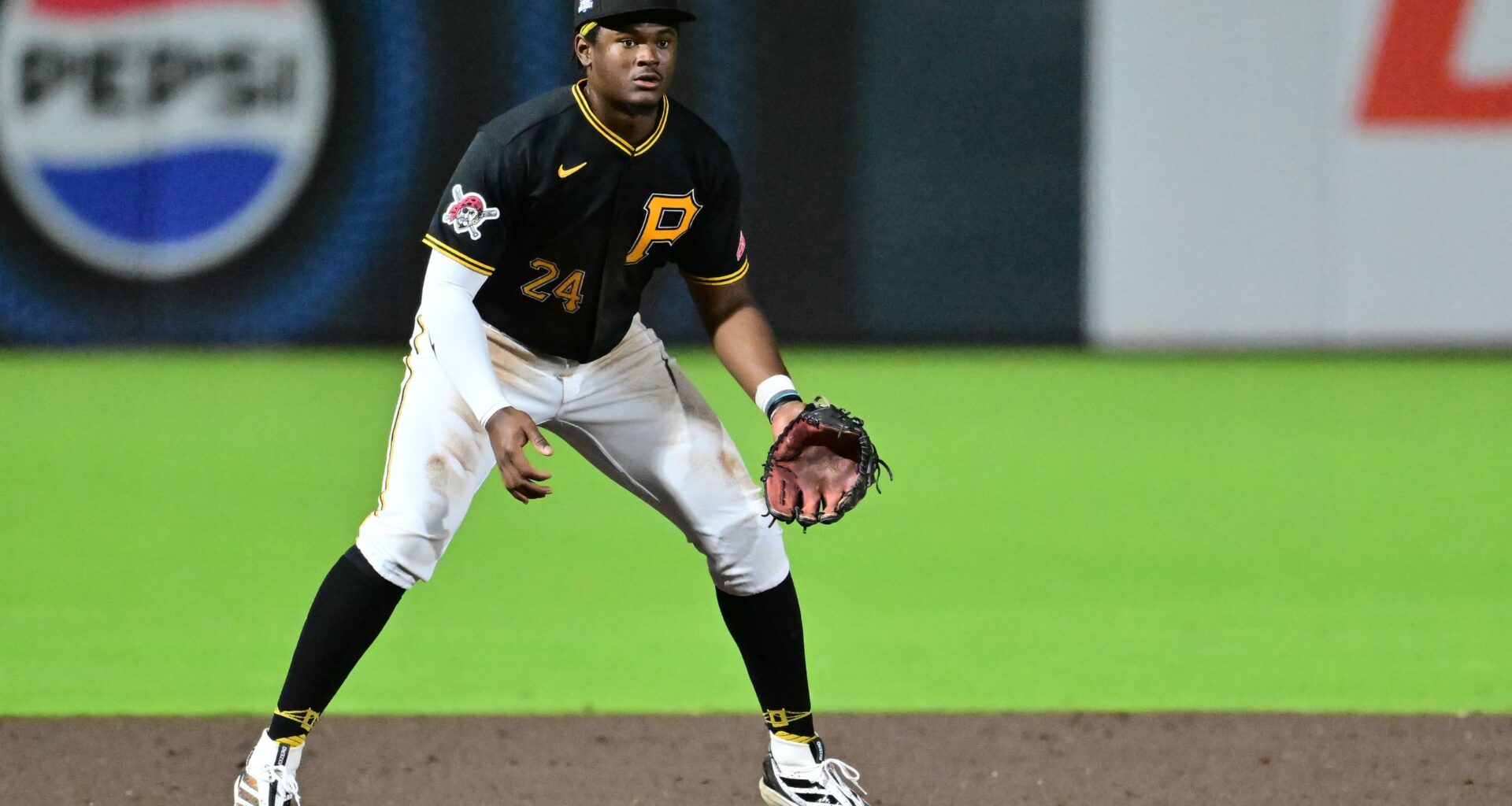
Murf Gray, 3B, Pirates
I only got to see last year’s Pirates supplemental second-round pick for one game, but he showed off some intriguing raw tools.
Gray looks the part physically at 6-foot-4, 230 pounds, and he has minimal remaining projection. He showed good bat speed and had a hard-hit line drive to left. He was also one of the few hitters who was able to catch up to Esteban Mejia’s triple-digit velocity. In the field, Gray showed off a very strong arm at third, ranging behind the bag and then making an accurate throw to first.
Jack Anker, RHP, Pirates
Anker, the Pirates’ 2025 sixth-rounder, showed a diverse arsenal and strong pitchability in his outing against the Orioles. The righthander utilized a short arm action and did a good job mixing shapes.
Anker’s fastball only sat 91-93 mph, but he was able to locate it well. He kept hitters off balance by mixing in a changeup at 84-85 mph with late dive and two breaking balls. He showed good feel for both his breakers in a 12-6 curveball at 81-82 mph and a slider in the mid 80s.