
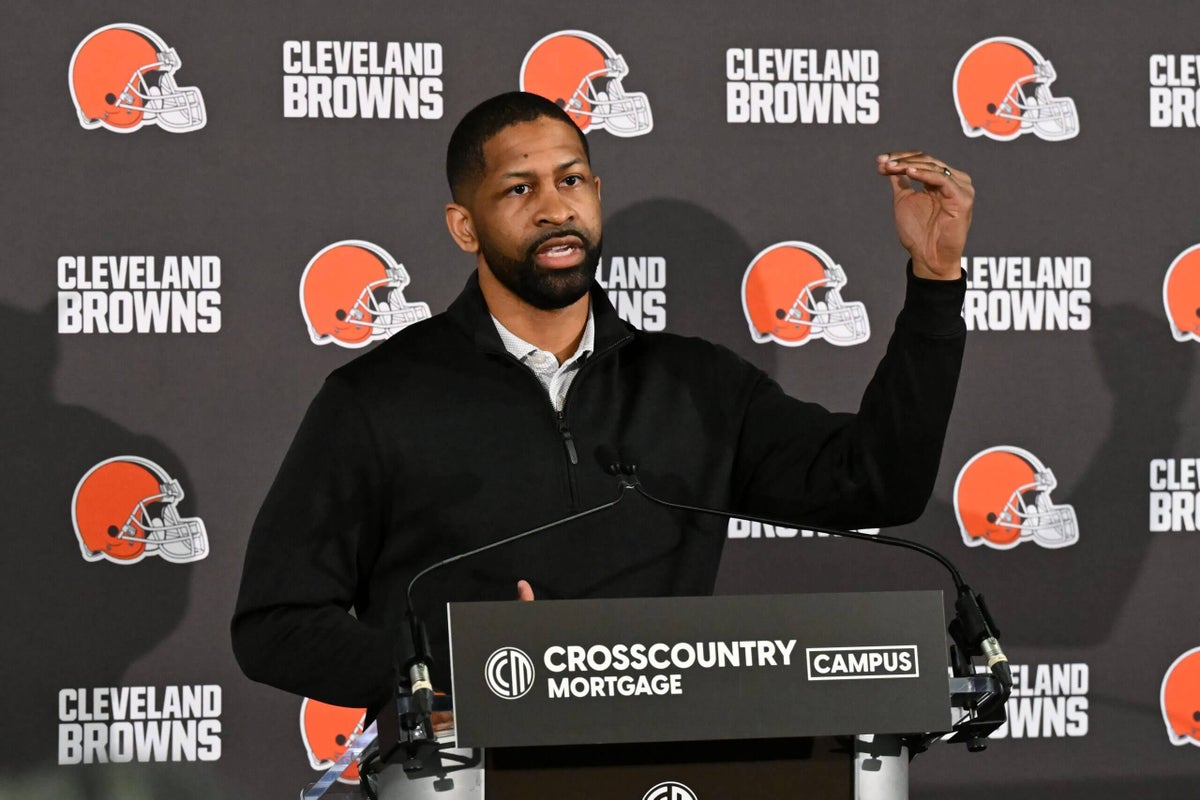
PHOENIX — The Cleveland Browns will withdraw their proposal for the NFL to extend the window to trade draft picks to up to five years out, according to two league sources.
Currently, teams can trade picks up to three years out. Browns general manager Andrew Berry, who proposed the alteration, believed the change would give teams more flexibility in terms of transaction volume and creativity, but few within the league seemed to agree.
Los Angeles Rams coach Sean McVay was among those who dismissed the idea.
“There’s zero chance it gets through,” McVay, a member of the NFL’s competition committee, said Monday morning. “It doesn’t have any support.
“Andrew Berry is as smart as it gets, and his ability to articulate the thought process behind it is very sound. But just the general feeling that I get from being here, even on the committee, I would be shocked if there was anything other than a question about it and nothing comes of it. There’s really not enough tangible reasons to say why we would change a system that’s kind of worked.”
The Browns’ goal was to generate discussion around the idea, per a league source, and they are expected to bring back an amended version of the proposal next year.
The Rams went seven consecutive years without a first-round pick, in large part because of trades for Jalen Ramsey and Matthew Stafford, who played instrumental roles in their Super Bowl LVI title. Rams general manager Les Snead famously wore a “F— them picks” T-shirt to the championship parade, and Rams president Kevin Demoff publicly supported Berry’s proposal. McVay, however, said he was personally against it.
“I don’t support it,” McVay said. “I love Kevin. Kevin and I can have different opinions on stuff. Here’s what I think: Kevin is super smart. Kevin is always about the interest level, and his reasoning behind it is sound and rational. But Kevin also knows there’s no way that thing’s getting through.”
We are one week into the NFL league year and teams already have $1.1 billion of dead money on their books!
I’m not sure allowing teams an extra two years of picks to trade is any more irresponsible in mortgaging the future https://t.co/nQnzUE0fzm
— Kevin Demoff (@kdemoff) March 18, 2026
Berry engineered the 2022 trade to acquire quarterback Deshaun Watson from the Houston Texans in exchange for three first-rounders and immediately signed Watson to a five-year, $230 million fully guaranteed contract. The trade has been a disaster for the Browns. Watson has appeared in only 19 games over the first four years of the deal because of injuries and a league suspension. Now healthy, he is competing against Shedeur Sanders to be Cleveland’s starting quarterback this year.
The average job span of an NFL general manager is less than five years, meaning GMs under the new proposal could be trading away picks for years in which they won’t even be in the seat of power.
NBA teams can trade picks up to seven years out but must retain a first-rounder in at least every other season. The NHL does not put limits on draft pick trades, and MLB teams can only deal away Competitive Balance picks.
“Three years is really probably more of an arbitrary marker in terms of how far out you can deploy your future assets,” Berry said during the league meeting. “Honestly, I think a lot of the perhaps resistance is this idea that a desperate general manager, a desperate head coach could leverage a team’s future irresponsibly. I think that’s a little bit more rooted in fear than reality, though. … There is always ownership oversight for every NFL franchise.”
Berry said 27 trades over the past 10 years have included a pick three years out. Of those 27, only three have included a first-rounder, and four others have included Day 2 picks.
“I don’t think you’re all of a sudden going to see this trend where people are trading picks four or five years out,” Berry said. “I think those are very rare circumstances, but what it does do is it gives you more creative alternatives for maybe less signature or less progressive moves because of how you want to balance the discounting of present versus future assets.”
Tampa Bay Buccaneers coach Todd Bowles sided with McVay against the idea.
“There’s a lot to think about there from a trade standpoint,” Bowles said earlier Monday. “It could be good, and it could be bad. Right now, I would probably be against it for reasons that I know from a trade standpoint down the line. People start giving away picks here and there, it would probably be hard to keep up with. We’ll see what the future holds.”