
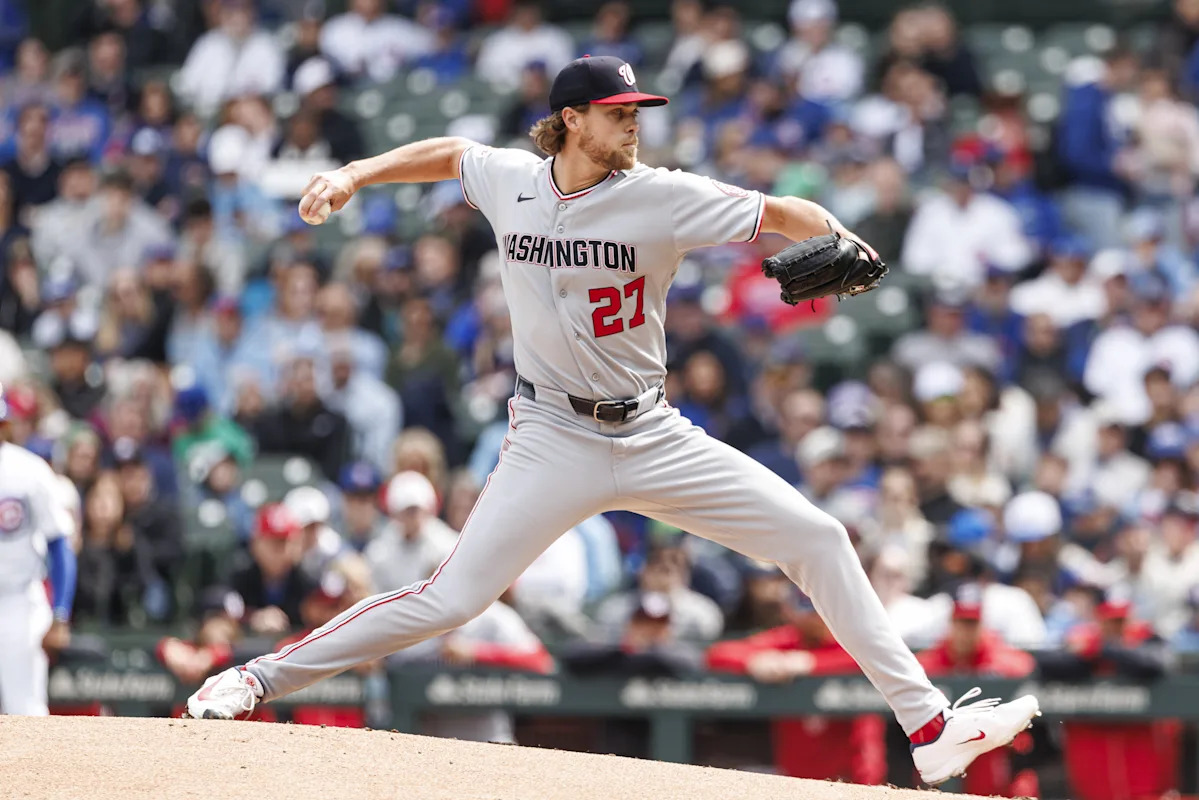
Through 4 games under new pitching coach Simon Mathews, Nationals pitchers as a group are seeing somewhat of a renaissance in terms of their “stuff”, with many of them finding extra velocity, spin, or movement on their pitches. Chief among them in terms of major changes has been Jake Irvin, who demonstrated perhaps more changes than any pitcher in the big leagues from 2025 to 2026 during his 5-inning, 2-run performance on Sunday at Wrigley Field. Let’s break down these changes and what they mean for Irvin’s 2026 outlook.
The first thing of note is that Irvin’s velocity was up a tick in his first start of 2026 from 2025. His fastball was over 1 MPH faster than it was in 2025, and all of his breaking balls and offspeeds were up a few ticks of velo (except for one, but more on that later). Perhaps this was just a result of Irvin feeling fresh in his very first start of the year, and it will be back to 2025 levels in a few weeks, but velocity being down was a problem for Irvin from the start last year, so it’s certainly refreshing to see that not be the case this season.
Advertisement
Another change Irvin made was dropping his arm angle for the 4th consecutive season. Irvin had an average arm angle of 32 degrees when he entered the big leagues in 2023, and has dropped it all the way to 25 degrees now in 2026. The result is a complete overhaul in his pitch’s movement, with none of his arsenal having the same movement profile as when he entered the bigs.
The pitch that saw the most major change from the arm angle tweak, as well as a likely change in grip, was his slider, which lost nearly 2 MPH of velocity, and in exchange, had nearly 9 more inches of vertical break than it had in 2025, making the pitch more of a sweeper than a traditional slider. Pitch models are a big fan of the change to the pitch, with Thomas Nestico’s Stuff+ formula grading the pitch at 111, 9 points up from 2025, and in the top 50 for all sliders in baseball.
Irvin also refined his pitch usage in his first start of 2026, cutting his fastball and curveball usage and distributing it to other pitches. Against righties, Irvin used his sinker primarily, throwing it 30% of the time, and bumped up his cutter and slider/sweeper usage from 6% and 7% to 10% and 14%, respectively. He attacked outside all afternoon with his pitches, looking to miss barrels with his horizontal moving pitches, while occasionally coming inside with his fastball and sinker.
When facing lefties, Irvin drastically cut use of his fastball and curveball, with the heater usage dropping from 38% to 26% and the curveball from 33% to 23%. With that 24% drop in usage of his 2 main pitches in 2025, he filled it with a 16% increase in cutter usage, 4% increase in changeup usage, and 4% increase in slider usage. He kept his sinker below the zone, hammered inside with his curveball and cutter, and kept them guessing with fastballs on the outside corner.
Advertisement
To recap, through a velocity increase, refining of his slider, and optimization of his pitch usage, Irvin saw an overall improvement to his stuff and impressive results against an impressive Cubs lineup, with the only runs he allowed being solo shots in the wind turbine called Wrigley Field. If he can keep his velocity up and continue to attack hitters with a plan that fits his arsenal, we may be seeing a return to 2024 first-half Jake Irvin form.