
The 14th National High School Invitational at the USA Baseball Complex in Cary, N.C., had a slew of potential day one draft picks, mostly on the pitching side, but maybe just one or two first-round picks. I was there for all of the first day and most of the second, so here’s a rundown of the guys who stood out.
• Right-hander Kaden Waechter, the son of former Tampa Bay Rays pitcher Doug Waechter, was the best overall prospect at the event, showing a five-pitch mix with a solid delivery that has him coming from a low release height of about 4’8” thanks to a low three-quarters slot. The Florida State commit was 91-95 with 20+ inches of vertical break, throwing both a two- and a four-seamer, along with a tight cutter at 89-91, a sharp slider at 84-86 that he’d throw away from righties or at their front hips, and a mid-80s changeup. He’s very on-line to the plate and throws plenty of strikes; he walked two batters and struck out 10 in this outing.
Waechter seems like less of a high-upside play than the typical high school pitcher who goes in the first round or close to it, showing more polish and feel, along with enough present stuff to see him in that top echelon of prep arms. Maybe the fact that he’s not throwing 99 already will make him a safer bet?
• Right-hander Wilson Andersen, Waechter’s teammate, was one of the biggest surprises at the event, as he came out pumping 92-96 with a hard breaking ball at 81-85, showing slider speed with 11/5 curveball shape, along with an upper-80s changeup that he used away to lefties. He’s on-line from a slot above three-quarters, filling up the zone with the fastball, which he threw for about two-thirds of his pitches, while the breaker was more of a chase pitch for him and the changeup wasn’t much of a factor. The Mississippi State commit looks like a future mid-rotation starter if the third pitch comes.
• Shortstop James Clark of St. John Bosco High (Calif.) was the best position-player prospect at the event, showing bat speed, foot speed, and patience, but looking overmatched by the speed of these games at shortstop. His swing is short, but he swings hard, with a sharp move down and back to start before he whips it through the zone; I saw him put the ball in play multiple times, but nothing harder than a line-drive single. The Duke commit did take a ton of pitches and had several good at bats that ended in outs, even against left-handed pitchers (Clark is a lefty as well). He made at least three fielding/throwing errors just in what I saw, all because he was rushing on the play.
• Clark’s teammate Jaden Jackson, a center fielder committed to UCLA, was wilder at the plate, showing more power but less of an approach. He also doubled off the wall but jogged out of the box like it was a homer.
• Orange Lutheran right-hander Gary Morse is 6-foot-7 — stop, it’s over now — and dominated in his outing with a fastball up to 95 that had up to 22 inches of induced vertical break, along with an easily plus changeup with big fading action to it. The Tennessee commit struck out 16 batters, tying an NHSI record, and gave up just one hit in seven innings.
His mediocre breaking ball is the concern; he throws a curveball that’s not very sharp and that he sometimes casts (releases it too early) so hitters can pick it up. If he had that third pitch, or anything to indicate he could spin the ball well, he’d probably be in consideration late in the first round.
• Right-hander Wyatt Clatur is now the No. 1 starter for Nolensville High in Tennessee after Bo Holloway transferred to a tiny religious school for his senior year. Clatur was 94-96 with a solid slider at 78-79, and I didn’t see a changeup from him. He threw effectively for three innings before he lost the zone in the fourth inning and left the game.
The Virginia commit looks like a good athlete and fields his position well, which is kind of rare for amateur pitchers at this point.
• Righty Grayson Willoughby of Trinity High in Louisville, Ky., threw almost all fastballs, 92-97 with above-average induced vertical break, with just a couple of sliders and changeups, neither of which was an average pitch. He hit 97 three times early in the outing but was down to 89 in the fifth inning. His delivery is fine, mostly on-line to the plate, with a high three-quarters slot, and strikes weren’t an issue. He’ll need a better breaking ball at the very least. A Kentucky commit, he will turn 19 before the draft.
Other draft players I saw in the last few weeks…
• Lefty Logan Schmidt of Ganesha High in Pomona, Calif., is going to be one of the first high school pitchers selected this July, as the LSU commit has been up to 95-96 with a hammer breaking ball. I caught him in a home start on a Saturday morning when, for some reason, he was throwing all cutters in the first few innings, sitting 89-92 on the pitch, while the breaking ball, which I think was more sweeper than slider, was sharp with late downward break at 82-85. He flashed a couple of changeups at 81-83.
He’s got a short arm action with high effort, in particular because sometimes his back foot is off the ground before he lands, so he’s not pushing off as much as he could. He didn’t have great command in the first inning — possibly because he wasn’t throwing any four-seamers — but settled down as the outing went on, not just throwing better strikes but pitching more aggressively as well. I don’t love how it all works, but he has arm strength, feel to spin the ball and a strong 6-foot-4 frame already. He’s also young for the class, turning 18 in late July.
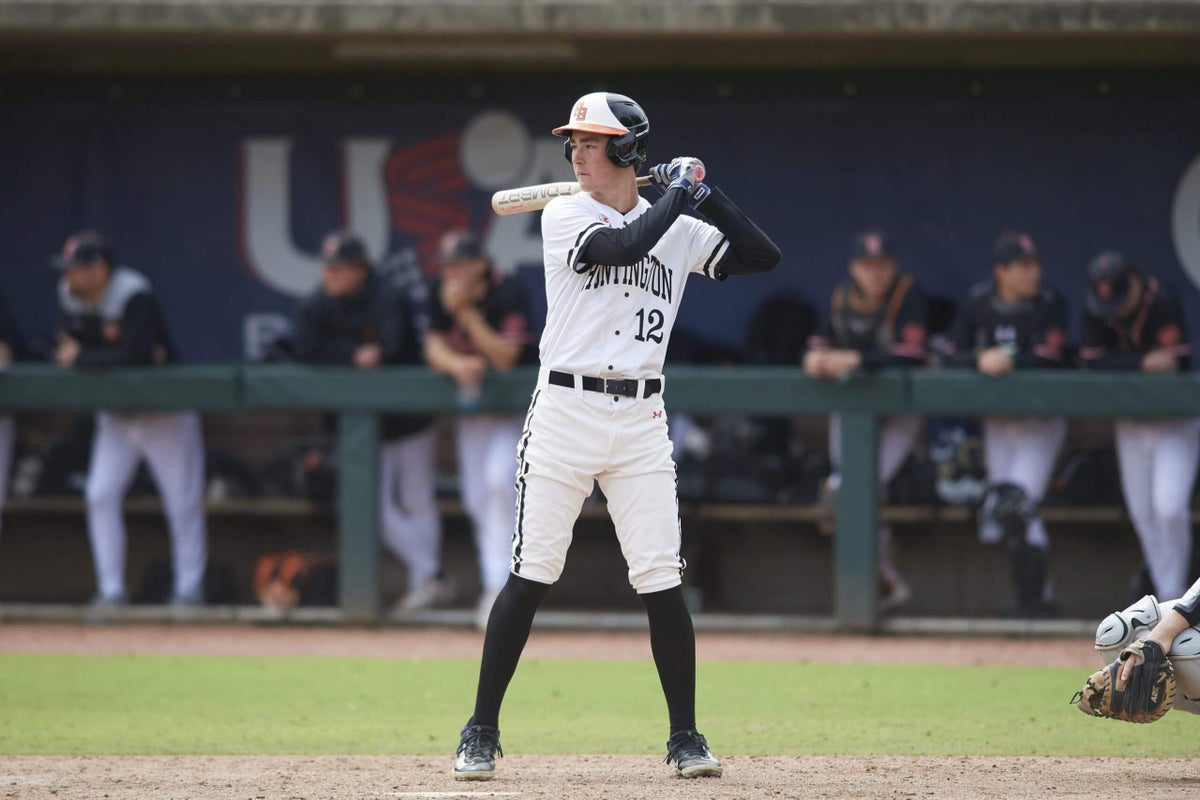
• I saw two-way player Jared Grindlinger, a left-handed pitcher and outfielder for Huntington Beach High, but only saw him hitting, which I think is the less likely path for him to start his career based on what scouts are saying. Grindlinger won’t turn 17 until mid-April and just reclassified to graduate this year, making him one of the youngest players in the class, just a few weeks older than Alabama infielder Rocco Maniscalco (who has struggled at the plate this spring).
Grindlinger is all projection at this point — he’s 6-foot-3 and looks extremely slender, although he’s listed at 185 pounds — and his bat speed is below average. If he were 18 already, I’d be a little more concerned about that, but he’s young and looks like he’s going to get significantly stronger. He has excellent bat-to-ball skills, squaring up several pitches in the game I saw, and has at least average power already despite the bat speed deficiency.
He’s going to score extremely high for teams that value age in their draft models; he’s more than six months younger than Mike Trout or Bryce Harper were on their draft days. I find the idea of drafting a barely 17-year-old pitcher mildly terrifying — at least if we’re talking in the top 30 or 40 picks, where Grindlinger fits — because of the injury risk, but I’d be fine taking him as a position player who pitches occasionally, or just as a position player for now with pitching always available if the bat speed doesn’t come.
• I got another look at UCLA after seeing Schmidt, and saw an uncharacteristically bad game on defense from shortstop Roch Cholowsky, who remains the top prospect in this class but may have some more competition up there than expected (notably from Georgia Tech catcher Vahn Lackey, now hitting .423/.541/.845). Cholowsky failed to make two fairly routine plays to his right, one where he didn’t get the glove down in time, while at the plate he had a ground-ball single to left and popped up to short right along with a walk and an HBP. I’m not trying to sound alarmist here at all — I’m just noting what I saw. I was at least hoping for a little more from him in the three games I’ve seen this spring.
• The top Canadian prospect in this draft class is lefty Sean Duncan, who played as part of the Langley Blaze travel team while I was in Arizona. He threw three solid innings against a team of Dodgers prospects who were below the Low-A roster — that is, guys ticketed for extended spring and/or the complex league, mostly older than Duncan was — with a fastball up to 96 with huge ride and induced vertical break, a plus changeup and a very clean, repeatable delivery.
His breaking ball gets mixed reviews; he gets such high spin rates that I think it’s reasonable to project an above-average pitch there down the road, even if right now he doesn’t show the same feel for throwing that pitch that he does for the fastball and changeup. There’s a lot to like here if you want to target high school pitching, especially since that seems to be the depth of this draft.
• USC lefty Mason Edwards came into his most recent start with a 0.26 ERA on the season, allowing just a single run through six starts. He did not like the cold rain he encountered at Maryland, however, walking six batters in 4 1/3 innings and allowing four runs, although with just two of them earned his ERA only rose to 0.67. Edwards mostly sat 89-91 and topped out at 93, struggling badly to throw strikes in his first two innings; handed a 4-0 lead in the bottom of the first, he walked the first three batters he faced, one of whom eventually scored. He did show an above-average curveball that got a whiff every time a Terp swung at it, and turned to it a few times when he needed to get something over the plate, while his changeup was above-average when he landed it. This was obviously not his best showing, and the conditions were lousy, but he did at least show promise to those two secondary pitches.