

Tristan H. CockcroftApr 1, 2026, 11:43 PM
CloseTristan H. Cockcroft is senior writer for fantasy baseball and football at ESPN. Tristan is a member of the FSWA Hall of Fame. He is also a two-time LABR and three-time Tout Wars champion.
Multiple Authors
The opening weeks of a new baseball season can be particularly tricky to navigate.
Statistical samples are small, “overreaction theater” is a nightly sellout, and every hot-starting player seems to be destined for a breakthrough season or, if undrafted, “the pickup of the year.” It’s also a time when fantasy managers are itching to make wholesale changes to the rosters they put in place only days ago. That means it’s prime time to capitalize upon others’ mistakes … but also to ensure you don’t make those very mistakes yourself.
The easy takeaway is to trust your preseason draft preparation and be painstakingly patient in early April. But we must make some judgments based upon small statistical samples, or risk passing up on potentially league-winning possibilities.
NBA Playoff Challenge

Pick the winners and crown your NBA champion! Create A Bracket
This gets especially tough when it comes to starting pitchers, most of whom have made only one start so far. Thanks to the many advanced metrics available to us these days, however, we’re able to make far more informed decisions about lightly used starters. Again, wholesale changes on the pitching side are foolish at this early stage — so, no panicking over Paul Skenes‘ nightmarish Opening Day outing, which was heavily influenced by Oneil Cruz‘s defensive gaffes and saw the right-hander post similar velocity and movement on his pitches! Still, some findings have me already thinking twice about my preseason valuations of certain starters.
The following five pitchers all have early metrics which hint that their 2026 statistical ceilings are much higher than anticipated. If you roster them, resist trading them, and if you don’t, consider making an offer while the asking price might still be realistic.
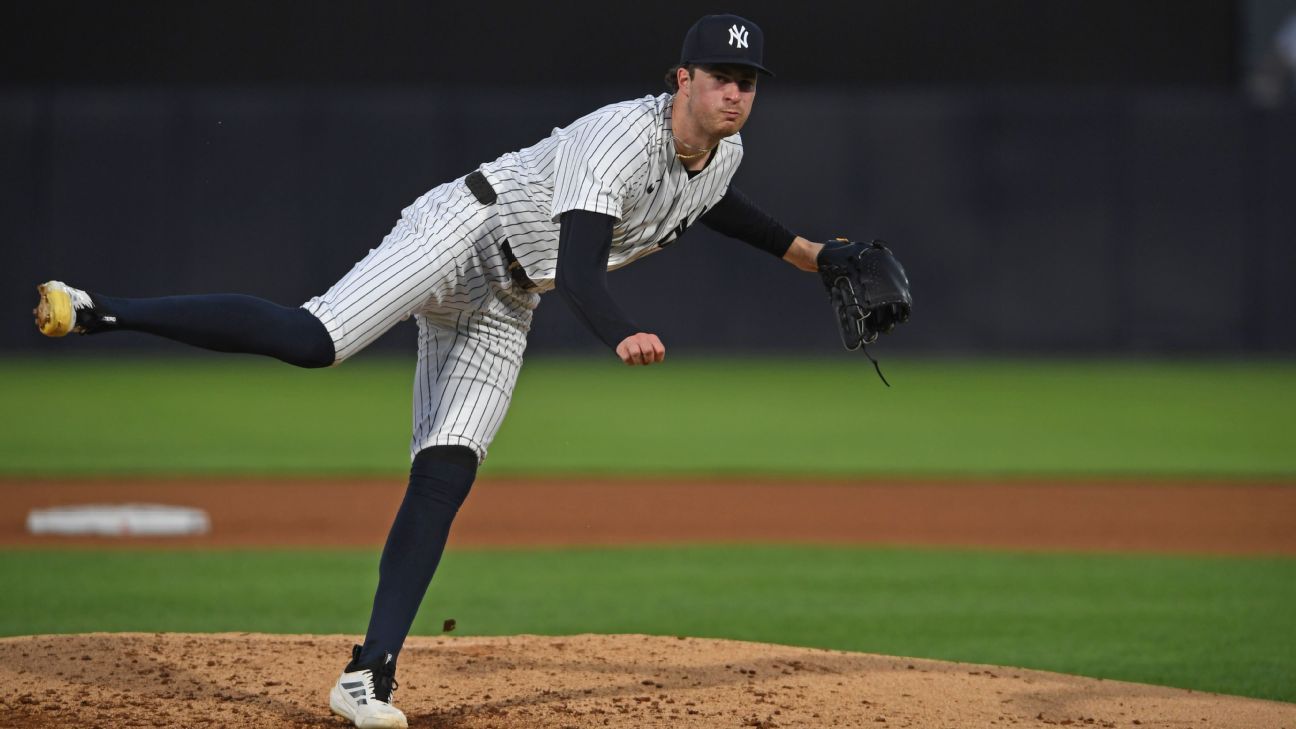
 Cam Schlittler, New York Yankees
Only three pitchers scored more than Schlittler’s 25 fantasy points in their first regular-season start, and his stuff seemed equally filthy to what we saw on the national stage in his two 2025 postseason appearances. Schlittler is still dialing up his fastball above 98 mph, and he’s now leaning more heavily upon a cutter that has been rather effective against left-handed hitters (.200 BAA, 24.1% miss and 31.3% hard-hit rates between 2025’s regular season/postseason, 2026’s spring training and his start last Friday).
The Yankees don’t appear to have serious concerns about Schlittler’s workload, which makes sense considering he totaled 120 2/3 innings in 2024 and 149 2/3 in 2025 (164, if you include the postseason). It might seem outrageous to declare his ceiling firmly within the positional top 10 for 2026, considering he has a mere 17 starts as a big leaguer (again, counting his playoff work) and wasn’t even regarded as a blue-chip prospect, but his stuff certainly builds him a compelling case.
 Shohei Ohtani, Los Angeles DodgersPlayoff Hockey Challenge

Who will lift the Stanley Cup? Create up to two brackets today. Create A Bracket
I might not have been more shocked by any spring training development than when Ohtani returned from the World Baseball Classic and, four days later, threw 61 pitches after not having picked up a ball in a structured game since October … and looked darned good doing it. He’d throw another 86 pitches six days after that, generating a 40% whiff rate on swings in his two outings and finishing with 15 strikeouts out of the 34 hitters he faced — and he’d throw another 87 in his regular-season debut on Tuesday, totaling six shutout innings of one-hit baseball worth 22 fantasy points.
While Ohtani was actively throwing bullpen sessions on the side before and during the WBC, 87 pitches is nevertheless more than he threw in all but two of his 14 regular-season starts last season, as strong a signal as any that the Dodgers regard him as a full-time member of their rotation for 2026.
Yes, we all know Ohtani is always likely to be in the MVP conversation as a hitter alone… but if the Dodgers are willing to let Ohtani challenge his career high of 166 innings pitched (2022) — and I suspect they might be — his 2025 gains in terms of velocity, control and whiff rate give him a legitimate chance at a 1,000-point (550 hitting, 450 pitching) season. We might have yet to see Ohtani’s MVP-level pitching come to life. Wow!

The unusual entry on the list, Imanaga’s 2025 fantasy production took a step backwards — and he was hardly stellar in his first start of this season (5 IP, 4 ER). Dig deeper into the numbers, however, and he has made some interesting strides in terms of his pitch repertoire, all of which could make him an early trade target.
Thanks to the improvements he made with his sweeper late last season, his already sound splitter, and the two-tick boost in his average fastball velocity between spring training and his first regular-season start, Imanaga posted a 20.1% swinging strike rate during spring training. It was the third-best rate among any current rotation member. He’d then generate a 39.5% whiff rate in his 2026 debut, his pitching line undone by a three-run Joey Wiemer home run. Based on the pitch repertoire advances, however, Imanaga might well be able to recapture his 2024 performance level, if not better.
 Chase Burns, Cincinnati RedsEditor’s Picks
1 Related
Burns’ fantasy value took a hit during spring training, when Reds management was floating the idea of a three-man piggybacking arrangement between him, Rhett Lowder and Brandon Williamson to fill their final two rotation spots. If you watched Burns’ Monday season debut (five innings of one-hit ball with seven K’s), however, you saw exactly what makes the 23-year-old right-hander one of the most exciting young starters in the game.
Since his MLB debut on June 24, 2025, Burns has gotten a whiff on 34.1% of batters’ swings between the regular season and preseason, the best rate by any pitcher who has faced at least as many as the 278 batters he has. Having a 98-plus-mph fastball and slider that has generated a 60% whiff rate between spring training and the opening week — seriously, it has! — will do that. Expect the Reds to be cautious with Burns — a key part of their future and a pitcher who dealt with flexor issues late last year — but if he’s afforded even 140 innings, he could be a top-20 positional fantasy performer.

He’s the dark horse on the list, but Leiter’s gradual gains over the past nine months, coupled with his front-line prospect pedigree, make him an appealing 2026 breakthrough candidate. His Monday start saw him strike out eight Baltimore Orioles, the fourth time in his past eight regular-season outings that he has recorded at least that many, while his 21 swings-and-misses are third most by any pitcher in a game thus far (Jacob Misiorowski 25, Dylan Cease 24).
The addition of a cutter has helped diversify Leiter’s pitch repertoire, providing good contrast against his 97-plus-mph fastball and elite changeup, meaning the boost to his strikeout rate might be sustainable. Bear in mind that he scored 158 second-half fantasy points last season (a total exceeded by only 20 pitchers) and that was before the arrival of his new pitch. Leiter could top out as a top-25 starter.