
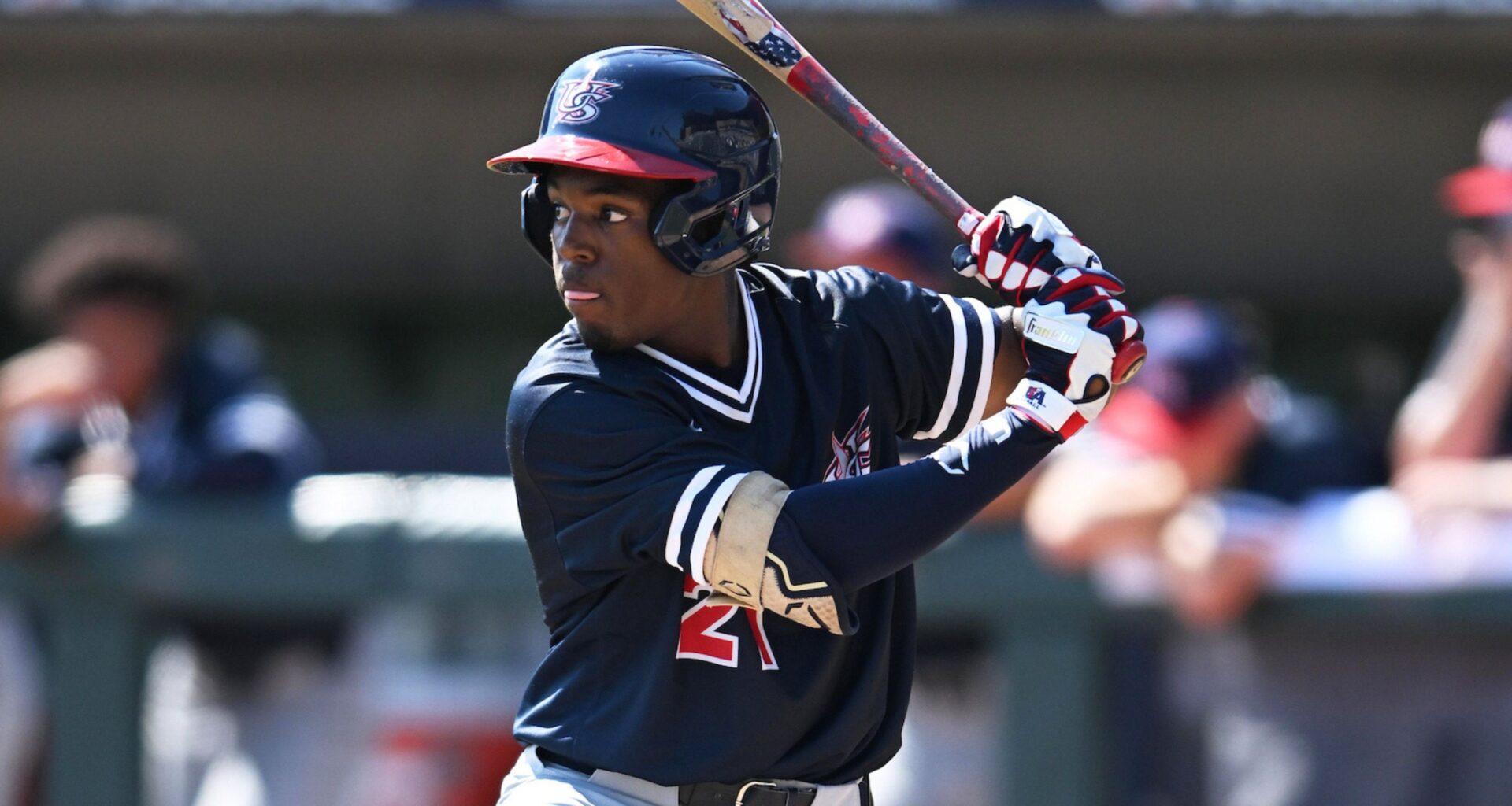
Last weekend, Orange (Calif.) Lutheran High won the 2026 National High School Invitational for the fourth time in program history, beating 2025 champion Venice (Fla.) High, 7-6. The win for the SoCal powerhouse marked the 10th championship for a California program in the 13-year history of the event. It also improved OLu’s record at the NHSI to a staggering 24-3.
While the result will lead to continued bragging rights for California prep baseball, it was also a key event for individual prospects from all over the country—for this year’s draft and beyond.
Below, Baseball America subscribers can read notes on 32 top draft prospects—including college commitments and high school draft rankings for 2026 and 2027—to know from the event.
James Clark, SS, St. John Bosco HS, Bellflower, Calif.
Rank: No. 23
Commit: Duke
Clark was the top-ranked 2026 prep prospect in attendance this year, and he has a chance to be a first-round pick this July on the merits of his lefthanded bat. He showed an advanced approach all week, going 3-for-15 with three singles, three walks and two strikeouts.
Viewed as one of the better pure hitters in the high school class, Clark has an impressive feel for the barrel and a strong understanding of the zone. He picks up pitches well and is confident in his swings and takes, rarely expanding the zone or forcing the issue when he doesn’t need to.
Clark has a notable barrel move in his swing. He starts with a high hand set with his barrel pointed down and behind him in his pre-pitch stance, then has a significant hand hitch and barrel tip as he makes his leg lift and gets his hands into launch position. While a bit unorthodox, Clark has the bat-to-ball skills and bat speed to make it work, and he always seems comfortable and in control in the box.
He’s a great runner who gets out of the box quickly and regularly turned in 60-grade run times from home to first. He should be an impactful runner with a chance to play multiple up-the-middle defensive positions.
A shortstop now, Clark didn’t have his best weekend with the glove. He made a number of unforced defensive mistakes and generally looked a bit out of sync on the defensive side with his hands, footwork and throwing accuracy. Scouts will undoubtedly come away with mixed views on his long-term defensive home, with some thinking about him as a future second baseman or center fielder. Those more bullish on his natural physical tools and athleticism might want to give him every opportunity to continue polishing his fielding in pro ball.
Kaden Waechter, RHP, Tampa (Fla.) Jesuit HS
Rank: No. 30
Commit: Florida State
Waechter was the top pitching prospect in this year’s field. He took the ball on Wednesday against Trinity High in what would be one of the best pitching duels of the event against righthander Grayson Willoughby. Waechter has a great pitcher’s frame at 6-foot-3, 185 pounds with plenty of room to add more strength, a loose and easy delivery with a fluid arm action and stuff that could send him into the first round.
He touched 95 mph with his fastball and sat around 92 while using a slider as his main secondary. Waechter showed impressive feel to land the slider for strikes in this outing. He threw it in the mid 80s, getting seven whiffs on 14 swings. Waechter also mixed in a mid-80s changeup as an occasional third pitch in lefthanded matchups.
Waechter had a long first inning that included a hit batter, a walk and an infield single, but he settled into a nice rhythm from the second inning on and ultimately struck out 10 batters and walked just two in six innings. He threw 100 pitches, with 66 landing for strikes.
Brady Harris, OF, Trinity Christian Academy, Jacksonville, Fla.
Rank: No. 67
Commit: Florida
Harris is a conundrum of a prospect, with excellent physical tools and a great hitting track record as an underclassman. Since the 2025 summer started, however, he’s struggled with the bat and entered the NHSI with real offensive questions.
It was a solid tournament for the 6-foot-2, 185-pound center fielder. He went 5-for-14 with a hit in each game, one double, two walks and three strikeouts and consistently turned in above-average run times out of the box.
Harris has a fairly simple-looking swing with his weight shifted onto his back leg and quiet hands, but he takes a big stride and showed a tendency to get too far out in front of the ball throughout the weekend. That overstriding means he’s often leaking out early and susceptible to spin, and not letting the ball travel or getting his entire lower half engaged into the swing. Seeing spin out of the hand has become a question for him, and continuing to get reps against high-quality breaking balls will be helpful for Harris to fully tap into the impressive pure bat speed and raw power that he does have.
He looks the part in center field and showed a plus arm during pre-game in/out.
Cooper Sides, RHP, Orange (Calif.) Lutheran HS
In what felt like a never-ending procession of lanky, projectable righties in this year’s NHSI, Sides was one of the final high-end pitching prospects to toe the rubber in Cary. He started for the eventual champions on Friday against Casteel and threw five innings while scattering six hits and one unearned run with two walks and three strikeouts.
Sides has a long-levered frame at 6-foot-6, 225 pounds and attacks hitters with a fast arm from a low three-quarters slot and direct stride to the plate. There is some effort in the delivery with a head whack and a spin in his finish, and he also has a long arm action in the back.
Sides threw his fastball in the low-to-mid 90s and reached 97 mph, with some late run and cut depending on the location. While the fastball showed good power, he didn’t miss many barrels with it in this look and was fairly scattered with his command throughout the outing.
Sides threw an 80-85 mph slider with variable shape and consistency. The breaking ball flashed bite at times, but it also looked more like a slurvy in-between breaking ball at other times when he didn’t fully get on top of and backed up to his arm side. Scouts seemed to prefer his mid-80s changeup, which he spiked a few times but showed solid potential.
While not his best outing, it’s obvious that Sides has impressive pure stuff to work with.
Wilson Andersen, RHP, Tampa (Fla.) Jesuit HS
Rank: No. 93
Commit: Mississippi State
Andersen is one of the best No. 2 starters you’ll find in the country and joins rotation-mate Kaden Waechter as the team’s second top 100 draft prospect in the 2026 class. He started game two against Aquinas and threw six innings with five hits, two earned runs, three walks and six strikeouts on 104 pitches.
Andersen has a great pitcher’s frame at 6-foot-4, 200 pounds with more room to add strength. His arm works quickly, but he does throw slightly across his body with an occasional spin-off to the first base side in his finish and some audible effort. He reached back for 97 mph on four different occasions and sat comfortably in the 93-95 mph range early before ticking down in his final few frames.
He threw a sharp low-80s slider as his primary offspeed offering and generated a handful of ugly swings and misses—six in total on 10 swings, for a 60% miss rate—and did the same with a few upper-80s changeups against lefties.
Gary Morse, RHP, Orange (Calif.) Lutheran HS
Rank: No. 113
Commit: Tennessee
Morse had one of the most dominant pitching outings in NHSI history, striking out 16 batters in a complete game shutout against Regis Jesuit. Those 16 strikeouts tied Seth Keller’s 16 strikeouts for The First Academy back in 2022.
Morse is a tall righty with a 6-foot-8, 210-pound frame, an unconventional delivery and one of the best changeups in this draft class. He attacked batters with a fastball that got into the mid 90s, a changeup that was his go-to secondary vs. lefties and a slider that he used more against righties. The changeup is clearly his best offering at the moment. It’s a low-80s parachuting pitch that features tons of armside fade and depth. He lands it to his armside against lefties regularly and used the pitch to generate 12 whiffs on 15 swings.
Morse’s low-80s breaking ball has three-quarters shape and low spin rates. It’s not the same sort of swing-and-miss offering that his changeup is right now, and it will need more refinement and bite to join his fastball and changeup.
Wyatt Clatur, RHP, Nolensville (Tenn.) HS
Rank: No. 139
Commit: Virginia
Clatur has a fast arm and a big fastball to go with it, but he struggled to sync everything up and throw strikes in this look against a talented St. John Bosco squad. Clatur threw 3.1 innings and allowed two hits and four earned runs, with five walks and a pair of strikeouts.
His stuff is electric, though, and he’s also on the younger end for this year’s high school class. He sat in the 92-95 mph range with his fastball and touched 97 multiple times while mixing a slurvy breaking ball with flashes of late-snapping action and a mid-80s changeup.
Clatur will need to make strides with his control across the board, but in this look, he showed a tendency to yank his fastball to the glove side. He was generally scattered with both of his secondaries and struggled to land them down at the bottom of the zone.
Julian Garcia, RHP, St. John Bosco HS, Bellflower, Calif.
Rank: No. 155
Commit: Virginia
Garcia had a coming out party at Perfect Game’s Jupiter world championship last fall, and matched up against Wyatt Clatur and Nolensville in the first game of the NHSI. He threw five innings, allowed two hits and one run, with one walk and four strikeouts.
Garcia is a strong, filled-out righthander with great arm speed that comes with some real effort and a bit of recoil in his finish and a prominent wrist rap in the back of his arm action. Despite that delivery, he dominated the zone with his fastball and averaged a tick over 93 mph while touching 96. He used the fastball 75% of the time in this outing and went to a big downer curveball in the mid 70s with terrific depth and finish as his go-to secondary. The pitch jumps out of his hand at times, but when he buries it down, it has solid bite.
He did mix a few changeups in the 84-87 mph range, but he missed with them down and to his arm side.
Ryan Harwood, OF, Casteel HS, Queen Creek, Ariz.
Rank: No. 167
Commit: Texas A&M
Harwood has been a high-profile prospect in Arizona for years thanks to his advanced physicality and power upside as a young hitter. Now listed at 6-foot-3, 205 pounds, Harwood continues to look like a classic power-over-hit corner outfield profile.
He went 3-for-15 with four strikeouts at the NHSI while hitting in the middle of the Casteel lineup and playing left field. Harwood has a fast bat and a track record of making strong swing decisions, though he did get a bit aggressive on pitches out of the zone in Cary. He also showed some miss tendencies against secondaries down, in particular.
Ryne Barker, SS, Casteel HS, Queen Creek, Ariz.
Rank: No. 168
Commit: Texas Tech
Barker was one of the notable risers on our most recent draft board, and he flashed one of the loudest individual tools of the position players at this year’s NHSI. Barker went 5-for-13 with five singles, a walk and no strikeouts. He also didn’t swing and miss a single time over the weekend and generally showed an impressive feel for the zone.
The 6-foot-2, 175-pound infielder and lefthanded hitter is a dynamic runner and turned in multiple 80-grade run times, but he also has a jailbreak swing—he’s already on the move towards first base before his swing is fully complete—and his home-to-first speed plays up because of that.
That does put plenty of pressure on infield defenses to get to the ball and get it across the diamond quickly to get him out, but it also means Barker leaves some impact on the table and can get overly slap-happy and out in front on pitches that he could probably stick in the box and drive with more authority.
He has contact skills to build on though, with a highly projectable frame that should add plenty of strength. He also showed a solid arm at third base and made a few nice defensive plays there. He should get an opportunity to play shortstop at the next level, and his at least double-plus speed could mean a move to the outfield is possible if necessary, as well.
Grayson Willoughby, RHP, Trinity HS, Louisville
Rank: No. 187
Commit: Kentucky
Willoughby put together one of the gutsiest outings of the event against Tampa Jesuit and Kaden Waechter, showing how dominant his big fastball could be in a 2-0 Trinity win. The 6-foot-2, 185-pound righty overwhelmingly attacked hitters with his fastball, using the pitch 78 times compared to just 14 secondaries (an 85% usage).
He averaged 93-94 mph and touched 97, racking up nine swings and misses with the heater. Willoughby’s velocity ticked down into the upper 80s in the fourth and fifth inning, and a sharp comebacker off his leg in the fifth inning led to questions about whether he’d return to the mound. He did, and he also showed he was holding some heat in the tank. Willoughby ramped his fastball back up to 93-94 mph in the sixth and seventh innings and touched 96.
His final line was seven innings, two hits, no runs, two walks and seven strikeouts. While Willoughby’s fastball is an obvious carrying pitch, he will need to refine his secondaries. His feel to spin and land a mid-70s breaking ball was inconsistent, and he also missed the zone a handful of times with a changeup around 80 mph.
CJ Weinstein, 2B, Orange (Calif.) Lutheran HS
Rank: No. 234
Commit: LSU
If you wanted to watch an advanced pure hitter, Weinstein might be your guy. While he has just modest physical tools and is already playing on the right side of the infield as Orange Lutheran’s second baseman, there were few players who took as many impressive at-bats as Weinstein did at this year’s NHSI.
He was among the event leaders in quality at-bats and went 6-for-12 with a triple, three doubles, four walks and two strikeouts. He’s a patient hitter who has a tremendous feel for the zone and rarely expands it, showing a quick, level swing that should be conducive to plenty of line drives and high batting averages.
Parker Loew, SS, Trinity Christian Academy, Jacksonville, Fla.
Loew hit cleanup throughout the weekend for Trinity Christian and showed a hitterish look while doing so. He went 4-for-11 with a pair of doubles and no walks or strikeouts while showing a knack for the barrel and a solid ability to drive the ball to both gaps. He’s a 6-foot, 180-pound righthanded hitter and shortstop who has a mild hitch but quick hands that could allow him to start hitting for more power in the near future.
Loew is also a strong runner who has clocked plus run times in the past and has a strong arm for the left side of the infield, with decent defensive actions that could give him a chance to stick at shortstop. It’s a rock-solid package of tools that could make him an impactful player if he gets to campus at LSU.
Marcus Greis, RHP, Orange (Calif.) Lutheran HS
Greis threw four innings as a reliever against Trinity Christian on Thursday. He didn’t allow a hit or a run while striking out four, walking two and showing some solid stuff. He’s a lean righty with a 6-foot-2, 190-pound frame and a quick arm.
Greis reached back for 93 mph with his fastball a handful of times, but averaged 90. He threw a low-80s slider as his primary offspeed and did a nice job landing it at the bottom of the zone while flashing a pair of mid-80s changeups against lefties.
Laird Williams, RHP, Edmond (Okla.) Memorial HS
Williams came closest to matching Morse’s dominance in this year’s NHSI. He started for Edmond on Thursday against Regis Jesuit and threw a complete, seven-inning game with two hits, one earned run, two walks and 11 strikeouts. Williams is also an imposing righty. He has a 6-foot-8, 240-pound frame and racked up plenty of whiffs with his fastball/breaking ball combo.
He threw his fastball in the 88-90 mph range and touched 92, while spinning a tight downer breaking ball around 80 mph that he used to generate seven whiffs on 11 swings (64% miss). Laird also threw an 83-86 mph changeup that showed swing-and-miss potential vs. lefties with some armside fade, but he had below-average control of this pitch.
Quick Hits On More 2026 Players
Brooks Berry, 1B, Baylor HS, Chattanooga, Tenn. — Berry hit in the No. 3 hole and played first base for Baylor all weekend. He went 5-for-14 with two walks and no strikeouts, and also didn’t swing and miss the entire tournament.
Kael Barney, 1B, Nolensville (Tenn.) HS — Barney is a 6-foot-5, 195-pound lefthanded hitter who showed some impressive pullside power. He went 4-for-13 with a home run, a triple, a double, three walks and three strikeouts. He homered against a 92-mph fastball from Julian Garcia that he did a nice job getting his hands down and in on.
Carter Cox, LHP, Venice (Fla.) HS — Cox threw a six-inning complete game against Gloucester Catholic on Wednesday. He allowed two hits and two walks but didn’t allow a run and struck out eight. The 6-foot, 190-pound lefty showed impressive command of his pitch mix and sat in the upper 80s and touched 90 mph with his fastball. He threw a slurvy in-between breaking ball in the mid and upper 70s and several changeups in the low 80s.
Braeden Lipoff, C, Gloucester Catholic HS, Gloucester City, N.J. — Lipoff hit one of the 12 home runs of this year’s NHSI and went 6-for-12 overall, with a double, a walk and a strikeout.
Jordan Martinez, 3B, Trinity Christian Academy, Jacksonville, Fla. — Martinez manned the hot corner for Trinity Christian and showed some tools with his bat speed and arm strength. He went 4-for-12 with four singles, a walk and four strikeouts. The swing can get a bit long, but there’s intriguing power upside here, and his throws had great carry across the diamond.
Jack Schuman, OF, Baylor HS, Chattanooga, Tenn. — Schuman had just two hits in the No. 4 spot behind Berry in Baylor’s lineup, but he looked solid tracking balls down in center field with good jumps and speed.
Konnor Stargel, RHP, Trinity HS, Louisville — Other prospects in this piece might have more pro upside than Stargel, but he deserves praise for his outing against a St. John Bosco club that is one of the most talented in the country. Stargel didn’t throw a fastball harder than 87 mph, but he mixed that mid-80s heater with a mid-70s breaking ball to shut out Bosco over seven complete innings. He allowed six hits, walked two batters and struck out five.
James Tronstein, SS, Harvard-Westlake HS, Studio City, Calif. — Tronstein led all hitters with 13 quality at-bats, per the official GameChanger scoring. He tallied hits in three of four games, including a three-hit game on Friday, and overall went 5-for-10 with four walks, one strikeout and a pair of doubles as Harvard-Westlake’s leadoff hitter.
Ethan Wheeler, RHP, Trinity Christian Academy, Jacksonville, Fla. — Wheeler came an out shy of throwing a complete game in his day-one matchup against Edmond Memorial. He threw 6.2 innings, allowed four hits and three runs, while walking two and striking out 10. Wheeler sat in the upper 80s with his fastball and touched 91, but generated 12 whiffs with the heater. He also threw a mid-70s curveball, upper-70s slider and mid-80s changeup.
Salvador Garcia, SS, Delbarton HS, Morristown, N.J. — Garcia showed solid shortstop actions and went 3-for-10 with a double, two singles, two walks and two strikeouts. His double was a well-struck ball to deep left-center that he picked out at the top of the zone at 88 mph.
Class Of 2027
Samir Mohammed, RHP, Tampa (Fla.) Jesuit HS
HS Rank: No. 11
Commit: LSU
Tampa Jesuit’s pitching staff is a relentless rotation of monsters, and because of that, 6-foot-5, 240-pound righty and junior Samir Mohammed didn’t get on the mound until game three Friday. He matched up against Regis Jesuit and showed some of the most high-octane stuff of the tournament, while throwing four innings and allowing five hits, two earned runs and four walks with 10 strikeouts.
Mohammed is a big and bulky pitcher with a physical lower half and huge broad shoulders. He throws from a lower three-quarters slot and has a long arm action. Mohammed averaged 96 mph with his fastball and touched 98 five separate times. He maintained that velocity into his final inning of work, touching 97 mph in the fourth and not throwing a fastball under 94 mph.
His secondaries include a power slider in the mid 80s and a diving changeup in the mid 80s that he showed impressive feel to land at the bottom of the zone. Mohammed got multiple whiffs on all three of his pitches in this outing: eight with his fastball, four with his slider and seven with his changeup.
Graham Houston, SS, Venice (Fla.) HS
HS Rank: No. 15
Commit: LSU
The Houston family has a chance to boast about multiple first-round picks. Marek Houston was drafted 16th overall by the Twins in 2025 out of Wake Forest, and his younger brother, Graham, is showing the skills to potentially have first-round upside straight out of high school in 2027.
The younger Houston is a lean, wiry and high-waisted switch hitter with a 6-foot, 175-pound frame and a well-rounded game. He went 7-for-13 with a home run, a double, two walks, one hit-by-pitch and no strikeouts or whiffs—plus a number of hard-hit balls that were either pulled foul or found a defender’s glove near the warning track. In the box, Houston has an advanced approach with a quick swing that looked a bit more natural from the left side.
He’s a graceful and athletic mover who runs well and has the sort of defensive instincts and actions you might expect given what Marek did for three years at Wake Forest. He made a number of routine plays with ease and showed an above-average arm as well.
Carter Hadnot, SS, Aquinas HS, San Bernardino, Calif.
HS Rank: No. 17
Commit: Uncommitted
Graham isn’t the only standout switch-hitting shortstop in the 2027 class. Hadnot checks in just a few spots behind him in the class and might actually have more flashy and exciting defensive tools. He’s tremendously projectable with a 6-foot-2, 175-pound frame that has tons of space to add more strength, and he already has outstanding defensive actions and plus speed. He’s got an athletic stride that allows him to chew up ground as a defender at shortstop, or on the basepaths as a runner, where his stolen base instincts are already quite obvious.
Hadnot’s actions and defensive upside are better than what he showcased over the weekend. He muffed one slow roller that he typically converts and also had a wide throw on a separate play that pulled his first baseman off the bag. But he also made an acrobatic diving grab on a ball in the hole, then popped up and made a savvy back-pick to get a runner out leaking off the third base bag. Scouts are already convinced he’s going to stick at shortstop and become an impact defender at the position.
With the bat he’s got present contact skills and went 5-for-13 with three walks, one strikeout and no whiffs. Gaining strength will be important for his power potential.
Hadnot is currently the top-ranked uncommitted player in the 2027 class. He’ll be an excellent addition for whatever program lands him—if pro teams don’t come calling first.
Baylor Denny, SS/RHP, Casteel HS, Queen Creek, Ariz.
Denny started on the mound for the first game of the week for Casteel then played shortstop for the final three games and looked the part as a rock-solid defender at the position. He also hit in the three-hole every game in front of seniors Ryan Harwood and Ryne Barker. He went 3-for-11 with three singles as a hitter but was most impressive for his work in the field, where he showed solid carry on his throws, as well as reliable footwork and shortstop actions. He’s more interesting to me as a position player, but Denny did touch 91 mph as a righthander and got a few whiffs with a mid-70s curveball that had solid spin.
Gray Davis, RHP, Trinity HS, Louisville
Davis is a physical righty with a 6-foot-1, 205-pound frame who throws from a three-quarters slot with an extended arm action. He got the start on Thursday against Baylor and threw five innings with three hits, one unearned run, three walks and eight strikeouts.
He threw a fastball in the 89-93 mph range and touched 95, while using a curveball around 80 mph as his primary breaking ball. Davis also mixed a mid-80s changeup and was comfortable throwing the pitch to both lefties and righties, though he generally preferred to use his breaking ball in right-on-right matchups.
Max Phillips, OF/LHP, Trinity HS, Louisville
Phillips flashed some impressive offensive tools with a 6-foot-3, 190-pound frame that’s easy to dream on. He went 3-for-8 with a home run, a double, three strikeouts and three hit-by-pitches. His homer was a no-doubt shot into the wind to his pull side to right-center when he caught an 84-mph fastball in the middle of the zone in a 1-1 count. Phillips showed some miss tendencies that could always be present given the length of his swing and levers, but the power upside is exciting. He hit leadoff in all four games, played two games at first, one game in center field and pitched in the other, with a fastball that was up to 90 mph.
Class Of 2028
Parker Klug, RHP, Delbarton HS, Morristown, N.J.
Klug is a member of the 2028 class, but doesn’t look like it with a 6-foot-3, 215-pound frame that’s already plenty physical and a fastball that was up to 93. He didn’t have the performance he was looking for against Nolensville—2 IP, 3 H, 6 R, 1 ER, 3 BB, 2 K—but has the size and stuff that will make him a player to keep an eye on. Klug throws from a steep arm slot and complemented the fastball with a mid-70s curveball with 12-to-6 shape. The breaking ball has impressive depth at its best and should become more of a weapon as he develops more power and consistency.