
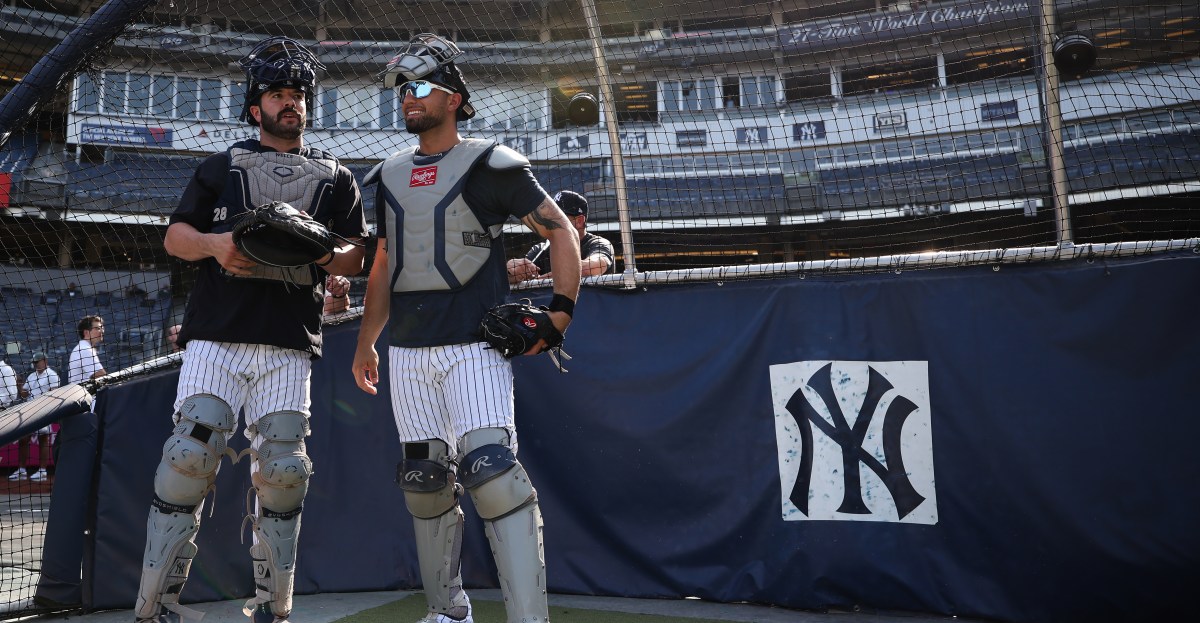
Among the most important positions around the diamond, there is a fair argument that catchers stand alone atop the list. Over their long history, the Yankees have been blessed with good backstops who can handle themselves with the gear and with the bat, with the likes of Bill Dickey, Yogi Berra, Elston Howard, Thurman Munson, and Jorge Posada leading the charge. While the Yankees may not boast those truly elite names behind the plate within the past decade, they have remained highly effective at manning the position, often with multiple players getting significant run.
In 2026, the job belongs to Austin Wells, with J.C. Escarra serving as a more-then-serviceable backup. Although neither of these backstops produce Piazza-esque numbers with the bat, they are both capable hitters, and have more recently shown themselves to be a potent duo on defense in particular. 2026 has been a historically good start on the pitching side of things in New York, and their catchers are playing pivotal roles in lifting their batterymates to new heights.
Wells, the clear starter at the position, has turned himself into a really solid all-around player. As a rookie in 2024, he showed legitimate potential with the bat, posting a 107 wRC+ in over 400 plate appearances, and although he took a slight step back last season, he made up for it with some pop, as he topped 20 homers for the first time. Wells didn’t go deep during his first week of regular season play, but his All-WBC-worthy performance in March signaled that he should remain no easy out.
Perhaps even more importantly, Wells has turned around his status as a defensive catcher. Originally seen as someone who may not stick behind the plate, both he and the Yankees have proved the skeptics wrong, as he has taken huge strides since arriving in the big leagues and seems to be thriving in the premium position.
During the 2025 campaign, Wells graded as one of baseball’s very best pitch-framers (12 framing runs via Statcast), while keeping himself afloat with average grades in other areas. Wells, who once seemed to be a bat-first catcher who had potential to end up position-less, now looks like one of the league’s steadier defenders behind the plate, all while handling his own on offense thanks to some legit thump with the bat.
While the Yankees should be satisfied with their first-stringer, whose 6.5 fWAR between 2024-25 ranks sixth among big league catchers, where they separate themselves is with their quality depth at the position.
Escarra, who initially made headlines as a feel-good story out of spring training last season, has also turned himself into a real force behind the plate. Despite only playing in only 40 games with the Yankees in 2025, his five catcher framing runs was bested by only seven catchers in baseball. Escarra established himself among the best defensive backstops in the minor leagues last season, and despite the limited work, one of the more adept pitch-framers in the sport. Even though ABS is now part of Major League Baseball, not every borderline call is going to be reviewed due to the challenge limits, and the Yankees have already stolen some strikes in 2026.
Beyond that, Escarra has a solid bat for backstop, where the bar is lower than most positions due to the inherent defensive value. His numbers will likely never jump off the page, with his 79 wRC+ last season, but he has solid discipline, posting a 11.2-percent walk rate, while limiting strikeouts and maintaining the decent potential to run into one now and then (even if you understandably discredit all spring training numbers, his three Grapefruit League bombs at least indicate that there is power in his bat). All told, Escarra stands as a more-then-adequate backup, as someone who can stay afloat with the bat, and potentially be a difference maker behind the plate.
The combination of the two catchers, Wells as a more significant threat with the bat and a surprising changing of the tide on defense, along with Escarra’s valuable glovework behind the plate, make the Yankees stand out at the position.* This is something they’ve excelled at in recent years, thanks to solid all-around value from the likes of Kyle Higashioka, Jose Trevino, and even all the way back to José Molina — skilled catching depth has legitimate value that can be hard to see with the naked eye.
*Since he’s the primary first baseman, we’re not even delving into the luxury of having Ben Rice around as a third catcher. But it sure is nice, especially because the Yankees and Rice have an interest in at least keeping that ability “in [his] back pocket.”
The success of Wells and Escarra has also allowed the Yankees to move some of their other catching depth in recent years for value elsewhere on the diamond. This includes moving Trevino for reliever Fernando Cruz, acquiring top pitching prospect Elmer Rodríguez in exchange for Carlos Narvaez, and adding the likes of David Bednar and Camilo Doval at last year’s Trade Deadline for prospects Rafael Flores Jr. and Jesus Rodriguez.
The 2026 season has gotten off to a roaring start on the pitching side of things for the Yankees, and it is only fair to credit their backstops for some of it. Two players, who were once a future non-catcher and a 30-year-old rookie have turned themselves into two of the sport’s best pitch-framers and game-managers, and as a result, an one of the game’s better catcher’s rooms.
Even if the offensive numbers remain where they are, the floor that Wells and Escarra provide on the whole is hard to overstate, and the Yankees pitchers who have dominated thus far would absolutely agree.