
Due to inclement weather, the Royals pushed back their Friday series-opening game against the Milwaukee Brewers to Saturday. They will now have a split doubleheader on Saturday against the Brewers, starting at 1:10 p.m..
The Royals are currently 3-3 entering the Brewers series, and the offense has gone through its share of ups and downs through their first six games. Once again, the Royals are making contact and hitting the ball well, ranking 10th in batting average. Furthermore, they have done a better job of getting on base and hitting home runs, two areas of inconsistency a season ago. They rank 15th in OBP and 16th in home runs hit. Last season, they ranked 22nd in OBP and 26th in home runs hit.
However, one area of relative weakness is runs scored. They rank 21st in baseball with 23 runs scored. They are tied with some big names such as the Phillies and Dodgers. However, for a Kansas City team with playoff aspirations, it needs to score more runs than the 651 it accumulated a year ago, which ranked 26th in baseball, according to Fangraphs.
One key player to the Royals’ offense this season is Salvador Perez.
The Royals’ primary catcher and captain will be entering his age-36 season and is coming off a season in which he hit .236 with a 95 wRC+. While those are slightly below-average marks, he did hit 30 home runs and collected 100 RBI. It was the third season he has collected 100 or more RBI, and his 30 home runs were his most since 2021, when he hit a Royals franchise record 48.
It’s been a much slower start for Salvy in 2026, though.
In six games and 25 plate appearances, the Royals captain is hitting .208 with a 74 wRC+. He has a home run, two runs scored, and an RBI. That said, his OBP is only .240, and his OPS is .615, 114 points lower than what he produced in OPS in 2025.
So what’s been Salvy’s issue? A lot can be credited to his trend in bat speed, and how that’s affected his ability to square up the ball early in the season.
Thus, let’s take a look at Perez’s bat tracking data via Statcast, explore some of his other Statcast percentiles, and what they could mean for Salvy’s outlook for 2026.
Salvy’s Bat Speed is Good, But Has Declined
The table below lists all the bat tracking data of Royals hitters with 1 or more plate appearances this season. While one can see Perez’s data, it also includes all other Royals hitters who have seen an at-bat in 2026. Salvy’s row is highlighted for reference purposes.
When it comes to average bat speed, Salvy ranks 7th of 13th qualified Royals hitters with a 72 MPH average bat speed. His hard-swing percentage also ranks 7th at 20%. He does this despite having a swing that is the second-longest on the team at 7.9 feet. Only Jac Caglianone has a longer swing at 8.4 feet.
Even though he is not Top-5 in bat speed, he is top-3 in squared-up percentage with a 42.4% mark through six games. Only Kyle Isbel (62.5%) and Isaac Collins (43.8%) have higher squared-up rates than Salvy. In terms of blast percentage, Perez lags a little bit at sixth with an 18.2% mark. That said, his blast rate is higher than Maikel Garcia‘s (12.5%) and Vinnie Pasquantino‘s (9.4%).
While the bat tracking metrics aren’t bad by any means, one would expect more from a team’s cleanup hitter. That said, how does his bat tracking data compare to a season ago? Well, let’s take a look at that below.
Last year, Salvy ranked 7th in average bat speed, but his 72.9 MPH bat speed was 0.9 MPH higher than his mark a season ago. His 30.5% hard-swing rate was also 10.5% higher, and his swing length has remained the same at 7.9 feet. That said, how do his squared-up and blast rates fare from a year ago?
Honestly, he’s actually performing better in those categories than a year ago.
Perez’s squared-up date in 2025 was 32.5%, and his blast% was 17.5%. For context, his squared-up rate is 9.9% higher this year, and his blast rate is 0.7% higher as well. Thus, while the overall results haven’t been good over six games, the bat-tracking data show that despite a slight decrease in bat speed, his ability to connect with the ball hasn’t changed much compared to 2025.
What Do the Other Statcast Percentiles Look Like?
For his other Statcast metrics, I used TJ Stats to illustrate how Perez has performed this year in key offensive categories and how they compare to last season.
Here’s a look at his 2025 Statcast percentile via TJ Stats.
.png.69c127c55a8b58faba595ceed6306728.png)
Even though he had a .311 wOBA, his xwOBA was much better at .383. In fact, the latter ranked in the 91st percentile while the former ranked in the 43rd percentile. Thus, there was a tremendous discrepancy between Perez’s batted-ball skills and the actual results.
Honestly, the skills Salvy showed, especially in terms of batted-ball ones, were still incredibly elite. He ranked in the 88th percentile in PullAir%, 91st percentile in barrel rate, 88th percentile in Max EV, and 77th percentile in 90th EV. When Perez connected with the ball, he often had power behind it and pulled it in the air, which is what one wants to see from a power hitter in the cleanup spot.
Here’s an example of Perez absolutely launching one last year against the Washington Nationals pitcher Cade Cavalli, to the Royals’ Hall of Fame.

Now, let’s take a look at what Salvy has done through 25 plate appearances this season, via TJ Stats.
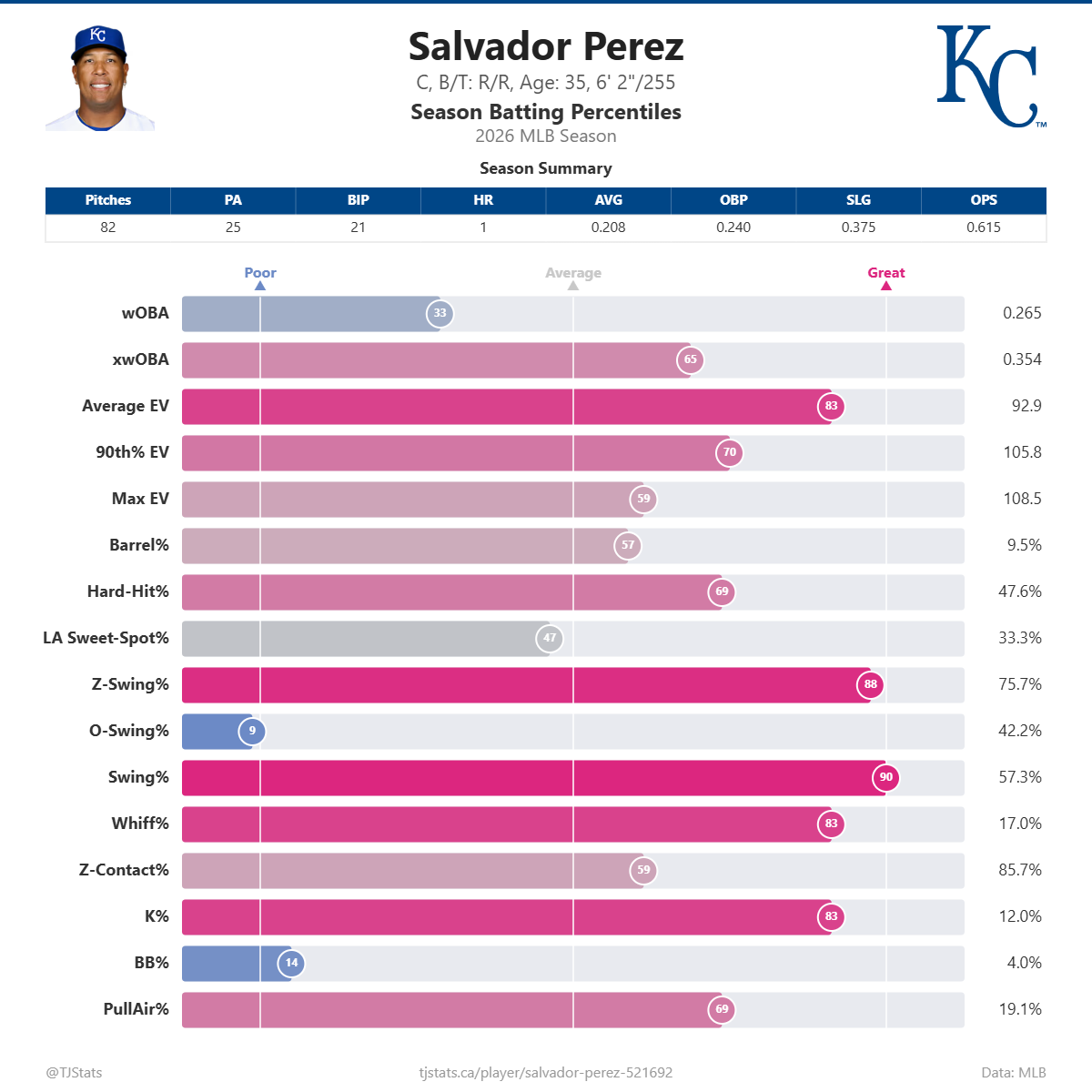
In some categories, Perez has seen some regression. His Pull Air% is slightly down at 19.1% (1.4% difference), and his 108.5 Max EV is 6.3 MPH lower than his 2025 mark. Furthermore, his 9.5% barrel rate is 4.9% lower than his 2025 barrel rate and ranks only in the 57th percentile. While that’s not bad by any means, it’s not the elite ranking that Royals fans were used to seeing from Salvy in the past.
That said, there are some areas where we have seen some early improvement from Perez.
His 12% K% is 7.7% better than a year ago, and his 17% whiff rate is 9.9% better as well. He’s doing this despite having a similar swing% this year (57.3% to 57.4% in 2025). Thus, Salvy is doing a better job of making contact at the plate this year, even if it has been at the sacrifice of some power initially. At the very least, that shows that he’s seeing the ball better and that he’s doing enough to put the ball in play.
Furthermore, Perez’s expected numbers aren’t down either. His .354 xwOBA isn’t as impressive as his .383 mark in 2025. However, it still ranks in the 65th percentile, and his xwOBA is 89 points higher than his actual wOBA. Salvy is still hitting the ball hard and showing power potential. His lone home run of the year, in Atlanta against Reynaldo Lopez, illustrates that and can be seen in the clip below.

When it comes to the Statcast percentiles, there are some signs of regression, especially in terms of exit velocity and barrels. That said, it’s still early in the year, and his improvement in contact skills this year could help him gain more power over the course of the year, especially as the weather heats up and he gets more settled in at the plate.
Final Thoughts On Salvy’s Start?
Overall, I do not think there’s much for Royals fans to worry about with Salvy this year.
Yes, the average, OPS, and wRC+ are down. However, those are results, and we have had such a small sample size. It’s hard to justify those results as an indicator for future success when there are fewer than 30 plate appearances (especially with a proven veteran like Perez).
The bat speed is a tad concerning, but I think the slight decline is more due to settling into a new season than a sign of age-fueled decline. The squared-up and blast rates show that Perez is still connecting with the ball decently at the plate, despite the slight regression in the speed of his swing. My guess is that we will see an uptick in Salvy’s swing speed soon, especially once he gets into a more set routine and gets more days at DH or 1B.
Unfortunately, Perez wasn’t able to get that on Thursday due to the Carter Jensen “tardiness” situation.
Granted, I think the situation was way overblown by the national media and probably not handled the best by the Royals (did we really need Jensen and Vinnie to be making statements to the media about it?). What should’ve been a “there was a personal issue, and we’ve handled it internally” from Matt Quatraro at the postgame presser has spun into a national story, even getting coverage on TMZ (which is wild).
Conversely, I understand the Royals’ frustration with Jensen because Salvy needs to save his energy for his bat, especially as the club’s cleanup hitter. More days behind the plate are only going to affect that ability, and that doesn’t help their playoff chances.
Thus, it will be interesting to see if, once the fog from this fiasco clears, we see more days from Jensen behind the plate to give Salvy a spell while keeping his bat in the lineup. The metrics and Statcast data are fine for Perez. However, the Royals also need to keep him fresh and healthy, and more time at first base and as a designated hitter is necessary to accomplish that goal.
Once he gets those “off days”, I guarantee that we will not just see the bat speed, exit velocity, and barrels improve, but the average, OPS, and wRC+ as well.