
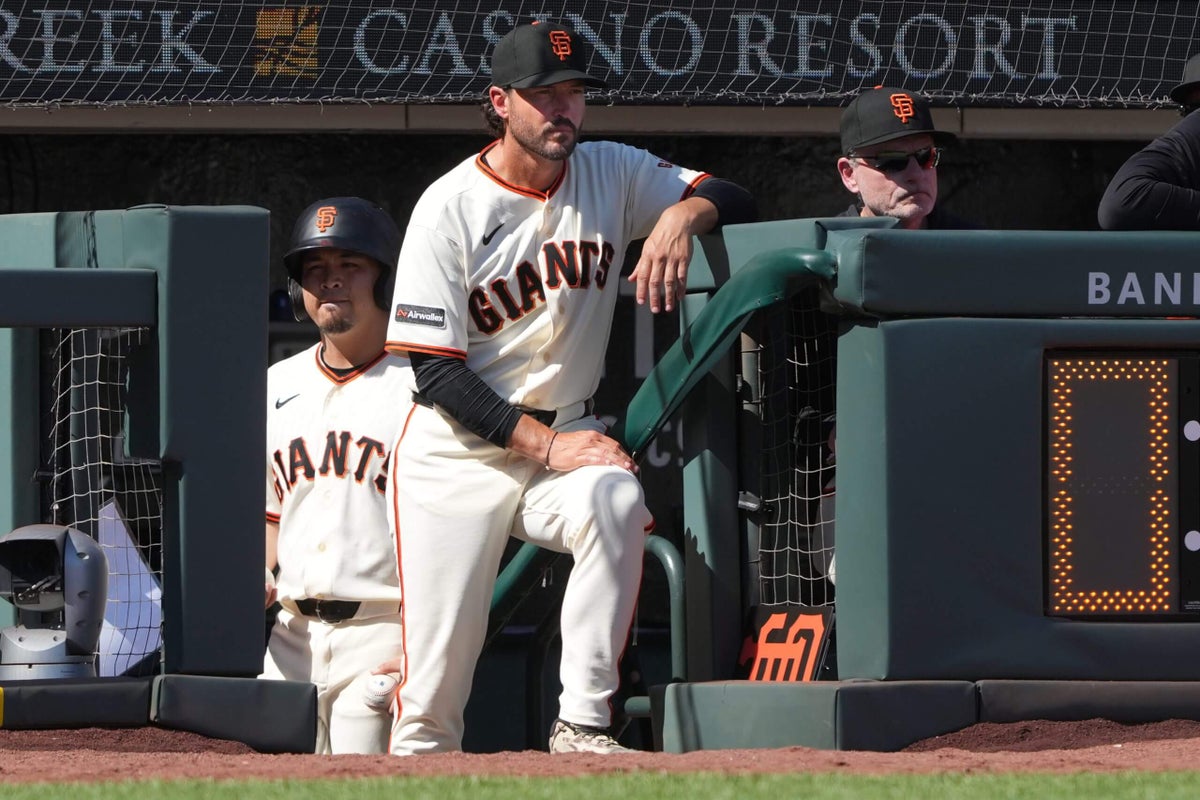
The San Francisco Giants’ bench did not factor into Friday night’s 10-3 loss to the New York Mets. There wasn’t a pinch-hitter, pinch-runner or defensive replacement involved. The Giants turned in a lineup card with nine batters before the game started, and they used only those nine batters. They’ve used just one pinch-hitter through the first eight games of the season.
This means it’s the perfect time to talk about the composition of the Giants’ bench. You don’t want the topic to come up when emotions are high, after the best or worst pinch-hitting decision of your life. Here was a game where the all-righty bench didn’t make a lick of difference. There will be more of them.
There are two ways to get used to the idea of an all-right-handed bench. The first is to remember that it won’t be like this all season. There will be injured list trips and reevaluations, slumps in the majors and torrid hot streaks in the minors. The left-handed hitting Grant McCray walked more than he struck out in the Cactus League, and he’s doing similar things in Triple-A Sacramento right now. Think about how many problems a lefty-swinging, speedy center fielder could solve on his own if he could hit, even a little bit. That’s just one of the players trying to mess with the all-righty bench, and one of them will eventually be successful. This is temporary.
The second way to get used to the idea is to revisit what benches are for in the first place. And the best way to do that is by exploring one of my favorite fun facts in all of baseball history. There’s a wide, wide, wide spectrum of how benches can be used, and the strategies don’t correlate much with team success or failure.
Start with the team that used more pinch-hitters than any other in baseball history, the 2021 Giants. Oh, how they loved their pinch-hitters, setting an all-time record for pinch-hit home runs (18). The Giants’ pinch-hitters didn’t exactly rake, collectively hitting .199, but their timing was superb. The strategy clearly came down from the front office, as the Farhan Zaidi-led team from 2019 was the third-busiest pinch-hitting team of all time. Only the 1965 Mets were between the two.
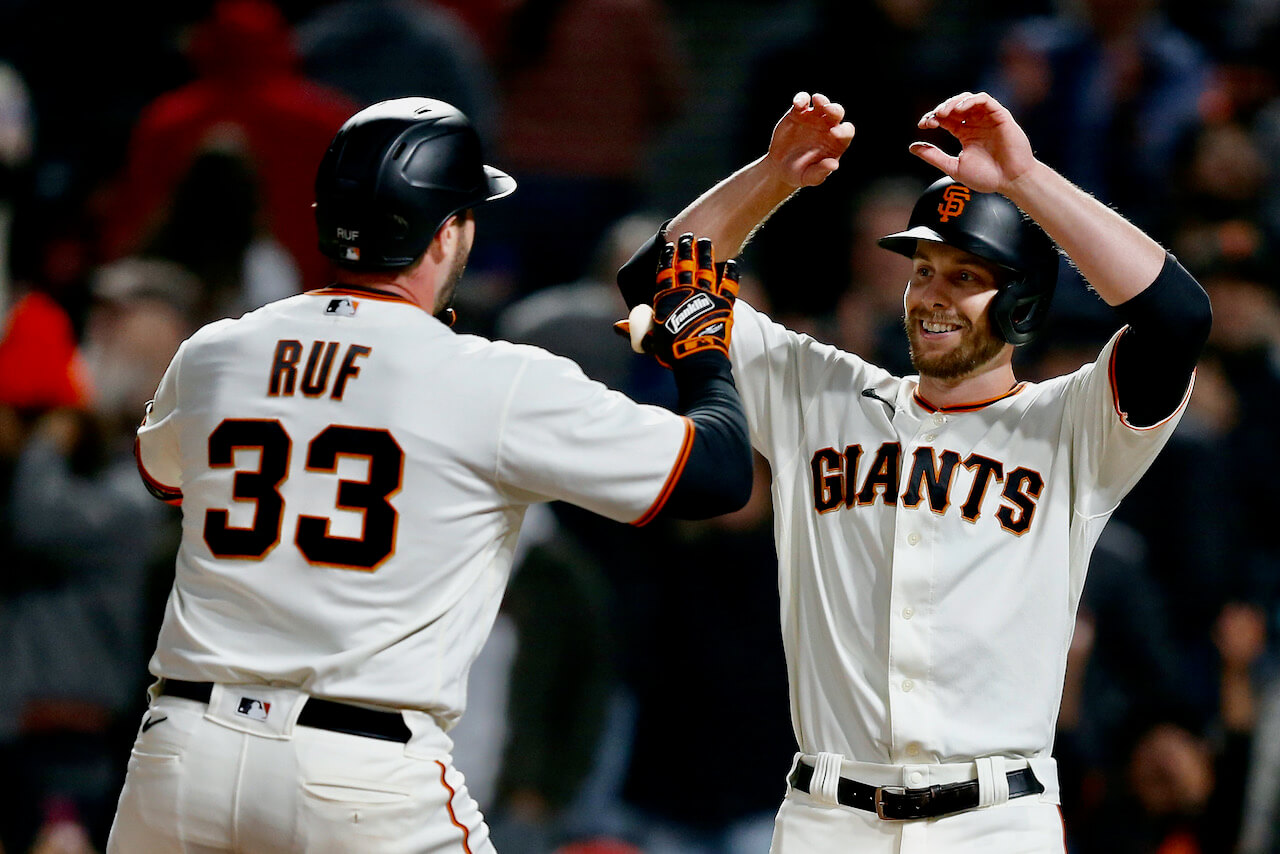
Austin Slater and Darin Ruf were frequently employed as pinch-hitters in 2021, and both had memorable moments in that role. (Lachlan Cunningham / Getty Images)
When it worked, the 2021 pinch-hitting strategy was delirious fun, with a they-can’t-keep-getting-away-with-this feeling that lasted for the entire regular season. So there’s one way to build an effective bench: matchups, matchups, matchups, with a manager who isn’t afraid to hurt feelings by sending up a pinch-hitter with the bases loaded in the fourth inning.
The ’21 Giants being pinch-hitting maniacs is only half of the fun fact, though. You need the other end of the extreme for the full picture, and you find it with the 1993 Toronto Blue Jays. You might remember that team as the one that would have lost the World Series to the Giants if the Colorado Rockies could have won a single stinking game against the Atlanta Braves, not that any of us are still thinking about these things 33 years later.
Those Blue Jays were also memorable in another way, setting a record for the fewest pinch-hitters in major-league history, using just 29 all season. In the 60-game 2020 season, 29 pinch-hitters would have tied for the 12th-fewest used by a team. Even if you crammed all 162 games of their 1993 season into the pandemic-shortened season, the Blue Jays still would have avoided pinch-hitters more than the average team.
The 1993 Blue Jays and 2021 Giants combine to make the fun fact, then. The team that used the fewest pinch-hitters of all-time? Wildly successful. They won the World Series, and we’re still talking about them today. The team that used the most pinch-hitters of all-time? Wildly successful. They won the most games in franchise history, and we’re still talking about them today.
It’s a lot of context for an obvious point: Pinch-hits are way, way down on the list of what makes or breaks a team’s season. It’s fun to play a Wild Draw Four on top of another manager’s Reverse, but it’s not what managers would prefer to do, given the choice. The ’21 Giants used their bench to make up for what they didn’t have. They had regulars who couldn’t hit left-handed pitching (Mike Yastrzemski) and bench players who were designed in a laboratory to hit left-handed pitching (Austin Slater). They would have preferred to carry Barry Bonds, for example, who could hit lefties and righties. (He’d occasionally hit them both at the same time, you know.)
The ’93 Blue Jays didn’t have this kind of dilemma. They had a lineup filled with Hall of Famers and Hall of Just Missers. The Hall of Famers included Paul Molitor, Rickey Henderson (acquired at the deadline) and Roberto Alomar. The Hall of Just Missers included Devon White, John Olerud and Tony Fernández, three of the best to never get inducted. Manager Cito Gaston didn’t pinch-hit for any of them. Heck, Gabe Kapler wouldn’t have pinch-hit for any of them. Look at those names.
That’s the kind of roster that every team wants, and it’s the one the Giants are going for right now. They’re turning their noses up at pinch-hitters. Let the teams without everyday players worry about that.
You might have spotted the obvious problem, here, which is that even in the most generous evaluation of the Giants’ current lineup, they’re probably three Hall of Famers short of the ’93 Blue Jays. It’s easy to send up only 29 pinch-hitters with a team like the ’93 Blue Jays.
Still, if the idea is that it’s better to have nine regulars and a limited bench than five regulars, four platoon-hitters and a meticulously planned bench, the Giants might have those regulars. It’s been something of a slow rollout for the unchanging perma-lineup, as Rafael Devers’ hamstring has kept him from playing first base. The apparent plan, though, is for the same nine hitters to take most of the at-bats all season. It’s a strategy that’s worth a try in the first month of the season.
The Giants can go back to the status quo if they don’t like what they see. Maybe Harrison Bader shouldn’t face as many right-handed pitchers, after all. Maybe Jung Hoo Lee will never be able to hit major-league lefties. Maybe Heliot Ramos’ eventual future is as a lefty-terrorizing platoon bat, but even you can understand why the Giants don’t want to assume that just yet. Lots of teams want to be the ’93 Blue Jays. Lots of baseball writers want to get rich by writing about baseball. Eventually reality catches up, and maybe the pinch-hitters will start flowing when it’s June and the lineup is festooned with hitters who struggle against same-side pitching.
Maybe. But it’s also possible that this aggregation of everyday players … plays every day. There will be injuries, and maybe the replacements will need to platoon. Barring that, though, it’s hard to imagine the Giants pinch-hitting for Ramos in the ninth against a right-handed closer, just like it’s hard to imagine them pinch-hitting for Lee against a left-handed specialist in the ninth inning. Those two are getting the Matt Chapman and Rafael Devers treatment, respectively. It’s temporary and contingent on them hitting same-side pitching, but they’re getting that kind of respect so far.
The best teams shouldn’t lean on their bench. MacGyver doesn’t break out of jail with a paper clip and envelope adhesive because he thinks it’s cool; he does it because he doesn’t have the key. If he could just get the key, it would save everyone time, but he’s forced to improvise. A perfect major-league team would have five bench players, and they would never pinch-hit:
• Backup catcher
• Backup infielder (who can play shortstop)
• Extra outfielder (who can play center field)
• Guy who can hit a ball 500 feet
• Guy who can steal a base
Handedness? Beside the point. That’s the platonic ideal for a bench on a team with nine everyday players. And sometimes the guy who can hit a ball 500 feet is the extra center fielder, or the guy who can steal a base is also the backup infielder, et cetera, which frees up bench spots to play with. Sometimes you get Daulton Varsho, and he can do all of the above, give or take. Every bench should have all of the above covered, though. The 2026 Giants are currently in compliance, even if the reserves are all right-handed.
The biggest downside to an all-righty strategy is that it cedes the advantage to the funkiest of the funky right-handers, pitchers like Tyler Rogers, Adam Ottavino, Chad Bradford and others. Against submariners and other weirdos, it would be nice to send a left-hander up to pinch-hit. Those kinds of pitchers are rare, though. It would be a much bigger problem with an all-lefty bench, with every bullpen having at least one oddball left-handed release point.
I’m skeptical the Giants actually have the personnel to maintain this strategy all season, but the reward is worth the risk early in the season. Worry less about handedness and more about what each player on the roster can or can’t do. This year’s team is the anti-2021 Giants, for better or for worse. If that doesn’t sound promising, then they’re the anti-2021, 2022 and 2023 Giants, who had to duct-tape players together because they were forced to. They didn’t want to do it. They had to.
This team doesn’t feel like they have to. They’re gambling that the continuity and consistent reps are worth more than the occasional late-inning platoon advantage. The odds are against it working all season, but it’s a dream worth chasing. The ’93 Blue Jays might not have been a match for Bill Swift and smilin’ Trevor Wilson, but they’re a baseball anomaly for all the right reasons. They’re what every baseball team, Giants included, are always attempting to build.