
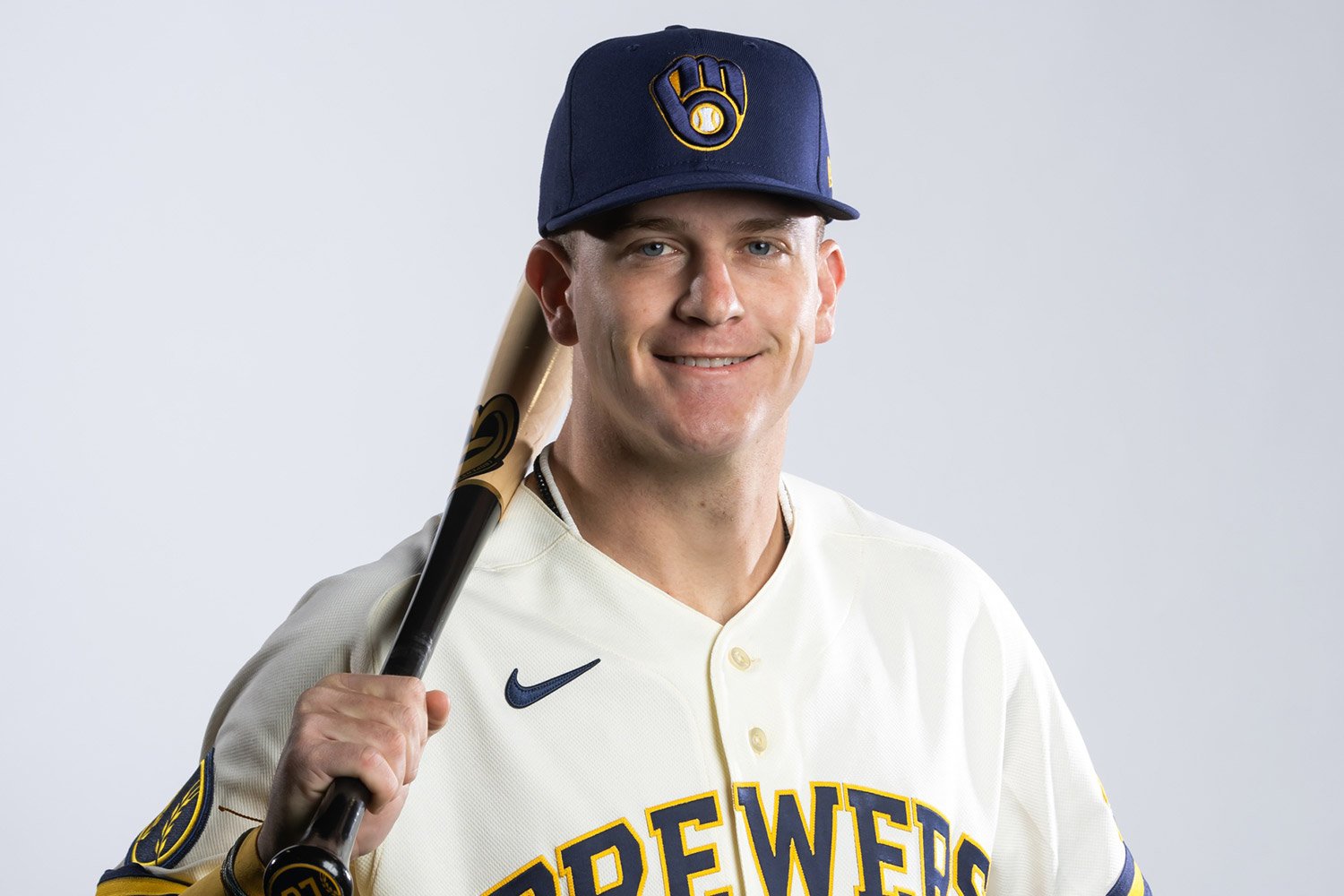
After reports last week that the Brewers were nearing an eight-year, $50.75 million extension with shortstop prospect Cooper Pratt, the club announced the deal on Friday afternoon. Pratt’s deal also includes club options for the 2034 and 2035 seasons, which could keep the 21-year-old in Milwaukee for up to the next 10 seasons.
“There have been so many people that from our perspective have had nothing but positive things to say about Cooper throughout his tenure as a Brewer, and even before he was a Brewer,” president of baseball operations Matt Arnold said. “So all of the arrows pointed in the right direction for us to commit to something like this.”
“We’re super excited to be able to do this with the Brewers and to be able to hopefully be a longtime Brewer, for sure,” said Pratt, who rejoined the Nashville Sounds over the weekend after traveling to Milwaukee to complete his physical and sign the deal.
It’s the second investment the Brewers have made in Pratt, who is ranked by Brewer Fanatic as the club’s No. 4 prospect. Milwaukee crafted its draft strategy around him in 2023, saving its bonus pool money in the first few rounds and convincing him to forgo his college commitment with a $1.35 million bonus as its sixth-round pick.
This extension reaffirms what was true three seasons ago: the Brewers are high on Pratt’s makeup. Despite his youth, Pratt has a high baseball IQ and feel for the game, which he pairs with well-rounded athleticism, even if none of his tools have developed into standout skills just yet. He’s already a solid defender, baserunner, and contact hitter.
With that profile, it’s unsurprising the club sought to extend Pratt through his prime seasons. The timing, however, was unusual. Pratt was in just three games into his first stint at Triple-A, and the Brewers have a full big-league infield in front of him. He didn’t appear especially close to a promotion and did not need to be added to the 40-man roster until after the 2027 season.
The extension forced the Brewers to select Pratt’s contract and option him to Triple-A. Arnold said the contract will not expedite his timeline to Milwaukee, which means Pratt will burn his first option season and spend most of the deal’s first year in the minor leagues. It’s an unusual upfront concession, but Arnold indicated that the length of the contract and Pratt’s potential make it worthwhile.
“I think when you talk about a deal that has a potential to last for 10 years, it’s not just something that we want to think about in the moment,” he said. “Certainly, there’s an opportunity there to bring a guy up if we want to, but we don’t have to force it. He hasn’t been in Triple-A that long. We want to continue to let him develop there at his own pace, but we want to take the long view here with Cooper.”
While Pratt’s glove at shortstop gives him a high floor and could make him a capable big-leaguer right now, more time in Triple-A may be best for his offensive development. His strong bat-to-ball skills helped him post a 123 DRC+ with Double-A Biloxi last year, according to Baseball Prospectus, but reducing his chases outside the strike zone and leveraging his 6-foot-4 frame for more power will make the difference between a glove-first infielder and one of the sport’s most well-rounded shortstops.
“I think that we believe in the bat,” Arnold said. “We believe in the glove, certainly. And again, this guy is really toolsy, too. He’s very athletic. He’s a big, physical kid, so we think there’s a chance to grow into some power, and he can really run. So when you have that kind of athletic foundation, it’s a really good thing.”
“There’s always something that you can get better at,” Pratt said. “There’s always room to improve at some position of the game. And if I can improve every year at something, then I’ll be perfectly fine.”
It was also an unusual deal for Pratt’s agent Scott Boras. His clients are typically known for avoiding extensions, preferring to enter free agency as scheduled to pursue a market-value contract.
Pratt’s extension delays his free agency, but in this early stage of his career, he felt that squaring away the business side of the game for up to the next decade would help his on-field focus and development.
“That was one of the biggest reasons why I kind of decided to do this,” he said. “I can just play and not have to worry about other stuff, all of the transactional stuff, and just play. When I do get called up to the show, I can just be ready to play in the show and not worry about any other outside things.”
“For Cooper, how and why he played had a lot to do with this decision,” Boras said. “What it meant for him to move ahead and to advance to the big leagues, in his mind, quicker. What it meant for him to approach the game in a way that allowed him to develop appropriately.”
Boras believes the stability secured by this contract could better position Pratt for that payday down the line.
“We want to optimize Cooper,” Boras said. “And I felt after listening to him and his family that this was a deal that will allow him to be his best. And if we make Cooper his best, contractually, the risk on the back side of this will allow us optimization in the next contract. The risk of seven or eight years of play before [free agency] happens is immense. But I also know that the height of his performance, after listening to Cooper, will be enhanced because he made this decision.”
The Brewers want Pratt to be a linchpin in their infield for years to come, and Pratt wants to develop into the best player he can be. Both sides feel his contract accomplishes those goals.
“I feel like in my heart I made a good decision,” Pratt said.