
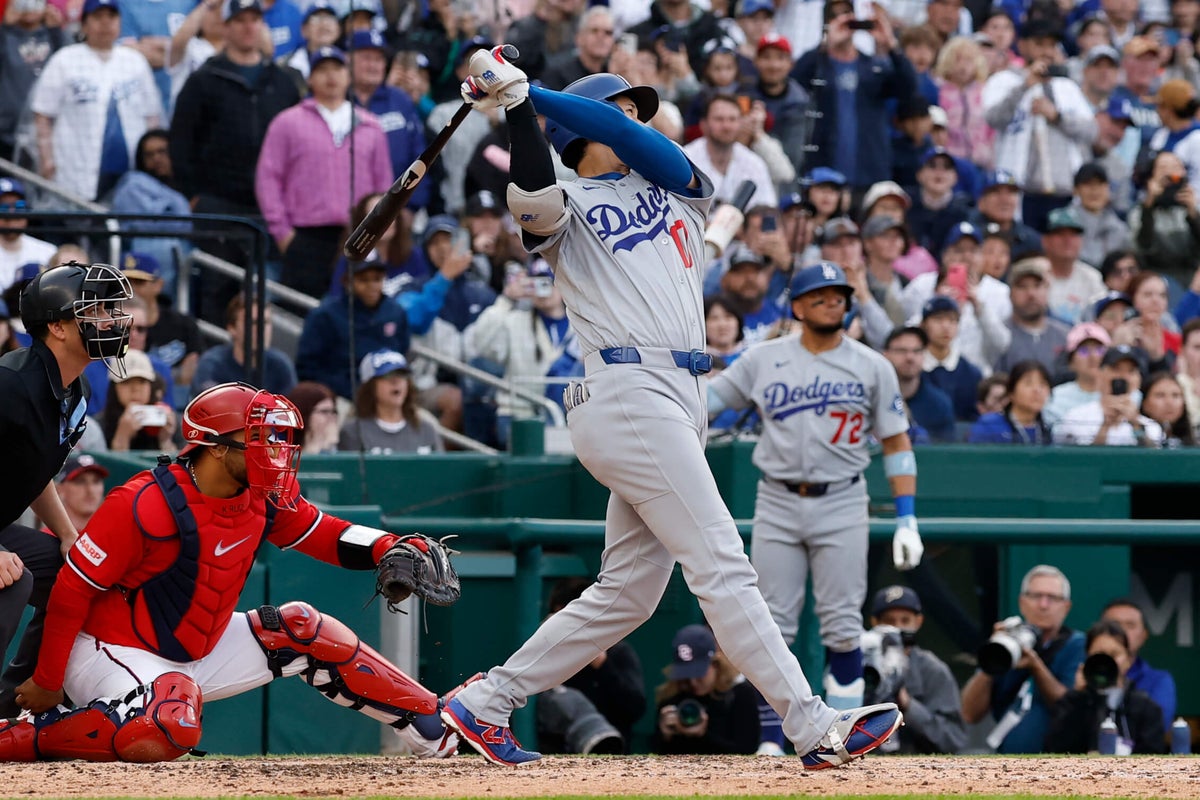
WASHINGTON — A few hours after finding out they’d be without star shortstop Mookie Betts for at least the near future, the Los Angeles Dodgers rallied for their largest comeback win in nearly a calendar year. After falling behind 6-1 after four innings, the Dodgers surged back with seven unanswered runs to stun the Washington Nationals 8-6 on Sunday afternoon, completing their second sweep of the season.
“We just didn’t quit,” manager Dave Roberts said. “It is a mark of our ballclub that every out matters, every game matters.”
Bring ’em in, Santiago! pic.twitter.com/V0YBGyUudF
— Los Angeles Dodgers (@Dodgers) April 5, 2026
The Dodgers (7-2) entered the series with two primary concerns. Roki Sasaki was one of them. He lumbered through five innings Sunday, and while his line indicated a worse showing than his overall performance, there are still a number of things he’ll need to clean up. His fastball velocity was down to roughly 96.5 mph, and his forkball was virtually ineffective. Perhaps that’s in correlation to the addition of a third pitch to his arsenal, a combination of a slider and cutter that Sasaki has increasingly used in his first two outings. It could also be a reflection of Sasaki’s fluctuating confidence as he searches for consistent command.
There was (perhaps overblown) discourse regarding the Dodgers’ slow start, specifically at the top of the order. After this series, that’s been put to rest. The Dodgers scored 31 runs in three days, and their 16 total homers lead the majors.
It’s been a solid start to the season for the reigning champions. Here’s what we learned about them over the weekend.
Why platoon shortstop instead of second base — and what it says about Alex Freeland
Before Sunday’s game, Betts was placed on the 10-day injured list with a right oblique strain, and the Dodgers recalled Hyeseong Kim from Triple-A Oklahoma City. The Dodgers do not have a timetable for Betts’ return and while Roberts was optimistic Betts would miss less time than the standard four to six weeks usually designated for oblique strains, such injuries are both delicate and finicky, making timetables difficult to project.
The Dodgers will now use Kim and Miguel Rojas in a platoon role at shortstop, while Alex Freeland sees the majority of the reps at second base. That might be surprising, given that Kim has played much more second base in the majors (278 innings) than at shortstop (46 innings). But the Dodgers want to see as much of Freeland as possible. Part of the reason Freeland made the team over Kim coming out of spring was because the Dodgers believed it was the best opportunity for him to see consistent playing time — something that won’t be guaranteed when a few of the team’s veterans return from the injured list.
The playing time won’t always shake out that way, and Kim should see ample reps, too. There will be some games when Roberts will sit Freeland in favor of the matchup. But those instances are expected to be few.
“I still want to try to get Alex some at-bats right handed,” Roberts said. “Right now, we just feel he’s a much better hitter from the left side. But yeah, I would say that the platoon more so is (at) short. But I also see Miggy getting at-bats potentially at short if a right-hander (is starting).”
The Dodgers know what Freeland can do in Triple A and feel the 24-year-old has nothing left to prove there. They would like to know what he can do as a major-league starter, specifically offensively. Those reps will eventually be harder to come by, with both Tommy Edman (ankle) and Kiké Hernández (elbow) slated to return in late May.
“The expectation is to go out there and play great defense, hit ninth in the order, take great at-bats, help us win baseball games,” Roberts said of Freeland at the end of spring training.
Freeland now has the chance to do that on an every day basis.
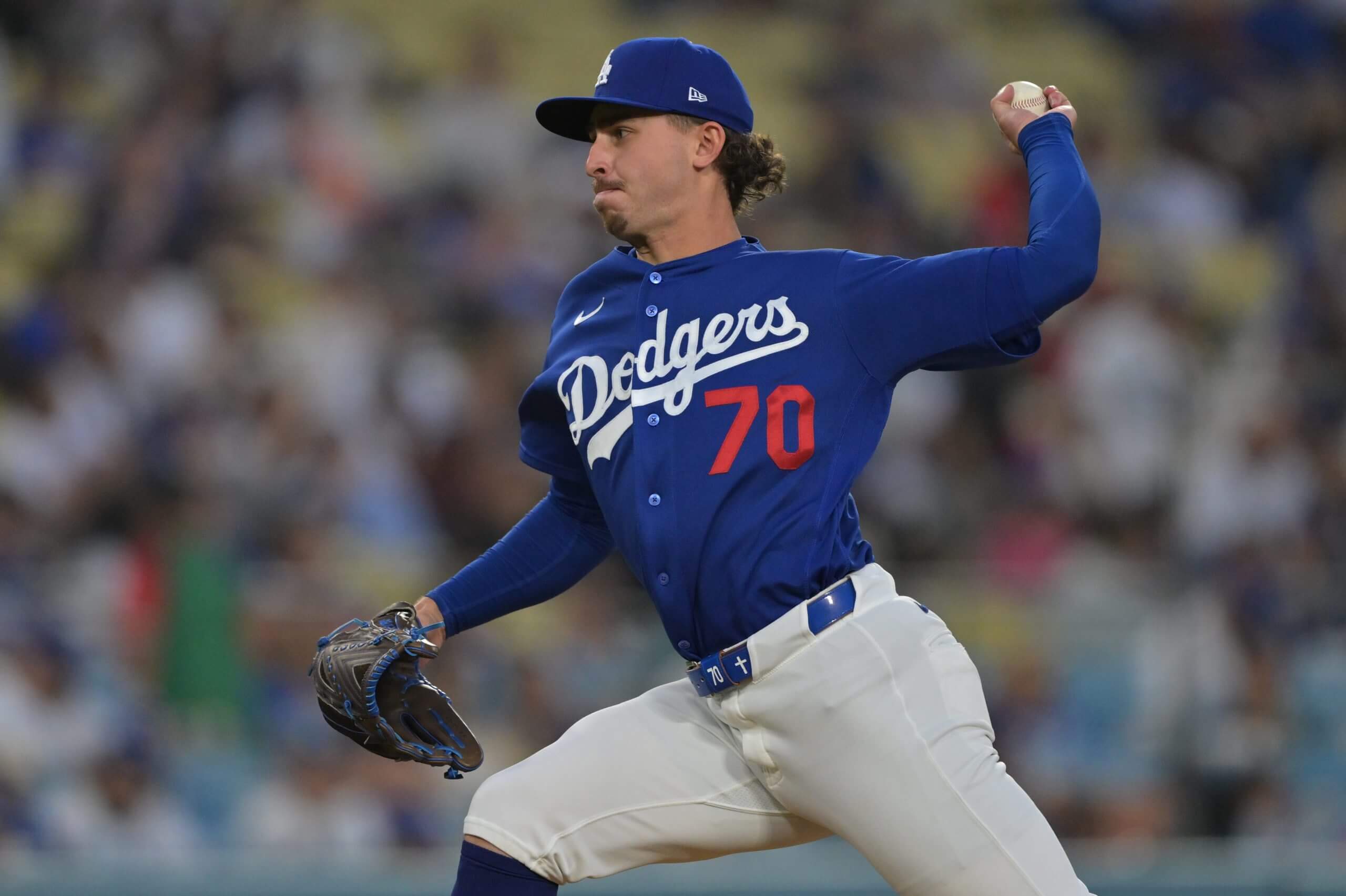
Justin Wrobleski, who threw 60 pitches in a relief appearance last week, is scheduled to make his first start of the season Monday. (Jayne Kamin / Oncea-Imagn Images)
The plan for Justin Wrobleski and the hybrid six-man rotation
After serving as a piggyback behind Sasaki through the first turn of the rotation, Wrobleski is set to make his first start of the season Monday against the Toronto Blue Jays.
The Dodgers had toyed with the idea of using a six-man rotation, or at least a version of one, dating to start of spring training. They decided to implement it because they believe it’s the most effective way to avoid overusing several starting pitchers who are either coming off injury or logging long seasons. With pitching injuries most prevalent in March and April, inserting Wrobleski when the calendar warrants it provides an extra day of rest for the remainder of the rotation. A favorable schedule in April — one that includes a scheduled day off on four out of five Thursdays, allows for the Dodgers to be even more strategic.
While the extra rest day will help all of the starters, the Dodgers will be especially mindful of Shohei Ohtani’s usage, especially in the season’s early months. The Dodgers plan to start Ohtani on six or seven days of rest. Similar to last season, they will try to structure his starts to line up with a scheduled off day. Ohtani’s next start — Wednesday’s series finale against the Blue Jays ahead of an off day Thursday — mirrors that philosophy.
That would not be possible without Wrobleski, who was able to plug behind Sasaki in the rotation after throwing four innings of relief following Sasaki’s first start of the season last Monday. Wrobleski logged 60 pitches and could be built up to roughly 75 for Monday’s start. He acknowledged the role is unorthodox but said his experience coming out of the bullpen last season helped him quickly adjust, and he complimented the coaching staff’s communication.
“They do a great job, even when you’re in a normal relief role, to kind of let you know throughout the season the plan for the day,” Wrobleski said. “You can’t script a baseball game, but for the most part, I’ll have a good idea of when I’m going in there.”
Because the Dodgers have another off day April 16, they likely won’t need to make a second turn through the rotation with six starters. They could treat Monday’s game as a spot start for Wrobleski and revert him to a piggyback option, especially with Sasaki still battling through command and execution issues. The Dodgers still view Wrobleski as a traditional starter in the long term, but they’ll utilize his flexibility for at least these first few weeks — and maybe even until Blake Snell (who threw another bullpen at Dodger Stadium while the team was away) is activated off the IL. The Dodgers are estimating a mid- to late-May return for Snell.
“I’m just staying ready for whatever role they want me in,” Wrobleski said. “Hopefully, eventually that turns into the rotation, but if it doesn’t, same kind of deal. It’s just about focusing on what I can do to get better each time out.”
How Dalton Rushing is learning to produce with limited playing time
Rushing could have been vexed by his at-bat in the top of the fourth. Down 0-2, he thought home-plate umpire Willie Traynor heard him call time. It was made evident he did not when Traynor gave Rushing a pitch-clock violation, resulting in strike three.
His next at-bat fared much better. Rushing whacked a two-run homer into the Nationals bullpen to cut Washington’s lead to 6-3 in the sixth — a pivotal step in the Dodgers’ mighty comeback.
Watch it fly, Dalton! pic.twitter.com/RsEbc70vc1
— Los Angeles Dodgers (@Dodgers) April 5, 2026
Rushing isn’t expected to see a ton of playing time. He is the backup catcher behind Will Smith, with Roberts having no true way to work in additional at-bats. It’s a role Rushing worked hard to adjust to, and he’s been candid that it has not come easy. But Rushing does feel he has a much better understanding of the role than he did last year, and it’s starting to show.
“It’s hard. It is. Like I said a lot last year, it’s something I had never done before,” Rushing said. “The comfort, holding confidence when you step in the box regardless of how many days between your starts — it’s not easy. I feel as if this year I have a better plan, a better idea of when I’m going to be playing.”
His preparedness, and his growing maturity, has impressed Roberts.
“The conversations he’s had with the coaches is better,” Roberts said. “The emotion spikes are less. Even in-game, you have a couple bad at-bats, but you still focus on getting your pitcher through the game, that’s growth. … This is his lot right now, as far as role, and he’s adjusting. It’s not an easy adjustment but I do see some improvement there from Dalton.”
Continuing that progress will be essential. Rushing has made just two starts this year, both as Sasaki’s batterymate. Those have come with their own difficulties given Sasaki’s struggles to start the year. But the early showings from Rushing, especially mentally, have been encouraging. While he’d certainly prefer more playing time, he’s learning to embrace how to be successful as a role player.
“There’s no holes on this team,” Rushing said. “You look at our bench, you look at our starters — we have some of the best players on the field obviously starting games. We also have some of the best players on the bench. It’s part of being a Dodger. You swallow your pride and do whatever you can to help the team win.”