
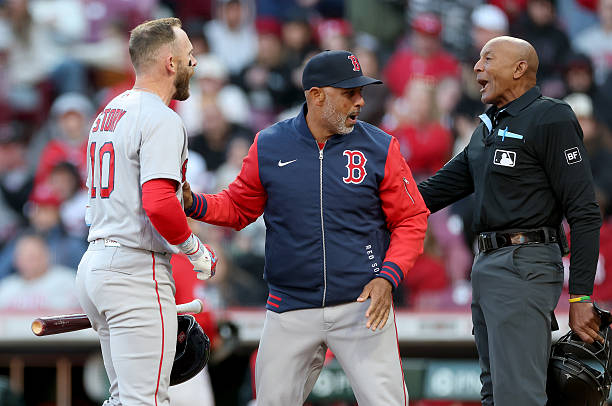
 Red Sox pitcher Trevor Story (#10), Red Sox manager Alex Cora and umpire CB Bucknor in the 8th inning during the game between the Boston Red Sox and the Cincinnati Reds at Great American Ball Park. Cincinnati, OH. March 28th, 2026. Photo courtesy of Andy Lyons/Getty Images.
By Jaime Suárez Del Valle
Boston University News Service
Bottom of the sixth with two outs, Cincinnati Reds third baseman Eugenio Suárez is up to bat against Boston Red Sox pitcher Ryan Watson, on a 1-2 pitch count. Watson’s next pitch is ruled a strike by umpire C.B. Bucknor. Last year, this would have ended the inning. This season, however, Suárez can challenge the call with a simple tap of his helmet, summoning the inaugural Automatic Ball-Strike (ABS) challenge system.
“That’s out of the zone, the inning continues!” exclaimed play-by-play commentator John Sadak amid the crowd’s roar as the video board showed Watson’s pitch out of the zone. With the challenge accepted, the pitch count is now 2-2.
Next pitch: same story. Bucknor calls a strike. Suárez repeats his head tap, back to the videoboard.
“Outside!” yells Sadak while reacting to the pitch falling out of the zone yet again. The crowd goes wild as Sadak adds, “the loudest cheers of the game come on back-to-back challenges!”
Just like that, momentum had flipped in Suárez’s favor — before he grounded out in the next swing.
The Reds beat the Red Sox in extra innings 6-5, but the game was not just a win for Cincinnati. It was a small win for the ABS challenge system and the MLB: a league attempting to innovate America’s favorite pastime.
The ABS challenge system, as described by Anthony Castrovince for MLB.com, is the “happy middle ground” between automatic robot umpires and the nuanced, human judgment by the plate umpire. After trial runs in the minor league level and Spring Training, it has finally moved up to the Majors this season. Simply put: a pitcher, batter or catcher can use one of the team’s two challenges (through a head tap) immediately after a pitch if they believe the umpire’s call is wrong.
Once initiated, an animation made using multiple T-Mobile cameras will play both in the videoboard for the crowd and in the broadcast for home viewers. The video will play an accurate recreation of where the pitch landed relative to the batter’s strike zone. If successful, the team retains the challenge and can continue doing so until they lose both.
Suárez’s consecutive challenges were not the only complaints filed against Bucknor’s calls that day, as six of eight challenges overturned his calls. As of April 2 at noon, ABS challenges have had an overall 55% overturn rate (189 out of 343 attempts).
With the coaching staff completely separated from the challenges, players have finally gotten the opportunity to disagree with calls in a way that does not put them at risk of ejection. Not only that, this dynamic adds another level of entertainment for the audience, made clear by the loud cheers following Suárez’s victorious challenges. Fans were also surveyed during Spring Training, per Castrovince, and results showed 72% believed the ABS system had a positive impact on their viewing experience.
This leaves MLB umpires, a group notorious for game-altering calls and tossing enraged players and coaches in the aftermath, between a rock and a hard place. From that same Spring Training survey, 69% of fans agreed with a complete use of ABS, rendering human umps obsolete. The caveat is that very few calls are actually being challenged, with Tim Capurso for Sports Illustrated writing:
“1.4% of all pitches were challenged during Spring Training, a number that lines up with data collected by MLB from the 2025 Triple A season.”
This, combined with the fact that only 343 out of thousands of pitches have been challenged, means that umpires are still doing a fairly good job, and players recognize that.
This innovation built off of the league’s success in rolling out the pitch clock a few years ago. According to Eric Fisher with Front Office Sports, MLB commissioner Rob Manfred said last fall that the accuracy of their prediction of the pitch clock’s effect on the game, based on constant testing and research, meant he could go back to the owners with this proposal and say “we can change again, and we can do it in a way that’s going to make your business better.” This is true, as 2025 saw a substantial rise in attendance and televised viewership, partially attributed to the quicker pace of the game brought by the pitch clock.
Is the umpire business in danger as MLB innovations start to creep into their territory? Even if the ABS challenge system benefits players a lot more, umps must take this as a sign to adapt before the system takes their place behind the plate.