
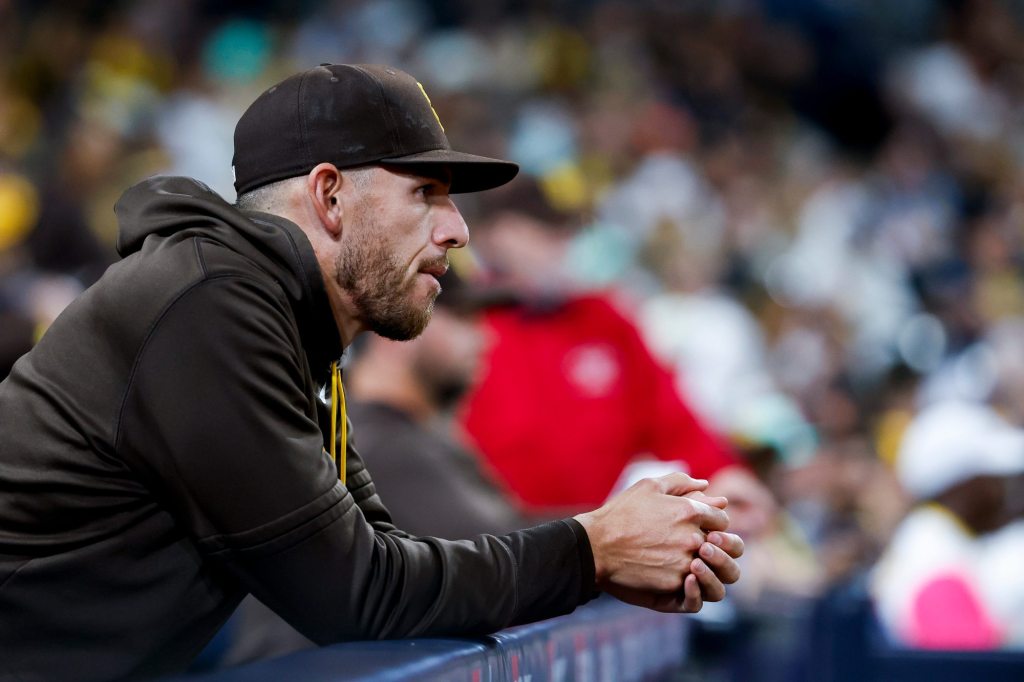
PITTSBURGH — Nothing will change how diligently Joe Musgrove is working or how desperately he wants to get back.
But it is nice to see a start like Germán Márquez had Monday, throwing five scoreless innings in a victory over the Pirates.
“If our starting staff was getting crushed, everyone is going to start asking more questions, which I guess in turn puts more pressure on me,” Musgrove said Tuesday. “… But it’s not like if we were struggling, I’d be forcing myself back any more than I am now. I just can’t seem to get the results I need.”
No one could soberly question Musgrove’s determination to push through pain or return from injury. He worked almost too maniacally to get back to pitching through a series of injuries in 2023, and he made 20 starts in 2024 with his elbow bothering him in every one of them before succumbing to Tommy John surgery in October.
It is the comeback from that surgery that has hit a snag and kept him from beginning his 2026 season.
Musgrove has been playing catch every other day (and at least once on successive days) for nearly two weeks.
There is no timetable for when he will get on a mound.
“Just trying to get some consistent feedback from the throwing,” he said over the weekend. “Right now, it’s throwing until we get to a point where I feel confident being able to go out and physically feel good enough to put something on the ball.”
It will be at least May before he returns to the major leagues since he will need multiple bullpen sessions and multiple rehab starts.
“It’s going to be a slow and arduous process,” manager Craig Stammen said. “But Joe is willing to put the work in and sooner or later, we’ll get him back.”
Musgrove doesn’t anticipate he will have to “build up all the way to six (innings) and 100 (pitches) before I’m back, but they want to see me be good and like physically feeling like I’m recovering.”
That was the issue that prompted Musgrove and the Padres to decide to shut him down in mid-March after he pitched in one exhibition and an ensuing turn in the bullpen.
“Just getting it to feel good enough to go out and pitch right now is not really what I’m looking for in March, April,” he said. “I’ve got to be able to pitch all year long and do more than just one or two starts and end up back in the same spot. So a lot of it is gauged on, ‘How do I feel right now and does this feel like something I can continue to build and progress with?’ So until I get to the point where I feel like I’m getting consistent enough days of good catch and recovery to where I feel like I can throw a ‘pen and I feel like after the ‘pen, I’ll be able to play long toss and throw another bullpen and get in the (next) game.
“The way that it’s been feeling, I just haven’t been confident about being able to get there. And it’s not like I’m not trying to. I’ve tried it and it hasn’t been there. We’ve invested so much time on rest and recovery stuff. I don’t want to waste the time that we’ve taken by pushing it back and then having to start this process all over again. I’m trying to get better as efficiently and quickly as I can. But it’s just not cooperating as well as I want to.
“Especially at this level. It’s one thing to come back in high school or college and keep pitching your season, but to get major league hitters out, your (expletive) has got to be good and you’ve got to be confident. And I just don’t have that right now. I’m not far off. I showed signs of it in spring. My stuff was there. Just the ability to execute breaking balls and get in the zone consistently and recover well enough to do it again in five days, just …”
Musgrove experiences pain when throwing some breaking balls, though it is not acute like it was in 2024. An MRI last month confirmed the graft from his surgery is intact.
Musgrove has dealt with the usual uncertainty due to discomfort at various stages in his rehab. It was not until he pushed it in spring training that it became clear he needed to take a step back.
“A lot of it is the confidence in the pitch because the pain is related to that specific pitch,” he said. “”Like, when it’s called, I’m less likely to want to throw it because it hurts and I know it’s not a very sharp pitch. Whereas, before, if I get behind in the count, I could throw four different pitches to both sides of the plate and get back in the count and control it, and I just felt in control.
“I don’t need it to be like, perfect, where like, ‘Oh, my slider is not great. I’m not gonna pitch.’ It’s just like, physically, it doesn’t feel good to throw the slider. And if I want to rip it and get big-league hitters out, like, I’ll have it for an outing and then be in bad shape. … I tried it in spring. Then I was, like, to the point where I said, ‘(Expletive) it.’ And I was just ripping them. And it was just getting worse.”