
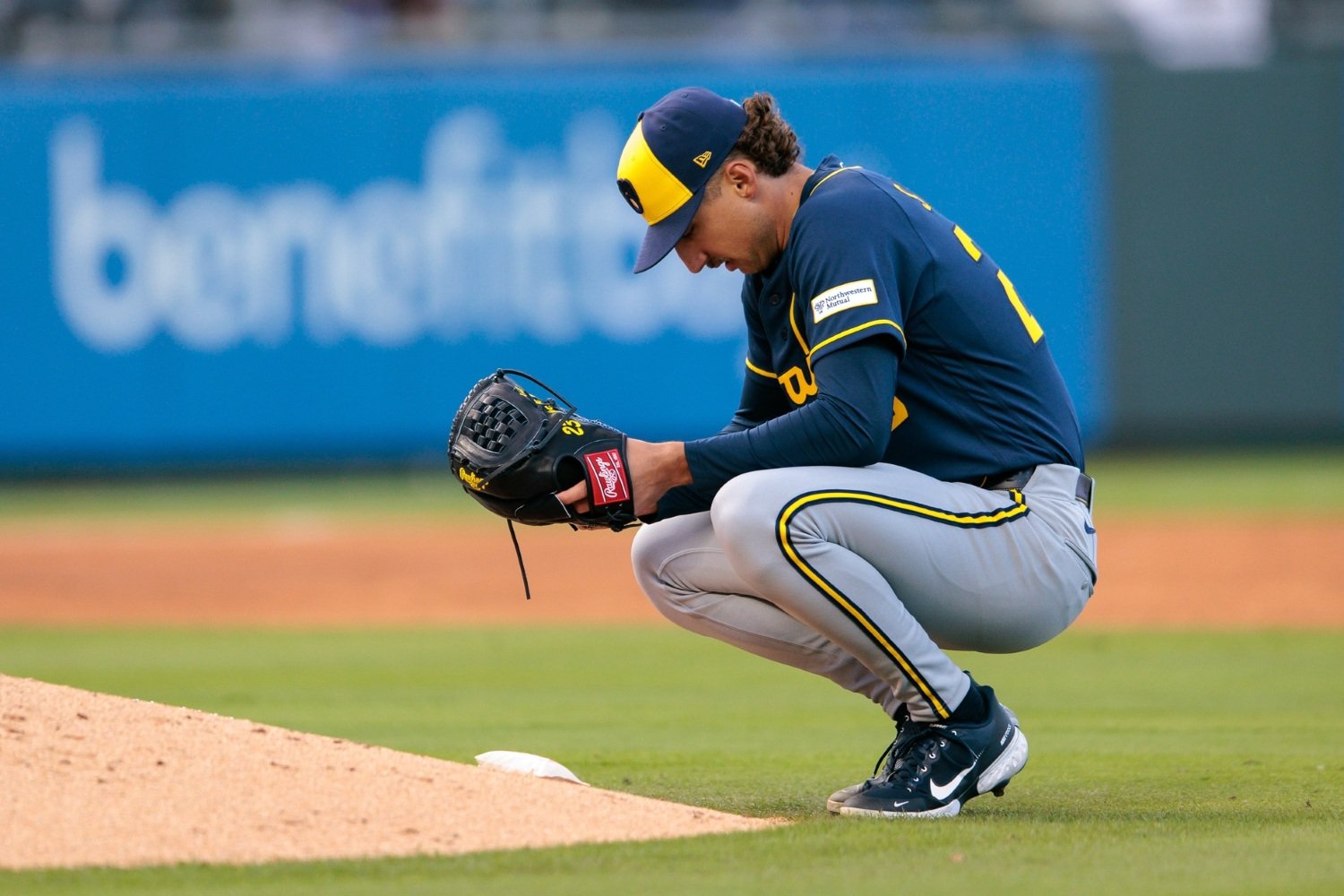
Brandon Sproat probably couldn’t imagine a worse start to his Brewers tenure. With under 7 innings pitched and 11 earned runs to his name after two starts, Sproat needs to show some progress over his next few starts; Robert Gasser and Logan Henderson are waiting in the wings. The question is: How can he turn things around?
.png.96f0a35d2a45a38ba2dc98b7f32d727a.png)
Initially, PitchProfiler seems to suggest that Sproat lacks a dominant fastball, and hitters are finding it too easy to time both it and his secondary offerings. Looking a little closer, however (specifically at the graph in the top right), that’s not entirely true. Sinkers rarely get glowing grades from stuff models, because even good sinkers don’t have the same correlation with swing-and-miss as (say) a four-seam fastball or curveball would. That being said, Sproat’s sinker has some wicked bowling ball-like movement, producing a 104 Stuff+ rating to right-handers. The rub: an ugly 87 Stuff+ to left-handers.
That’s a big disparity, and it prompted me to look a little deeper. The Brewers love fastballs almost more than any other team in baseball, but that sinker won’t consistently play well on its own to lefties, without excellent command. This is where the Brewers and Mets have differed in their approach. The Mets used a pitch pattern more similar to Logan Webb, utilizing a changeup and sinker tandem that have similar movement profiles but different velocity bands. The pitches look very similar, but the change in velocity makes Webb one of the best ground ball merchants in the sport.
In his brief time in the big leagues with the Mets last year, Sproat featured his changeup, curveball and four-seamer, at the expense of the sinker. So far, the Brewers have him trying to make the sinker work, despite that pitch’s almost universally stark platoon splits.
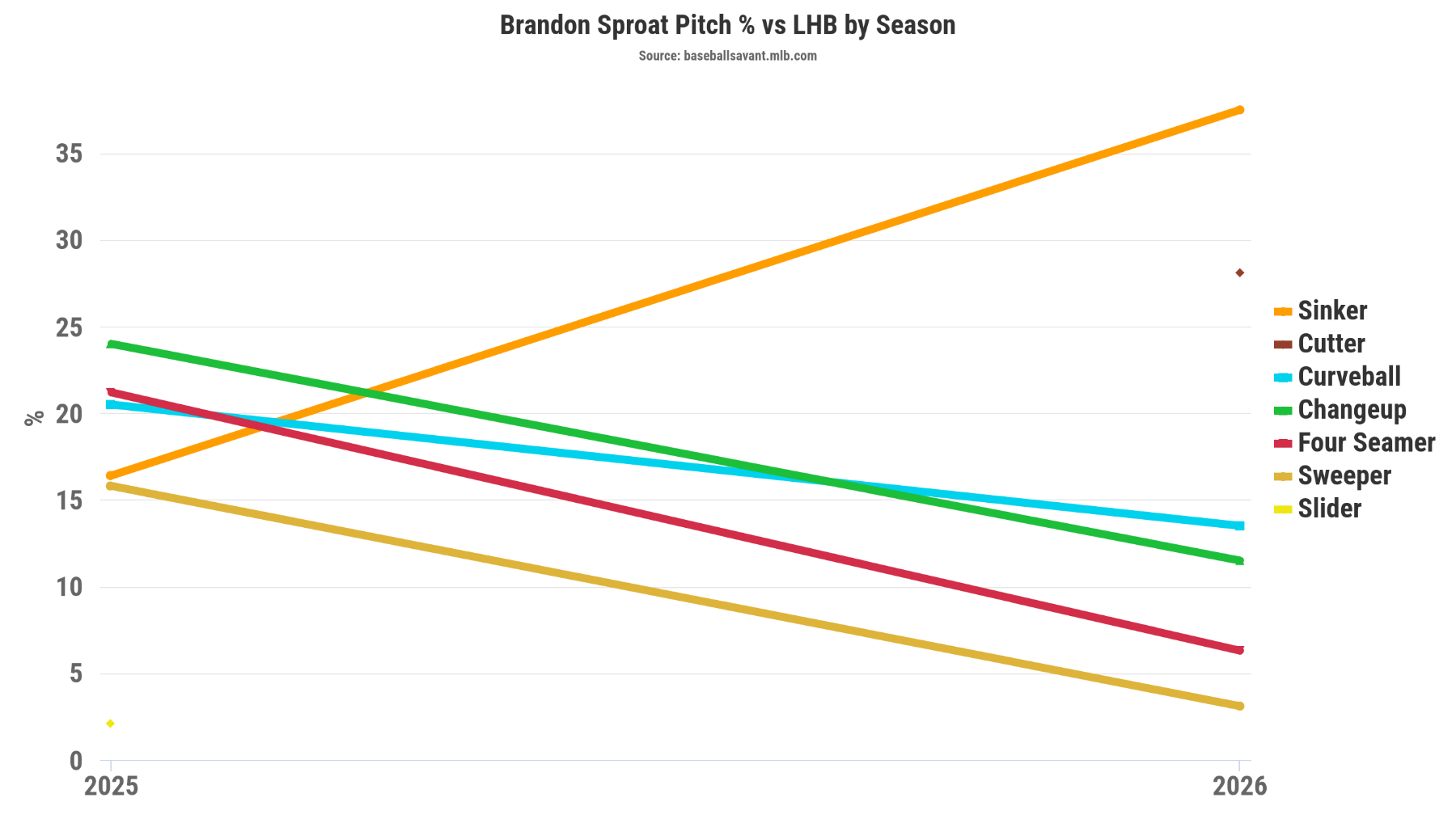
They’ve preferred the new, harder slider (or cutter) over the changeup; it’s a pitch that fits their traditional approach well. Alas, because the cutter and sinker have such a large difference in how much they move, the cutter is getting hit. Across 27 pitches (small sample size alert), lefties have cracked two homers and have a .744 expected weighted on-base average (xwOBA) against the cutter. (Remember, xwOBA is scaled to on-base percentage, so a .744 is video game-level violence.) When the pitch is being primarily used to come inside on lefties, it has to be located and set up well enough to survive those danger zones. So far, Sproat doesn’t have that.
He’s nervously approaching left-handers at present, falling behind a lot and nibbling with the sinker. He’s living down and away in the strike zone, but falling behind in counts has proved devastating for him. The fastballs just don’t play over the heart of the plate to opposite-handed hitters, and he’s struggled to get swings and misses on all but the changeup to lefties.
The changeup has dropped from 25% to 11% usage in 2026, and it hasn’t been located well enough to play off his sinker; pairing those pitches productively is always difficult. As you can see from the first graphic, these pitches move almost identically, and the changeup is only 5 MPH slower. The velocity separation would ideally be larger, but the changeup has managed to miss bats. Hopefully, it’s something he feels more comfortable using against left-handers in his next two starts, but he’ll also need a different way to set it up.
The main issue for Sproat is the walks. He’s faced 19 left-handed batters and walked six of them, compared to three strikeouts, with five hits on top of that. It’s a result of a fastball he doesn’t feel comfortable pounding the strike zone with, and the lack of a genuine out pitch in two-strike counts. The changeup may solve the latter, but it will be fascinating to see if the Brewers adjust his fastball mix, too, including getting back to more four-seam fastballs.
It’s also worth noting that Sproat has been caught by Gary Sánchez and Jeferson Quero in his first two starts. How William Contreras calls the game might be different, and the presence he provides behind the dish could help Sproat as he continues to ease into his role as a major-league pitcher.
Two things can be true at once. Sproat has been bogged down by nerves across his first two starts, showing more erratic command as a result. He could tighten up how he’s attacking hitters to weather the storm better and come out the other side with better results. The raw velocity and movement are there, but piecing it together has involved a steep learning curve for him at this level. How quickly he can navigate that curve will go a long way to deciding where he’s playing baseball in May and June.