
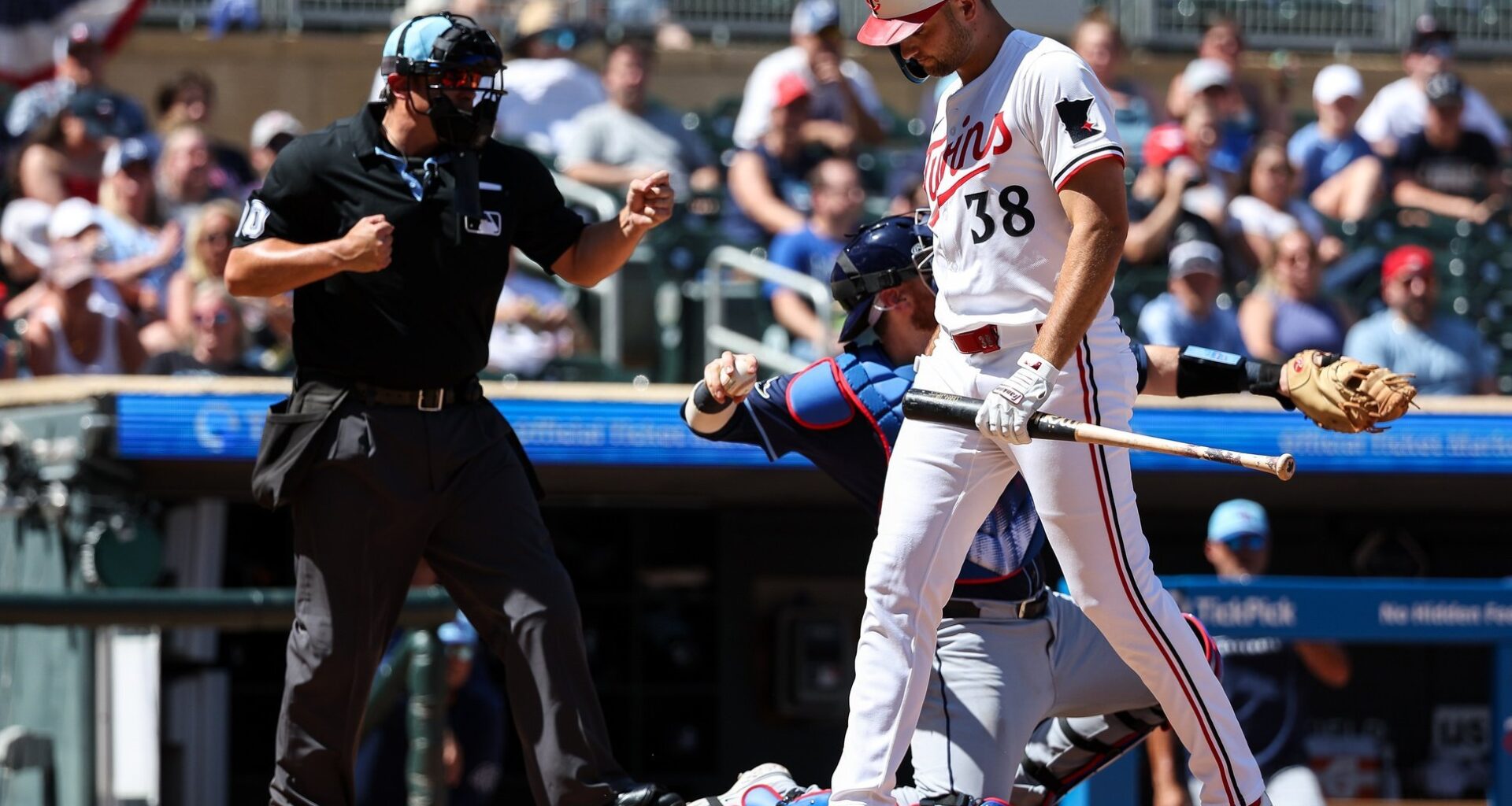
The Minnesota Twins have seemed to have a roster flaw in recent years, with a lack of impact right-handed bats. It is not an issue that has flown under the radar, either. Season after season, the lineup has leaned heavily to the left side, often prioritizing corner outfielders with power from that side of the plate. While that approach can work in a vacuum, it has created a predictable and exploitable weakness when the Twins face quality left-handed pitching.
A Multi-Year Trend That Cannot Be Ignored
This is not a small-sample-size problem or an early-season overreaction. The Twins have consistently struggled against left-handed pitchers over the last several seasons, and the numbers paint a clear picture.
From 2022 through 2025, Minnesota’s production against lefties has been firmly middle of the pack at best and well below average at worst when compared across the league. Among 120 individual team seasons in that span, the Twins ranked near the bottom more often than not.
The 2022 club posted a .701 OPS, ranking 77th out of 120. In 2023, there was a modest improvement to a .726 OPS, good for 53rd. The 2024 team took another small step forward with a .732 OPS, ranking 47th. However, that progress stalled in 2025 when the Twins slipped back to a .705 OPS, ranking 72nd.
Now in 2026, the issue has become even more pronounced. Entering play on Thursday, Minnesota owns a .636 OPS against left-handed pitching, ranking 18th overall. That total has been greatly helped by positive performances this week against left-handed starters like Tarik Skubal and Framber Valdez. However, that number reinforces a pattern that has lingered far too long for a team on the fringes of contention in the AL Central.
A Roster Built to Be Platooned
The current roster construction only amplifies the concern. Minnesota is overloaded with left-handed hitters who are often best utilized in platoon roles rather than everyday options against all pitching.
Players like Kody Clemens, Tristan Gray, Trevor Larnach, James Outman, and Matt Wallner all hit from the left side. Each brings something valuable, whether it is power or on-base ability, but asking that group collectively to handle tough left-handed starters is a difficult proposition.
Internally, there is hope that right-handed hitters like Royce Lewis and Luke Keaschall can provide balance and thump in those matchups. Lewis has shown flashes of being a middle-of-the-order force when healthy, but posted a .689 OPS against lefties last season. Keaschall is an intriguing young bat with a career .547 OPS when facing southpaws. Still, counting on them to fully stabilize the lineup against lefties feels optimistic given health questions and limited track records.
More importantly, the roster simply lacks enough right-handed depth to build a lineup tailored to attack a high-end southpaw. When a dominant left-handed starter takes the mound, Minnesota often has no choice but to run out a lineup that leans into its biggest weakness.
Help Is Coming, But Not the Right Kind
At first glance, help appears to be on the way. Four of the organization’s top five position player prospects opened the season at Triple-A, putting them one step away from the big leagues. However, their profiles do not necessarily solve this specific issue.
Walker Jenkins and Emmanuel Rodriguez are both left-handed hitters with significant upside. The Twins can reasonably hope that each develops into a hitter capable of holding his own against left-handed pitching, avoiding strict platoon roles. That would mirror the paths taken by Joe Mauer and Justin Morneau, who became complete hitters despite batting left-handed.
There are encouraging signs, but there are also clear gaps. Last season, Jenkins posted a .730 OPS against lefties compared to a .910 OPS against righties. Rodriguez showed an even wider split in 2025 with a .607 OPS against southpaws and a .950 OPS against righties. Both players have the talent to improve those numbers, but projecting that growth is far from certain.
The organization’s best right-handed hitting prospects at the level offer a more direct solution, though they come with their own questions. Gabriel Gonzalez dominated left-handed pitching last season with a 1.022 OPS while also holding his own against righties at .869. Kaelen Culpepper, on the other hand, posted reverse splits with a .700 OPS against lefties and a .905 OPS against righties.
Gonzalez stands out as a potential impact bat who could help balance the lineup, but relying on prospects to fix a longstanding major league issue is rarely a comfortable strategy.
An Issue That Demands a Clear Answer
The Twins have built a lineup identity around left-handed power, but the downside of that approach continues to surface in meaningful ways. Without enough right-handed hitters capable of doing damage, especially against left-handed pitching, the offense becomes easier to neutralize.
This is no longer a short-term quirk. It is a multi-year roster-construction problem that has carried over across different versions of the team. Until Minnesota finds a way to add impact right-handed bats or develops internal options who can truly break the mold, opposing teams will continue to exploit this imbalance.
What steps should the front office take to resolve this issue once and for all? Leave a comment and start the discussion.