
CHICAGO — With so much experience, depth and continuity, the Chicago Cubs were supposed to hit the ground running. The nucleus of a 92-win team stuck together throughout the winter, and the front office received an “A” for its offseason grade.
With a $223 million Opening Day payroll, the Cubs invested roughly $100 million more in their roster than their next-closest competitor in the National League Central, according to an Associated Press study, while still planning to add at the trade deadline and pay the luxury tax.
Finalizing contract extensions for fan favorites Pete Crow-Armstrong and Nico Hoerner during the first homestand created even more goodwill.
At the moment, however, that symmetry and momentum have not consistently shown up in the on-field product. The big-market, last-place Cubs are 6-8 after Saturday afternoon’s clunky 4-3 loss to the Pittsburgh Pirates, which lasted 3 hours and 40 minutes over 11 innings at Wrigley Field.
The day after the Cubs wasted six no-hit innings from Shota Imanaga in an eventual 2-0 loss, a crowd of 34,049 watched the offense go 1-for-15 with runners in scoring position, leaving 16 men on base and continuing a vexing trend.
“I don’t think anybody’s waiting on it,” Cubs third baseman Alex Bregman said. “We’re all, every single day, getting after it, trying to turn it. I feel like, over the course of 162, the cream will rise to the top, and we’ll play good baseball. We haven’t done that so far. We know we’re capable of playing way better than we’ve played. We just got to execute better in those situations.”
Bregman, the All-Star who signed a five-year, $175 million contract this past offseason to be the finishing piece of the lineup, extended Saturday’s game with a two-out RBI single in the ninth inning. But even with the automatic runner on second, the Cubs did not score in the 10th or 11th innings.
It’s early, and it’ll still be early six weeks from now, so there’s no reason to panic. From the clubhouse to the manager’s office to the front office, the Cubs process information, contain emotions and take a rational approach to a relentless schedule.
This just isn’t how they drew it up.
Thus far, the 2026 Cubs have not had a comeback victory, and the club has won back-to-back games only once. Two members of the Opening Day rotation are now on the injured list. Emerging closer Daniel Palencia has received just one save opportunity since his dominant performance for Team Venezuela in the World Baseball Classic.
For president of baseball operations Jed Hoyer, the main area of concern is losing Cade Horton to season-ending surgery on his right elbow.
“Other than that,” Hoyer said, “nothing has altered anything I would think about. I look at this as the equivalent of playing one NFL game, or it’s the equivalent of playing one hole in a round of golf. Trying to overanalyze what’s happened is a mistake — on a positive or a negative.
“Last year around this time, we were 7-5. We had won five in a row. We were scoring a gazillion runs a game. That ended up being our longest winning streak of the season. We have (almost) 150 games left.
“Our offense projects to be an excellent offense. I would be shocked if our offense isn’t an excellent offense. But April baseball and small samples can be difficult to look at.”
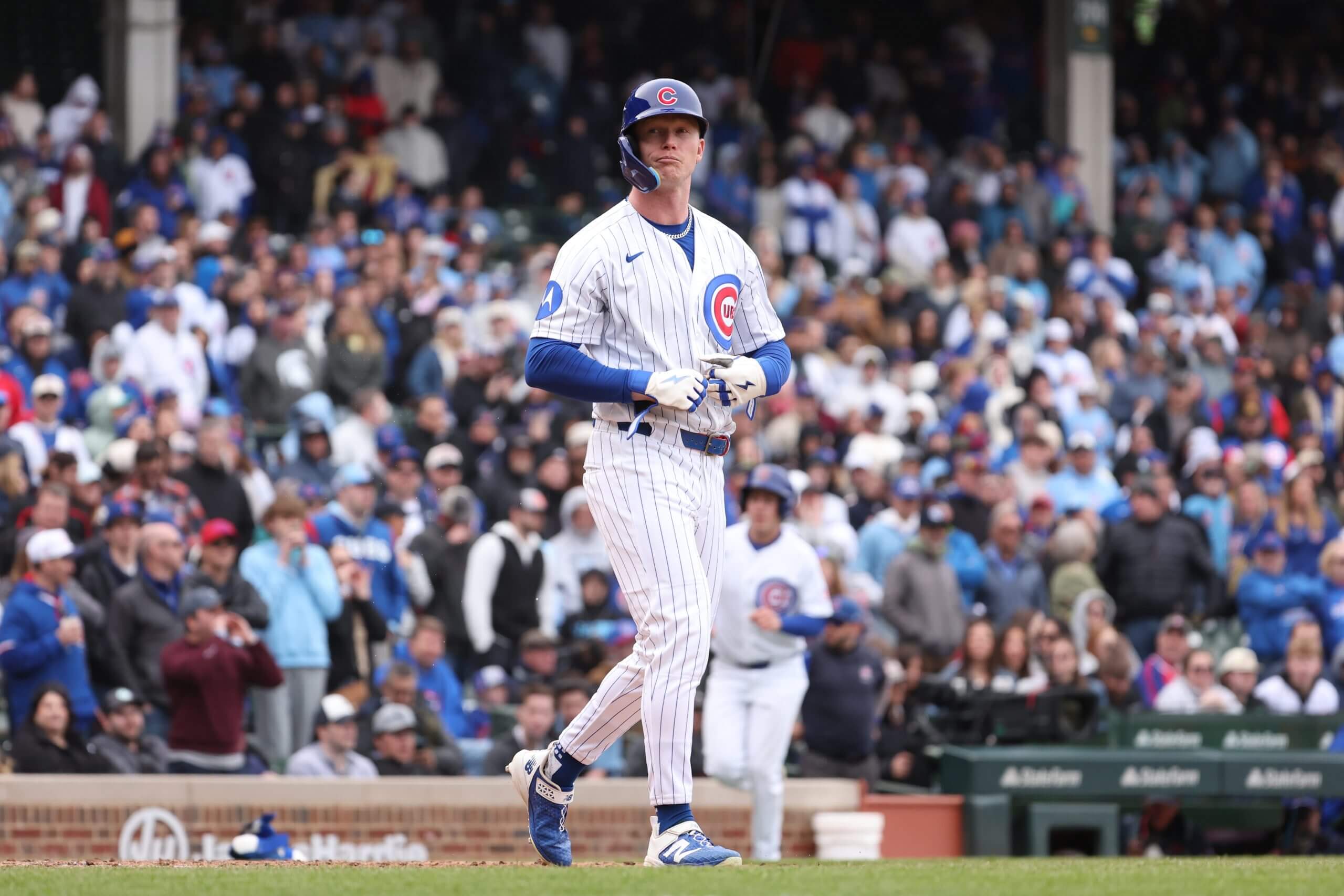
Pete Crow-Armstrong is among a group of Cubs hitters who are slumping to start the 2026 season. (Photo by Sage Zipeto/Getty Images)
Saturday’s lineup featured seven first-round picks plus two international players, Miguel Amaya and Moisés Ballesteros, who had been consistently ranked among the sport’s top 100 prospects at different points.
Besides Crow-Armstrong, Hoerner and Bregman, the franchise has also made a nine-figure commitment to Gold Glove shortstop Dansby Swanson, an occasional No. 9 hitter. On the bench, the Cubs had Matt Shaw, another first-round pick, and Seiya Suzuki, another player valued in the range of $100 million.
“We haven’t really hit yet,” Hoyer said, “and I actually think that excites me because we have really good players who haven’t gotten going yet. At the end of the day, they’ll get to where their baseball cards say they should be, or better. We have a lot of positive regression coming to us on the offensive side. Hopefully, it happens soon.”
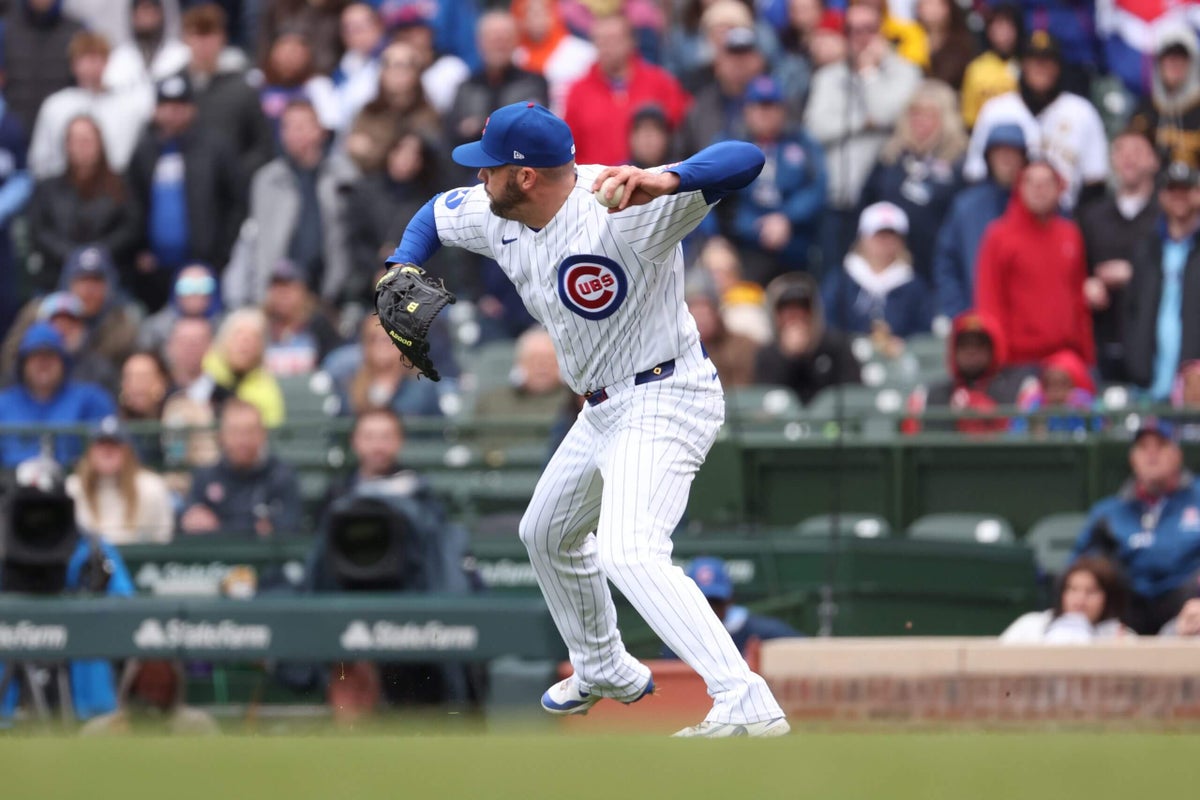
It didn’t happen against an improved Pittsburgh team that scored the first three runs that Edward Cabrera — another big offseason acquisition — has allowed as a Cub. The Pirates also took advantage of Caleb Thielbar’s throwing error to score an unearned run off the lefty reliever in the 11th inning. A group that prides itself on elite defense and attention to detail committed three errors overall Saturday.
Right now, Hoerner (.903) and Ian Happ (.809) are the team’s only qualified hitters with an OPS above .610. Crow-Armstrong, who’s shown flashes of being one of the sport’s most electrifying players, has one home run through 59 plate appearances.
Michael Busch, perhaps Chicago’s most dangerous hitter during last year’s playoffs, is mired in an 0-for-30 stretch that forced Cubs manager Craig Counsell to sub in Carson Kelly for a key at-bat against left-handed Pirates reliever Gregory Soto in the seventh inning. Kelly popped up the first pitch he saw.
“Offense is sequential,” Counsell said. “You have to string together. It has to be a line of consistent at-bats. You can’t have one good at-bat and then one at-bat that’s empty.
“On days when it’s difficult for the home run to be a part of your offense, it’s even more important that sequential offense happens. You have to have three, four straight good at-bats to score runs because you’re going to get some home runs knocked down.
“That’s really where we’ve probably failed. We’ve had the two good at-bats and then the next at-bat has not worked.”
Again, it’s only April. The Cubs absolutely believe this will work. It just hasn’t been as smooth as expected. They’ll try again Sunday afternoon at the Friendly Confines.
“Definitely frustrating,” Bregman said. “It’ll turn. Just got to keep fighting the fight.”