
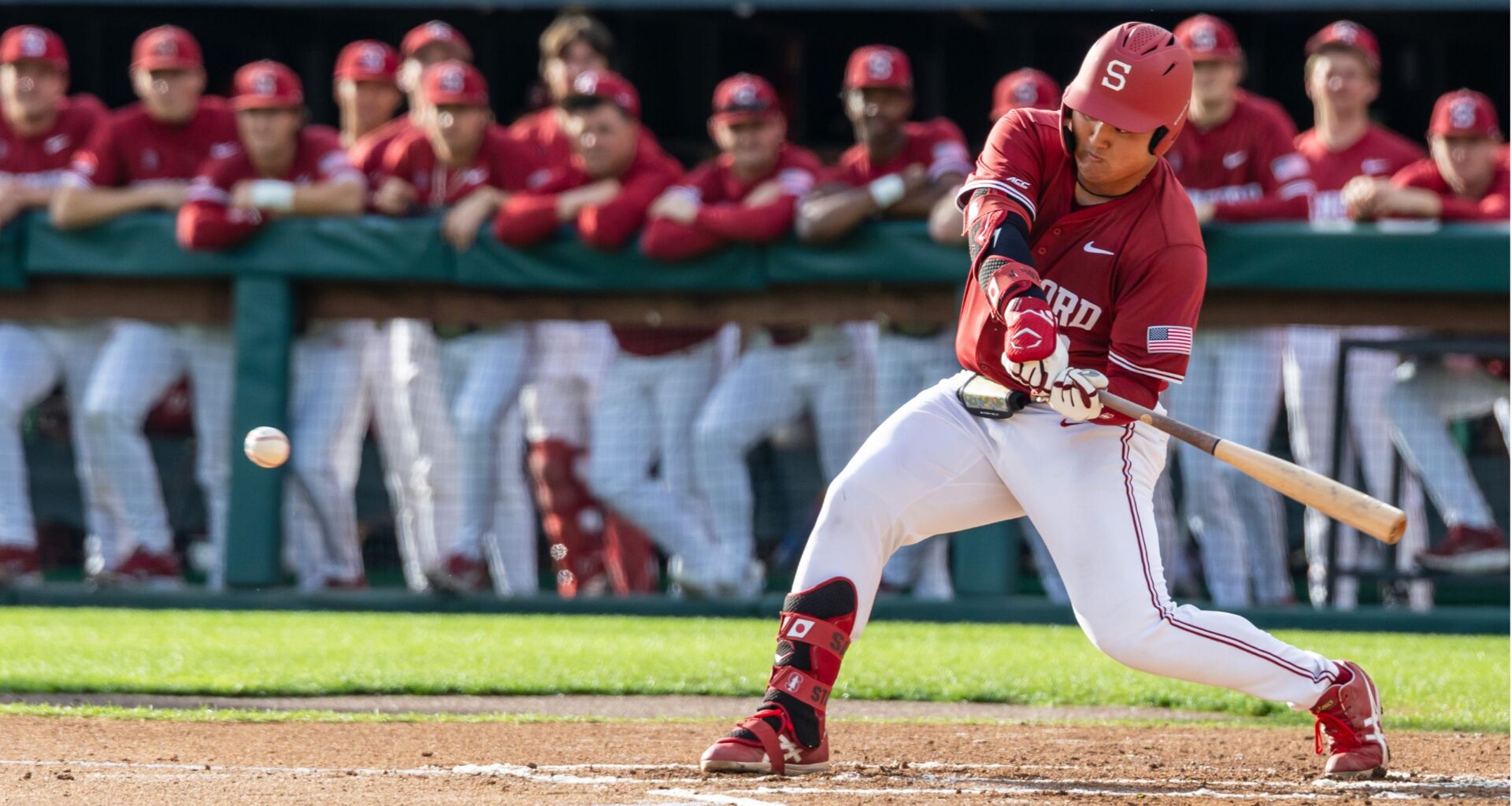
Image credit:
Rintaro Sasaki (Photo by Scott Gould/ISI Photos/ISI Photos via Getty Images)
The version of the draft conversation that lives almost entirely at the top is often shaped by industry consensus, anchored to rankings and reinforced by repetition. Those names become familiar and their profiles feel more settled.
But every year, a handful of college players force their way into relevance not through pedigree, but through performance. They show up in data first with exit velocities that don’t match the body or miss rates and stuff that outpace performance—underlying indicators that hint at something louder than the surface line suggests. They aren’t always polished, and they aren’t always conventional, but they are increasingly difficult to ignore.
This group lives in that space.
None of the 10 players featured below are included in the top 150 in Baseball America’s latest 2026 draft rankings. Some offer impressive bat-to-ball skills paired with quietly impactful power. Others are riding pitch characteristics or shapes that models love, even if traditional scouting reports lag behind.
Here are 10 college data sleepers in the 2026 draft who have given teams a reason to dig deeper.
Jake Bennett, DH/C/OF, Dallas Baptist
Bennett is putting himself squarely on the board and will force decisions deep into the draft if the production holds. Primarily Dallas Baptist’s designated hitter, he’s produced some of the loudest contact in the country, averaging 97 mph off the bat with a 112 mph 90th percentile mark.
The strength is real and it shows up without significant tradeoff. Bennett pairs his impact with an 80% contact rate, an 88% in-zone mark and an above-average 18% chase rate. There is still room to unlock more damage, too. He can be overly passive on pitches he can handle and would benefit from increasing his swing rate in the zone, particularly over the heart of the plate.
Bennett turns 22 in August, which puts him on the older side for the class, but the underlying data is difficult to ignore. If a club believes he can handle a corner outfield role or develop behind the plate, where he plays occasionally, the offensive profile carries enough weight to make him a compelling target.
Ryan Cooney, 2B, Oregon
Cooney has been one of the nation’s most effective leadoff hitters, pairing strength with advanced contact ability and feel for the barrel. The righthanded-hitting second baseman owns a 90 mph average exit velocity and a 101 mph 90th percentile mark. While that may point to a more mature strength profile, both figures still grade comfortably above average.
He produces hard contact consistently, with most of his damage coming on pulled line drives. Cooney’s 89% overall contact rate and 95% in-zone mark are both well above average, and he maintains an aggressive approach without losing control of the zone. His 21% chase rate is solid given how often he swings and how frequently he does damage when he gets a pitch to handle.
There are still areas to refine. He expands a lot more with two strikes and could benefit from getting the ball in the air more consistently. Even so, the combination of contact quality, bat-to-ball skill and athleticism gives the profile a stable foundation.
Caden Ferraro, OF/DH, Texas Tech
Ferraro made the jump from Brenham (Texas) Blinn College to Texas Tech for his junior season and has produced at a high level, slashing .426/.534/.713 with five home runs, 14 doubles and more walks (26) than strikeouts (20).
The underlying data is equally impressive. The 6-foot-2 lefthanded hitter owns a well above-average 95 mph average exit velocity and an elite 110 mph 90th percentile mark, pointing to significant underlying power. He makes contact at an above-average rate, limits chase and consistently attacks pitches in the zone.
There is still room for more impact. Much of his best contact currently comes on a line, and he could benefit from getting the ball in the air more consistently. Given the strength in the profile, that is a reasonable next step rather than a concern.
Grayson Fitzwater, 1B, VMI
Through 32 games, Fitzwater has been one of the most complete offensive performers in the class, slashing .385/.543/.844 with 12 home runs, 12 doubles, 11 stolen bases and 36 walks against just 16 strikeouts. The production is backed by force. He’s averaging 95 mph off the bat and consistently translating that into damage, particularly to the pull side where he shows a natural ability to lift the baseball without compromising contact.
What’s changed is the approach. Fitzwater has tightened his decision-making this spring, operating with more restraint and swinging less often than he did a year ago. The result is a near 10% reduction in chase rate with no tradeoff in impact, sharpening what was already a disciplined offensive profile. He controls the zone, gets to his spots and does damage when he finds them.
There’s a steadiness to the profile. He combines advanced swing decisions with feel for the barrel and produces impact without the swing-and-miss that often comes with it. While he’s primarily a first baseman, he’s a better athlete than the typical profile at the position and could handle a corner outfield role if needed, offering a bit more defensive flexibility.
Rintaro Sasaki, 1B, Stanford
Sasaki’s first year stateside was uneven, as he struggled to produce against Division I pitching. The surface line still isn’t loud, but the underlying indicators suggest a player beginning to make meaningful adjustments and regain some of the intrigue he carried before arriving in the United States.
He’s averaging 91 mph off the bat with a 107 mph 90th percentile mark, pairing that impact with above-average contact rates both overall and in-zone. He has also scaled back his swing rate, improving his chase decisions and tightening his overall approach. At times, that adjustment has pushed him toward passivity, and he will need to be more aggressive on pitches he can drive.
The batted ball profile is trending in the right direction. Sasaki has shown a growing ability to pull the ball in the air, a necessary step against higher-end velocity and sequencing.
The limitations remain. He is a well below-average athlete confined to first base or DH, and there are still questions about the overall hit tool. But the progress this spring is tangible and points to a player who is starting to find his footing, which should be enough to draw renewed interest and create some opportunity in July.
Eric Nachtsheim, RHP, McNeese State
We highlighted Nachtsheim earlier this season, and the performance and data have only continued to support it. The 6-foot-4, 235-pound righthander has pitched to a 3.43 ERA with 73 strikeouts to 16 walks over 44.2 innings, driven by a fastball that has consistently overpowered Southland Conference hitters.
The pitch sits 92-94, touches 97 and shows cut-ride with plus extension, reaching nearly seven feet and regularly grabbing over 20 inches of induced vertical break with a flat approach angle. It generated a 37% miss rate through April 6, which ranked fifth nationally among pitches thrown at least 350 times in tracked environments, making it a legitimate outlier and the clear driver of the profile.
He’s heavily fastball-oriented, but there are usable secondaries behind it. Nachtsheim throws a tight gyro slider with late depth that plays under barrels, while his changeup sits in the low-to-mid 80s with fade and tumble and has missed bats. Both pitches have miss rates north of 30%. He will also show a mid-to-high-80s cutter sparingly.
The concerns are fairly straightforward. Spin is below average across the arsenal and the control is average or a tick below, which points to significant reliever risk, especially given his age. But the body, extension and fastball characteristics give him a real carrying tool.
Eli Pillsbury, LHP, Jacksonville State
It’s been a long road for Pillsbury, who began his career with two seasons at Carterville (Ill.) John A. Logan College, transferred to NC State in 2025 without appearing in a game, then landed at Jacksonville State, where he has emerged as a standout. The 6-foot-2, 200-pound senior lefthander owns a 1.99 ERA with 53 strikeouts to nine walks over 45.1 innings.
Pillsbury works off a three-pitch mix headlined by his slider, which he throws 42% of the time. The low-80s offering features above-average spin and a tight, mostly horizontal shape. He consistently keeps it out of the zone, generating a 38% chase rate and a 41.5% miss rate.
His fastball sits 89-91 and has been up to 93 with excellent cut-ride characteristics, slightly above-average spin and a near-70% strike rate while still producing a 27% miss rate. He locates it well and could still add a tick or two of velocity.
The curveball shows straight downer shape with above-average spin. It is used primarily against righthanded hitters and, while it does not miss many bats, it has produced a 70% ground ball rate.
Pillsbury is a later bloomer, but the combination of performance, pitch shapes, feel for spin and remaining projection makes him an intriguing senior draft target.
Hunter Possehl, LHP, Florida Gulf Coast
Possehl’s profile starts in a rare bucket. The lefthander gets off the bus at 6-foot-7, 235 pounds, and pairs that physicality with a slider-heavy approach out of a slingy, sidearm look. A redshirt sophomore who logged just 19.2 collegiate innings prior to 2026, he remains relatively unexposed with clear room to develop.
His calling card is a low-to-mid 80s sweeper he throws roughly 35% of the time. The pitch averages well over 2,700 RPMs, shows more than 10 inches of horizontal break and generated a 59% miss rate through April 6, one of the highest marks in the country. It is a true bat-misser and the foundation of the profile.
The fastball is less dynamic. He sits 89-91 and has been up to 94 with a sinker that shows above-average run. It plays best at the bottom of the zone but generates limited swing-and-miss.
There is clear developmental runway. Possehl will need to add velocity and expand the arsenal to project at the next level, but evaluators who have seen him this spring point to attainable gains tied to his lower-half usage and overall operation. Given his length, levers and remaining physical projection, there is reason to believe more is coming. His present feel to spin the baseball gives him a foundation to build on as well from a pitch design standpoint.
Cal Randall, RHP, UCLA
Teams looking to invest in a reliever with the potential to move quickly have already gravitated toward Randall, a power righthander with premium traits and below-average control. He operates from a low three-quarters slot with a crossfire delivery, generating significant deception and angle.
Randall’s fastball is the foundation. It sits 95-97 and has been up to 100 with above-average carry, some run, nearly seven feet of extension and an elite -3.95-degree vertical approach angle. The pitch plays like a rise fastball at the top of the zone and consistently beats barrels, generating a 39% miss rate despite being in the zone just 51% of the time.
He pairs it with a high-80s/low-90s bullet slider that he spins well. The pitch has produced a 44% miss rate, though it is also inconsistently located. He will also mix a changeup with heavy tumble.
The profile is straightforward. Randall needs to throw more strikes, but the ingredients are already in place. The fastball characteristics, miss rates and overall power arsenal point clearly to a professional bullpen role, with the type of stuff that could allow him to move quickly.
Cal Scolari, RHP, Oregon
Scolari was a draft-eligible redshirt freshman in 2025 after missing multiple seasons due to Tommy John surgery, but opted to return and transferred from San Diego to Oregon, where he has continued to build his case. The 6-foot-4, 220-pound righthander owns a 2.81 ERA with 46 strikeouts to 16 walks over 32 innings as of April 9.
His fastball sits 93-95 and has been up to 98 with average carry and a flat attack angle. He struggles to locate it, landing it in the zone just 44% of the time with a 58% overall strike rate. He’s been more effective landing secondaries, particularly a high-70s to low-80s curveball that he spins well and finishes with late vertical depth.
His mid-80s slider is arguably his best pitch, showing sweep and generating a 42% miss rate. Of his three primary offerings, it is the only one with a strike rate north of 60%.
Scolari has no trouble missing bats, but his ability to consistently execute has been a career-long issue, with well below-average command and control. That points to elevated reliever risk, though the underlying pitch traits are attractive across the board and could still take a step forward as he gets further removed from a multi-year layoff.