
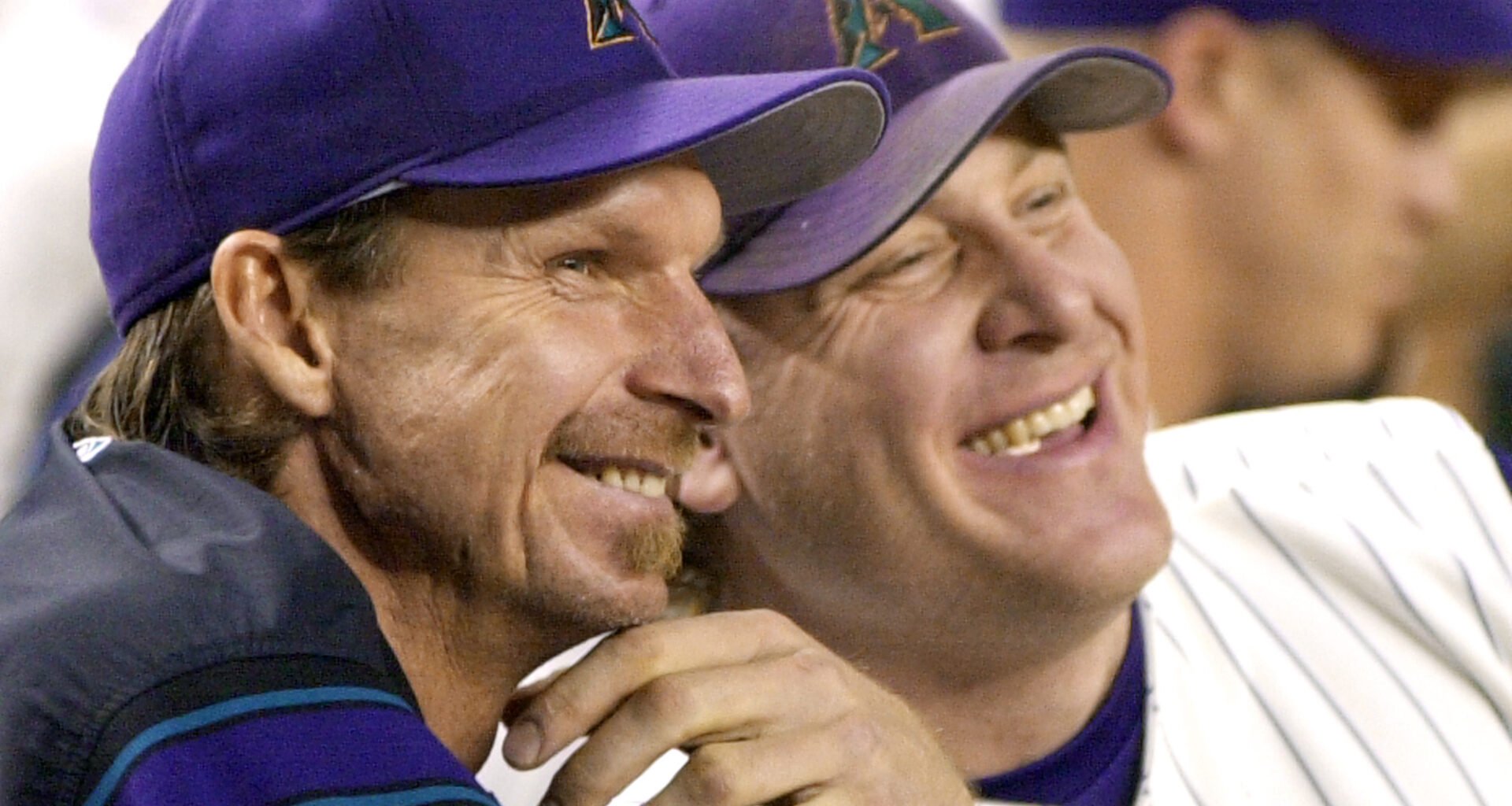

This is the next in a series of stories from Cronkite News looking back at the Diamondbacks’ 2001 World Series win.
PHOENIX – Before a single pitch was thrown in 2001, the Arizona Diamondbacks already felt there was something special about their team.
“We started spring training feeling like we had a chance to get to the World Series,” infielder Jay Bell said. “We just felt like that was who we were.”
That confidence carried one of the oldest rosters in the sport through one of the best seasons in franchise history, as Arizona became the fastest expansion team to win a World Series, defeating the New York Yankees in seven extraordinary games just four years after entering the league.
Six factors played significant roles in propelling the Diamondbacks to the biggest stage in baseball, and to capturing what is still Arizona’s only major professional men’s championship.
Luis Gonzalez’s career year
Gonzalez played 19 seasons in the major leagues but had a career year in 2001, setting highs in multiple categories. He slashed .325/.429/.688 and appeared in all 162 regular season games.
The outfielder belted a career-high 57 home runs and finished third in the league in RBIs behind Sammy Sosa and Todd Helton. His best regular-season game came against the Los Angeles Dodgers on June 19, when he hit two home runs and drove in six RBIs.
As most Diamondbacks fans can recite from memory, it was Gonzalez who had the game-winning hit in Game 7, a bloop single off Hall of Fame closer Mariano Rivera in the bottom of the ninth at the BOB in downtown Phoenix, with the score tied 2-2, bases loaded and one out.
When Gonzalez’ soft floater dropped into left field, sending Bell home with the winning run, it set off a fierce celebration in the rain for a fanbase thirsty for its first professional championship in Arizona. Twenty five years later, that Game 7, 3-2 win is still considered one of the greatest games ever played in baseball’s long history.
“There was really no weakness in our order. I think we had four guys maybe with 30-plus homers or 20-plus guys,” Gonzalez said. “And that was the year I had 57. So there were RBIs up and down that lineup to be had.”
One of the highest run differentials in a seven-game World Series
Arizona recorded one of the highest run differentials in a seven-game World Series, outscoring the Yankees 37-14. Dominant pitching from Randy Johnson and Curt Schilling kept the Yankees’ lineup in check in the blow-out wins, holding New York to just one run in Game 1 and two runs in Game 6, outscoring the Yankees 24-3 in those two games.
Despite the lopsided run differential, the series was anything but one-sided. Four of the seven games were decided by one run, and three of those went to New York at Yankee Stadium, giving the Yankees a 3-2 series lead after trailing 2-0.
One of the many lasting images from that series is Diamondbacks closer BK Kim kneeling on the mound in the Bronx in disbelief. He gave up a game-tying home run to Tino Martinez in the ninth inning of Game 4 and a game-tying homer to Scott Brosius in the ninth inning of Game 5, with the Yankees winning both games in extra innings.
Co-MVPs Schilling and Johnson
Schilling and Johnson became the first duo to share World Series MVP honors. The only other time more than two players won the award came in 1981, when Ron Cey, Pedro Guerrero and Steve Yeager split the MVP honors for the World-Series winning Los Angeles Dodgers.
Schilling and Johnson accounted for all four Diamondbacks victories with Johnson winning three. Both aces pitched in Game 7. Schilling got the start, and Johnson relieved Miguel Batista in the seventh inning. Johnson kept the Diamondbacks within one run, holding the Yankees scoreless before Luis Gonzalez’ walk-off hit won the Series.
Johnson and Schilling combined to pitch 38 2⁄3 innings of the 65 innings for the Diamondbacks.
Schilling started Games 1, 4 and 7, striking out 26 batters, walking two and allowing four runs for a 1.69 ERA in 21 ⅓ innings of work. Schilling retired 18 straight Yankees in a dominant Game 7 performance, holding New York to just two runs.
Schilling World Series starts:
Game 1: 7 IP, 3 H, 1 ER, 1 BB, 8 SO
Game 4: 7 IP, 3 H, 1 ER, 1 BB, 9 SO
Game 7: 7 ⅓ IP, 6 H, 2 ER, 0 BB, 9 SO
Johnson was just as dominant across his three appearances, striking out 19 Yankees, walking three and allowing two runs for an ERA of 1.04. Johnson threw a complete-game shutout in Game 2, allowing three hits with 11 strikeouts, and returned in relief in Game 7 to keep the Diamondbacks within one run.
Johnson World Series appearances:
Game 2: 9IP, 3H, 0ER, 1BB, 11SO
Game 6: 7IP, 6H, 2ER, 2BB, 7SO
Game 7: 1 ⅓ IP, 0H, 0ER, 0BB, 4SO
“It feels like it gives you a one-run lead before you even start the game,” Gonzalez said of the pitching duo. “All you’ve got to do is try to scratch out a run or two.”
Johnson and Schilling were the quintessential one-two punch, two aces with disparate personalities who formed the foundation of the Diamondbacks’ championship run.
Johnson was one of the most sought after pitchers on the free agent market after an incredible second half to the 1998 season, where he had an ERA of 1.28 and went 10-1 with the Houston Astros. He signed a four-year 52.4 million dollar deal with Arizona, but not without a full-court press from owner Jerry Colangelo.
”I go to Randy’s home, and his two agents are there, Randy says to me, ‘I don’t even know why you’re here. With (then-manager) Buck Showalter, how are we going to get along?’” Colangelo said. “I said, ‘Wait a minute, Randy. If you had earrings coming out of your nose, in your ears and tattoos from the top of your head to the bottom of your toes and long hair, I’d say, ‘I pass.’ But one out of three is OK. And he just laughed. And that broke him.”
Schilling, a product of Shadow Mountain High School in Phoenix, had been in the league for 12 years before landing in Arizona, after he requested a trade from Philadelphia, saying he wanted to pitch for a contender. The Diamondbacks traded first baseman Travis Lee and pitchers Vicente Padilla, Omar Daal, and Nelson Figueroa for the right-handed pitcher, bringing him back to the Valley.
Johnson struck out a league-high 372 batters, posted a 2.49 ERA and led all pitchers in WAR with 10.1, winning his third straight Cy Young Award in 2001. Schilling was runner-up for the award after putting together his best big league season in 2001, posting a 2.98 ERA, striking out 293 hitters and walking 39 batters in 256.2 innings of work. Schilling finished second in pitching WAR putting up 8.8.
Both starters put the Diamondbacks in baseball lore, recording 20-plus-win seasons and combining for a 43-12 win-loss record.
One of the oldest teams to win a World Series
No moment was too big for the Diamondbacks. Veteran leadership defined the roster. The average age during the regular season was 31.9 years, making it the oldest roster in team history.
No player in the World Series’ starting lineup was younger than 31.
At 37, Mark Grace was the oldest player in the starting lineup. A three-time ALL-Star, he also finished as runner-up for National League Rookie of the Year in 1988.
Steve Finley, 36, anchored the outfield with elite defense, earning five Gold Glove Awards over his career.
Damian Miller, 31, served as the starting catcher throughout the World Series and hit a career-high 13 home runs in 2001.
Gonzalez, 34, was in the midst of a career year, finishing third in National League MVP voting.
Craig Counsell, 31, was a versatile utility player and former World Series champion with the Florida Marlins.
Bell, 35, was in his 14th major league season and playing for his fifth team when he joined the Diamondbacks in 1998.
Tony Womack, 31, led the team in stolen bases in the regular season with 28.
Matt Williams, 35, was a five-time All-Star and four-time Silver Slugger who finished third in MVP voting in 1999.
The youngest player on the World Series roster was 22-year-old closer Byung-Hyun Kim, whom the Diamondbacks signed out of South Korea at 19. Cy Young award winner Johnson was 38.
“This was a veteran team,” former Diamondbacks general manager Joe Garagiola Jr. said. “This was a team of players who had a lot of individual success. But besides Craig Counsell, no one had championship success.”
Offense and defense shine brightly
The Diamondbacks’ pitching was elite in 2001, but their offense was just as effective. Arizona ranked in the top 10 in most offensive categories.
The Diamondbacks were a disciplined team, ranking fifth in walks (587) and 20th in strikeouts (1,052). They also showed power at the plate. Arizona slugged 208 home runs in 2001, tied for seventh in the National League, and posted a .442 slugging percentage but ranked below average in doubles.
Perhaps because they were an older team, they only stole 71 bases, with 28 of those coming from 31-year-old Tony Womack, and 14 from Reggie Sanders. Defensively, the Diamondbacks were equally strong, committing the second-fewest errors in the majors with 84.
“That year we had a bench that was devastating for opposing teams,” Garagiola Jr. said. “We set the NL record for most pinch hit home runs. The guys on the bench, these were all guys that could have and would have been everyday players on other teams.”
Fastest expansion team to ever win a World Series
After a successful MLB expansion in 1993, the league expanded again five years later. The Diamondbacks and then-Devil Rays entered the league in 1998. The Rays have made the World Series twice but have yet to win a championship.
The Diamondbacks have also made the World Series twice, but they became the fastest team to win one, doing so just four seasons after entering the league by defeating a Yankees team that had won the previous three titles.
The Diamondbacks initially were going to follow what the Colorado Rockies did a few years earlier by building through the draft and creating a farm system early on. But after a decline in demand for season tickets following Arizona’s debut season, the Diamondbacks decided that in order to sell tickets they would need to be competitive and go all in to win in just the second year of the young franchise’s existence.
“I just set out to win now,” Colangelo said. “And of course, our new plan, we won three divisional titles and won a World Series in that short period of time. It’s never been done before in the history of baseball, and probably never will be in today’s economic structure in baseball.”
This <a target=”_blank” href=”https://cronkitenews.azpbs.org/2026/04/16/diamondbacks-factors-behind-2001-world-series-championship/”>article</a> first appeared on <a target=”_blank” href=”https://cronkitenews.azpbs.org”>Cronkite News</a> and is republished here under a <a target=”_blank” href=”https://creativecommons.org/licenses/by-nd/4.0/”>Creative Commons Attribution-NoDerivatives 4.0 International License</a>.<img src=”https://i0.wp.com/cronkitenews.azpbs.org/wp-content/uploads/2026/02/favicon1.png?resize=85%2C85&ssl=1″ style=”width:1em;height:1em;margin-left:10px;”>
<img id=”republication-tracker-tool-source” src=”https://cronkitenews.azpbs.org/?republication-pixel=true&post=102244″ style=”width:1px;height:1px;”><script> PARSELY = { autotrack: false, onload: function() { PARSELY.beacon.trackPageView({ url: “https://cronkitenews.azpbs.org/2026/04/16/diamondbacks-factors-behind-2001-world-series-championship/”, urlref: window.location.href }); } } </script> <script id=”parsely-cfg” src=”//cdn.parsely.com/keys/cronkitenews.azpbs.org/p.js”></script>
Canonical Tag:
Copy Tag
Article Content:
Six factors highlighted Diamondbacks 2001 World Series championship team
Austin Gibbs, Cronkite News
April 16, 2026
This is the next in a series of stories from Cronkite News looking back at the Diamondbacks’ 2001 World Series win.
PHOENIX – Before a single pitch was thrown in 2001, the Arizona Diamondbacks already felt there was something special about their team.
“We started spring training feeling like we had a chance to get to the World Series,” infielder Jay Bell said. “We just felt like that was who we were.”
That confidence carried one of the oldest rosters in the sport through one of the best seasons in franchise history, as Arizona became the fastest expansion team to win a World Series, defeating the New York Yankees in seven extraordinary games just four years after entering the league.
Six factors played significant roles in propelling the Diamondbacks to the biggest stage in baseball, and to capturing what is still Arizona’s only major professional men’s championship.
Luis Gonzalez’s career year
Gonzalez played 19 seasons in the major leagues but had a career year in 2001, setting highs in multiple categories. He slashed .325/.429/.688 and appeared in all 162 regular season games.
The outfielder belted a career-high 57 home runs and finished third in the league in RBIs behind Sammy Sosa and Todd Helton. His best regular-season game came against the Los Angeles Dodgers on June 19, when he hit two home runs and drove in six RBIs.
As most Diamondbacks fans can recite from memory, it was Gonzalez who had the game-winning hit in Game 7, a bloop single off Hall of Fame closer Mariano Rivera in the bottom of the ninth at the BOB in downtown Phoenix, with the score tied 2-2, bases loaded and one out.
When Gonzalez’ soft floater dropped into left field, sending Bell home with the winning run, it set off a fierce celebration in the rain for a fanbase thirsty for its first professional championship in Arizona. Twenty five years later, that Game 7, 3-2 win is still considered one of the greatest games ever played in baseball’s long history.
“There was really no weakness in our order. I think we had four guys maybe with 30-plus homers or 20-plus guys,” Gonzalez said. “And that was the year I had 57. So there were RBIs up and down that lineup to be had.”
One of the highest run differentials in a seven-game World Series
Arizona recorded one of the highest run differentials in a seven-game World Series, outscoring the Yankees 37-14. Dominant pitching from Randy Johnson and Curt Schilling kept the Yankees’ lineup in check in the blow-out wins, holding New York to just one run in Game 1 and two runs in Game 6, outscoring the Yankees 24-3 in those two games.
Despite the lopsided run differential, the series was anything but one-sided. Four of the seven games were decided by one run, and three of those went to New York at Yankee Stadium, giving the Yankees a 3-2 series lead after trailing 2-0.
One of the many lasting images from that series is Diamondbacks closer BK Kim kneeling on the mound in the Bronx in disbelief. He gave up a game-tying home run to Tino Martinez in the ninth inning of Game 4 and a game-tying homer to Scott Brosius in the ninth inning of Game 5, with the Yankees winning both games in extra innings.
Co-MVPs Schilling and Johnson
Schilling and Johnson became the first duo to share World Series MVP honors. The only other time more than two players won the award came in 1981, when Ron Cey, Pedro Guerrero and Steve Yeager split the MVP honors for the World-Series winning Los Angeles Dodgers.
Schilling and Johnson accounted for all four Diamondbacks victories with Johnson winning three. Both aces pitched in Game 7. Schilling got the start, and Johnson relieved Miguel Batista in the seventh inning. Johnson kept the Diamondbacks within one run, holding the Yankees scoreless before Luis Gonzalez’ walk-off hit won the Series.
Johnson and Schilling combined to pitch 38 2⁄3 innings of the 65 innings for the Diamondbacks.
Schilling started Games 1, 4 and 7, striking out 26 batters, walking two and allowing four runs for a 1.69 ERA in 21 ⅓ innings of work. Schilling retired 18 straight Yankees in a dominant Game 7 performance, holding New York to just two runs.
Schilling World Series starts:
Game 1: 7 IP, 3 H, 1 ER, 1 BB, 8 SO
Game 4: 7 IP, 3 H, 1 ER, 1 BB, 9 SO
Game 7: 7 ⅓ IP, 6 H, 2 ER, 0 BB, 9 SO
Johnson was just as dominant across his three appearances, striking out 19 Yankees, walking three and allowing two runs for an ERA of 1.04. Johnson threw a complete-game shutout in Game 2, allowing three hits with 11 strikeouts, and returned in relief in Game 7 to keep the Diamondbacks within one run.
Johnson World Series appearances:
Game 2: 9IP, 3H, 0ER, 1BB, 11SO
Game 6: 7IP, 6H, 2ER, 2BB, 7SO
Game 7: 1 ⅓ IP, 0H, 0ER, 0BB, 4SO
“It feels like it gives you a one-run lead before you even start the game,” Gonzalez said of the pitching duo. “All you’ve got to do is try to scratch out a run or two.”
Johnson and Schilling were the quintessential one-two punch, two aces with disparate personalities who formed the foundation of the Diamondbacks’ championship run.
Johnson was one of the most sought after pitchers on the free agent market after an incredible second half to the 1998 season, where he had an ERA of 1.28 and went 10-1 with the Houston Astros. He signed a four-year 52.4 million dollar deal with Arizona, but not without a full-court press from owner Jerry Colangelo.
”I go to Randy’s home, and his two agents are there, Randy says to me, ‘I don’t even know why you’re here. With (then-manager) Buck Showalter, how are we going to get along?’” Colangelo said. “I said, ‘Wait a minute, Randy. If you had earrings coming out of your nose, in your ears and tattoos from the top of your head to the bottom of your toes and long hair, I’d say, ‘I pass.’ But one out of three is OK. And he just laughed. And that broke him.”
Schilling, a product of Shadow Mountain High School in Phoenix, had been in the league for 12 years before landing in Arizona, after he requested a trade from Philadelphia, saying he wanted to pitch for a contender. The Diamondbacks traded first baseman Travis Lee and pitchers Vicente Padilla, Omar Daal, and Nelson Figueroa for the right-handed pitcher, bringing him back to the Valley.
Johnson struck out a league-high 372 batters, posted a 2.49 ERA and led all pitchers in WAR with 10.1, winning his third straight Cy Young Award in 2001. Schilling was runner-up for the award after putting together his best big league season in 2001, posting a 2.98 ERA, striking out 293 hitters and walking 39 batters in 256.2 innings of work. Schilling finished second in pitching WAR putting up 8.8.
Both starters put the Diamondbacks in baseball lore, recording 20-plus-win seasons and combining for a 43-12 win-loss record.
One of the oldest teams to win a World Series
No moment was too big for the Diamondbacks. Veteran leadership defined the roster. The average age during the regular season was 31.9 years, making it the oldest roster in team history.
No player in the World Series’ starting lineup was younger than 31.
At 37, Mark Grace was the oldest player in the starting lineup. A three-time ALL-Star, he also finished as runner-up for National League Rookie of the Year in 1988.
Steve Finley, 36, anchored the outfield with elite defense, earning five Gold Glove Awards over his career.
Damian Miller, 31, served as the starting catcher throughout the World Series and hit a career-high 13 home runs in 2001.
Gonzalez, 34, was in the midst of a career year, finishing third in National League MVP voting.
Craig Counsell, 31, was a versatile utility player and former World Series champion with the Florida Marlins.
Bell, 35, was in his 14th major league season and playing for his fifth team when he joined the Diamondbacks in 1998.
Tony Womack, 31, led the team in stolen bases in the regular season with 28.
Matt Williams, 35, was a five-time All-Star and four-time Silver Slugger who finished third in MVP voting in 1999.
The youngest player on the World Series roster was 22-year-old closer Byung-Hyun Kim, whom the Diamondbacks signed out of South Korea at 19. Cy Young award winner Johnson was 38.
“This was a veteran team,” former Diamondbacks general manager Joe Garagiola Jr. said. “This was a team of players who had a lot of individual success. But besides Craig Counsell, no one had championship success.”
Offense and defense shine brightly
The Diamondbacks’ pitching was elite in 2001, but their offense was just as effective. Arizona ranked in the top 10 in most offensive categories.
The Diamondbacks were a disciplined team, ranking fifth in walks (587) and 20th in strikeouts (1,052). They also showed power at the plate. Arizona slugged 208 home runs in 2001, tied for seventh in the National League, and posted a .442 slugging percentage but ranked below average in doubles.
Perhaps because they were an older team, they only stole 71 bases, with 28 of those coming from 31-year-old Tony Womack, and 14 from Reggie Sanders. Defensively, the Diamondbacks were equally strong, committing the second-fewest errors in the majors with 84.
“That year we had a bench that was devastating for opposing teams,” Garagiola Jr. said. “We set the NL record for most pinch hit home runs. The guys on the bench, these were all guys that could have and would have been everyday players on other teams.”
Fastest expansion team to ever win a World Series
After a successful MLB expansion in 1993, the league expanded again five years later. The Diamondbacks and then-Devil Rays entered the league in 1998. The Rays have made the World Series twice but have yet to win a championship.
The Diamondbacks have also made the World Series twice, but they became the fastest team to win one, doing so just four seasons after entering the league by defeating a Yankees team that had won the previous three titles.
The Diamondbacks initially were going to follow what the Colorado Rockies did a few years earlier by building through the draft and creating a farm system early on. But after a decline in demand for season tickets following Arizona’s debut season, the Diamondbacks decided that in order to sell tickets they would need to be competitive and go all in to win in just the second year of the young franchise’s existence.
“I just set out to win now,” Colangelo said. “And of course, our new plan, we won three divisional titles and won a World Series in that short period of time. It’s never been done before in the history of baseball, and probably never will be in today’s economic structure in baseball.”
This article first appeared on Cronkite News and is republished here under a Creative Commons Attribution-NoDerivatives 4.0 International License.
Copy Content
Tracking snippet:
Copy Snippet