
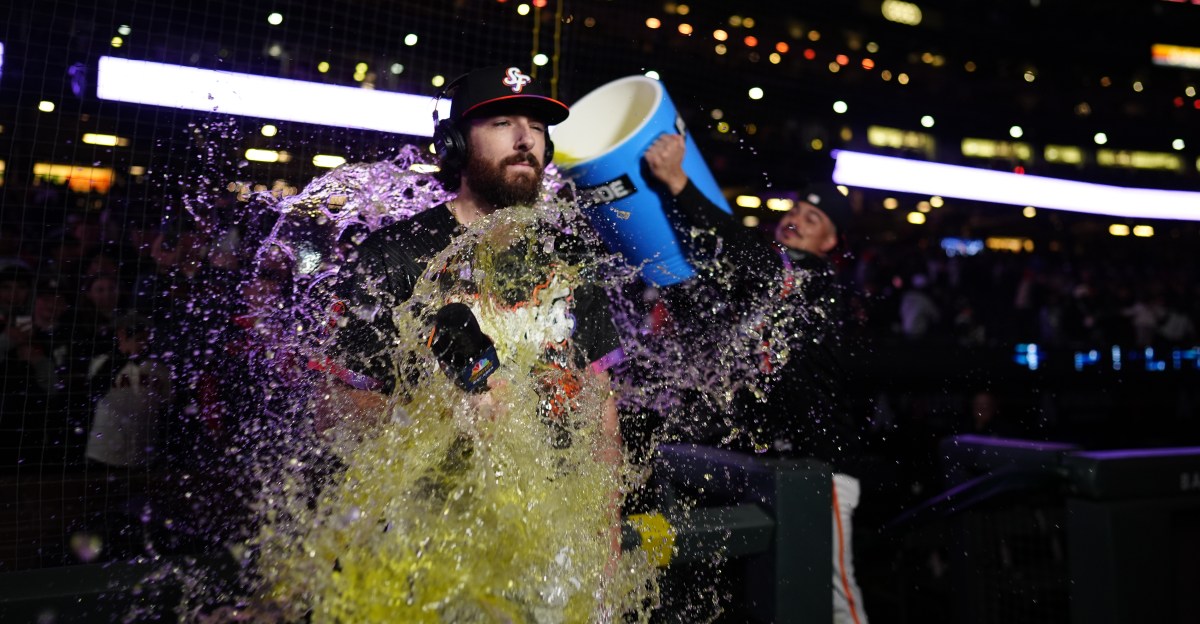
The San Francisco Giants have not developed a reputation for intelligence early this season, but on Tuesday they did something very, very smart. They jumped on Yoshinobu Yamamoto early.
You’re familiar with Yamamoto. You hoped he was as good as everyone said he was when the Giants appeared determined to not be outbid for his services two years ago. You feared that he was as good as everyone said he was when he instead signed with the Los Angeles Dodgers. You confirmed that he was as good as everyone said he was when did his best Madison Bumgarner impression last fall while leading the Dodgers to a second consecutive championship, collecting a World Series MVP award and a top-three Cy Young finish along the way.
So the Giants did the sensible thing. They pounced before Yamamoto had time to realize where he was.
Willy Adames led off the bottom of the first inning with an infield single, and took second on an error by shortstop Hyeseong Kim. Luis Arráez followed by doing the one thing he does better than anyone on the planet: hitting a single.
Yamamoto was just seven pitches in, and found himself both in trouble and unsure what had happened. Lost in a haze of confusion and crisp Bay Area fog, he proceeded to walk Matt Chapman, loading the bases with no outs.
The Giants are not always prepared to capitalize on these situations. You might go so far as to say that they’re rarely prepared to capitalize on these situations.
But they capitalized on this situation.
On the very next pitch, Rafael Devers looked nothing like his old self, as he barely made contact on a get-it-in fastball, ever so lightly dusting a foul tip into Dalton Rushing’s glove.
But on the pitch after that, Devers looked very much like his old self, dipping below the zone to grab a sinker and still smacking it loudly into the outfield, scoring a run.
The Giants had achieved the rare act of capitalizing, and had a rarer act left in their back pocket: adding on.
Casey Schmitt hit next and flew a ball into left field, scoring a run on a sacrifice fly which, it turns out, was the absolute best-case scenario for the Dodgers. Despite it being a fairly routine fly ball for Teoscar Hernández, center fielder Alex Call flew full speed after it, robbing his teammate of catch and instead gifting him a head-on collision. Miraculously, Call hung onto the ball. Even more miraculously, neither player was injured on the type of play that catches an entire stadium’s collective breath.
After the dust from that had settled, Jung Hoo Lee wisely seemed to predict that Yamamoto would be a little out of sorts, and so he jumped on a first pitch curveball that hung up in the zone, and toasted it into right field, scoring a third run.
Just like that, the Giants had put a three-spot on Yamamoto and forced 26 pitches out of him. The ref was counting to 10, and the star pitcher was wobbling his way back to his feet and falling against the ropes.
And then Yamamoto retired the next 10 batters he faced, quickly and with almost dismissive ease, and went around the lineup two full times before giving up another hit.
Things got entertaining when he did finally give up another hit, though. In the sixth inning, the Northern California rain started to come down in droves. But being the grandson of one adverse weather condition apparently gets you in with all adverse weather conditions, as Lee was utterly unbothered by the large amounts of water falling on his face, and again hit a single to right field, this time with two outs and nobody on, giving him his sixth multi-hit game in the last 10 contests.
Heliot Ramos followed and, I’m pleased to report, the swing that he found in Washington D.C. appears to have made the trip back to the West Coast, as he worked the count full before blasting a 108.5-mph single right back up the middle.
Which is where the fun — and pain — began.
Lee, who had a two-out jump, who knew that the wet baseball would be hard to throw, and who had watched for innings on end as none of his teammates could get a hit off of Yamamoto, decided to try to score.
A hard-hit single that was directly to the center fielder.
More accurately, Héctor Borg took all of that into consideration, saw the speed at which Lee was flying at, and watched Call lazily get the ball back in, and decided what the hell, let’s get funky.
It didn’t work, but it was fun. And in Borg’s defense, it took a wonderfully-thrown relay by Alex Freeland and a perfect tag by Rushing to retire Lee, and I’d put the odds of that not happening as higher than the odds of Drew Gilbert getting a rain-soaked hit off of the second-best pitcher in the National League when they’re in a flow state that we sports mortals simply cannot relate to.
But Lee was out indeed, and in more than one sense of the word. He walked off the field gingerly, and was replaced two innings later by Jerar Encarnación. Thankfully, the Giants did not sound concerned about the injury, which Tony Vitello described as a banged-up right quad. Unfortunately, the Giants do not have a great track record with expressing a lack of concern in an injury. But that’s an issue for another day.
Yamamoto returned for the seventh inning and struck out Gilbert, Patrick Bailey, and Adames, in order, all looking, capping an exceptional night that had felt impossible just six innings earlier: seven frames, six hits, no extra-base hits, two walks, and seven strikeouts.
But the Giants had not only jumped on him early, but stacked more than half of their baserunners in one inning, using sequencing to get a few runs on the board. And now all that was left was to rely on the pitchers, and hope that they could teach Yamamoto about the glorious and dreadful (but today just glorious) art of The Caining.
It’s funny. When you watch sports with a rooting interest, you inherently see everything through the lens of your team. The old adage that hitters don’t hit home runs, but rather that pitchers throw them, is emphatically true when your team is pitching. And it’s a crock of manure when your team is at bat.
Such it is that when we think of a Caining — or a Webbing, to use the parlance of the youths — we associate it with the Giants hitters being feckless numbskulls incapable of the teensiest shred of offensive life. We never really frame it as a great pitcher showing off their talents at the Giants’ expense. But really, it’s both.
Roupp’s season has been a revelation, and with every start he inches a little further away from “encouraging start to the season” and a little closer to “wait a dang minute, this guy might be really, really good.” But he hadn’t faced a team like the Dodgers this year, and this felt like the test. And it felt like he knew it was a test, and was screaming the answer when he opened the game by striking out Shohei Ohtani, something he would do twice on the day.
It also felt like Roupp was yelling his answer when, after ceding a two-out first-inning walk to Freddie Freeman when Bailey chose not to challenge a pitch that probably was strike three, Roupp calmly took his spot on the mound, glared at the opposing hitter, and needed just two more pitches to end the inning.
But it was the third inning where Roupp really stated his top-of-the-rotation case, when he struck out Freeland swinging, then struck out Ohtani swinging, then struck out Kyle Tucker swinging. That’s a whole lot of hundreds of millions of left-handed dollars (a few even not deferred!) that Roupp mowed down easily, with both a demeanor and a talent that look more and more like Bumgarner with every passing day.
Yet while Roupp’s excellence was the main story of LA’s stuck-in-first offense, it was the fourth inning where the Caining really transpired. That’s the inning where the Dodgers and their fans shook their heads and questioned how this could happen to them, while Yamamoto sat somewhere on the bench wondering why his own teammates hate him so much.
Freeman opened the inning by drawing a walk. Hernández worked three balls before rolling over a pitch, hitting it softly into a fielder’s choice. Max Muncy walked. And then the play that briefly shifted momentum: Rushing took a 3-1 curveball, called for strike two. He challenged, and won by what could generously be described as an eyelash. Suddenly the bases were loaded, and there was just one out.
And then Roupp walked Kim, putting the Dodgers on the board and doing nothing to ease the danger of the situation. But after falling behind to Call 2-0, Roupp battled back and, thanks to an infield defense that lived up to its potential and paycheck, got a gorgeous inning-ending double play.
Roupp’s fifth inning was much cleaner, as he took down the side in order, sandwiching an Ohtani fly ball with Freeland and Tucker strikeouts. It was an outing that, true to the Bumgarner comparisons, was as steeped in grit as it was in talent. He needed a career-high 106 pitches to get through just five innings. He threw just 58 of those pitches for strikes. He walked five batters, including a run home.
But he gave up just one hit — a soft two-out line drive by Kim — and that one run was the only one he would allow.
Baseball enthusiasts and keen eyes alike will note that Roupp pitching five innings still left four innings unaccounted for, and the Giants were legally required to give those innings to the bullpen, which really added to the Caining/Webbing of the Yamamotoing. No Dodgers fan will sleep well tonight with the thought that the Giants bullpen preserved a lead for four innings, and, armed with that knowledge, you should sleep well tonight.
But Vitello pressed the right buttons, and, more importantly, the arms delivered.
Against an almost entirely left-handed lineup, Vitello turned to lefty killer/killed by righties southpaw Ryan Borucki for the sixth, and it was the perfect time to go in that direction. Borucki easily dismissed of three lefties — Freeman, Muncy, and Rushing — and did so with such comfort that you barely noticed that a righty (Hernández) snuck in there to bop a double that went nowhere (righties are now hitting 8-15 with four extra-base hits against Borucki this season).
Vitello stacked his lefties, turning to Matt Gage in the seventh, who got two quick outs before walking Freeland.
That brought up what was, at the time, the most intriguing bullpen decision by Vitello, and one that you rarely ever see. With his lefty reliever cruising, looking good, and having thrown just 14 pitches, and with a trio of left-handed hitters up next, the Giants skipper trudged out to the mound, took the ball, and brought in a different lefty. The oh-so-rare lefty-replacing-lefty.
But if you know anything about Erik Miller, it’s that no one on earth has proven as capable of getting Ohtani out, and so Vitello turned to his secret weapon. And in a cruel twist of fate, Ohtani hit a soft infield single to keep the inning going.
Just long enough for Tucker to strike out swinging.
Vitello’s decision to turn to Miller was unconventional, but it was both savvy and analytically sound. What happened in the ninth, however, was a bit more controversial.
After a smooth eighth — Miller retired two batters, and left one runner on for Keaton Winn, who absolutely obliterated pinch-hitter Will Smith, with a nasty sequence of sinkers and splitters — Vitello had a choice to make. I assumed it would be a four-out save opportunity for Winn, who has had perhaps the most electric stuff of anyone in the bullpen this year.
But no. Vitello turned to Ryan Walker. The same Walker who was fresh off a blown save in a similar opportunity. The same Walker who has flirted with disaster enough recently that you can hear — even through the TV — the reaction in the stands as the nerves kick in.
Arguably the biggest selling point of Vitello was his ability to manage players and get the most out of them. Bob Melvin lost his job because once the Giants started slumping they simply couldn’t stop, and that wasn’t just a team issue: it happened at the team level because it happened so frequently at the individual level.
That’s why Vitello is in San Francisco where, he admitted before the game, he finally stepped out to enjoy the local culture on Monday night.
I don’t want to give all the credit for good baseball plays to one of the few people in uniform who wasn’t making baseball plays, but I had to wonder: had Vitello’s motivational ways worked some magic on Walker?
He looked fantastic striking out pinch-hitter Andy Pages, who has been one of the best hitters in baseball this year, on just four pitches. Perhaps Vitello’s show of trust was helping him settle in.
He looked excellent getting Call to fly one out to left field, never falling behind in the count. Maybe Vitello, who has refused to name a closer publicly, has said the perfect things privately.
He looked dynamic striking out Freeland with an other-worldly sinker, then unleashed the roar of someone who felt like himself for the first time in a while. Like someone who has made no attempts to hide that they want to be the closer, and that they believe they should be the closer.
The buttons correctly pressed. A Caining on the other foot. Another data point suggesting Roupp is That Guy. Some timely hits. And a bullpen that maybe isn’t so bad, after all.
Most importantly, LA beaten. By a delightful 3-1 margin.