
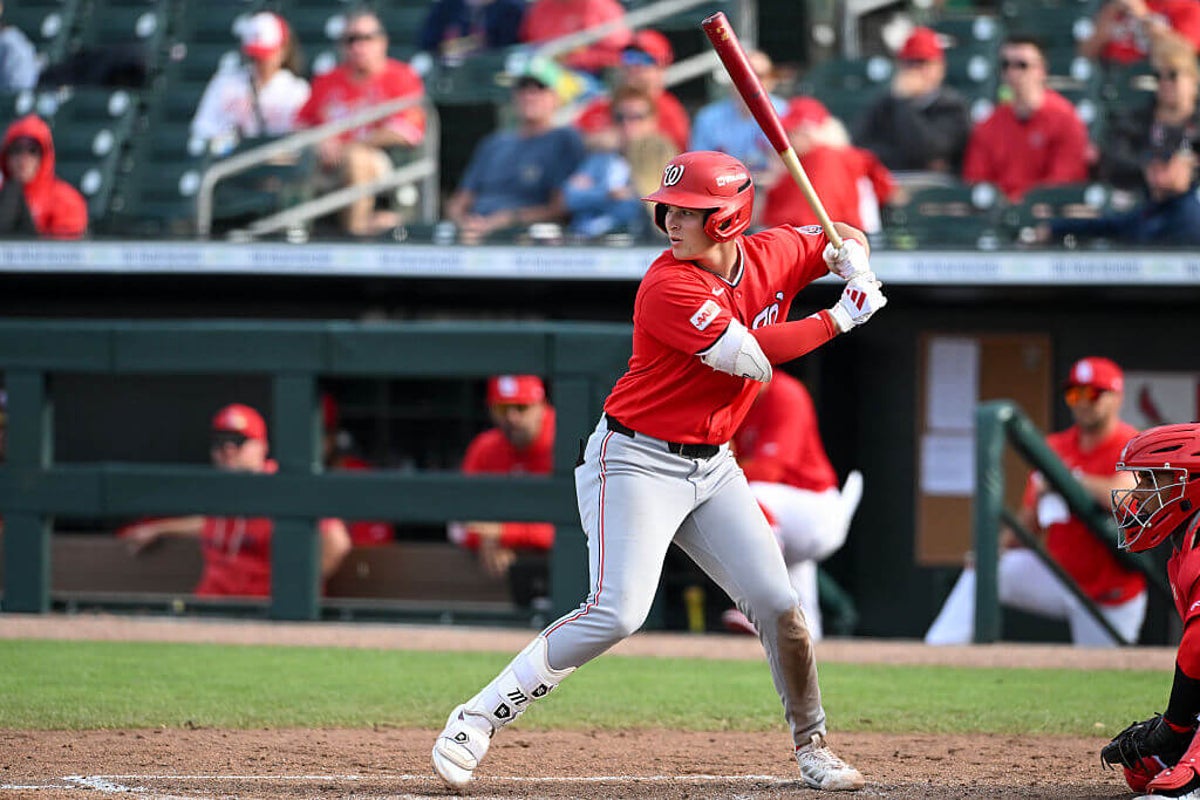
FREDERICKSBURG, Va. — Eli Willits, the No. 1 pick in last year’s MLB draft, heard a guttural scream. He pursed his lips, shrugged his shoulders and apologized. First pitch was three hours away, but as is often the case for the new-look Class-A Fredericksburg Nationals, there was already a competition.
Batting practice last Saturday wrapped up with an intentional choice — a home run derby that pitted the team’s position groups against one another. The infield group, fronted by Willits and loaded with other top prospects, was (and will remain) the team to beat. Somewhere within this bunch, the Washington Nationals believe, are players who will bring them back to relevance.
But on this sunny afternoon, about 50 miles south of Nationals Park, the infielders were up against a former derby pitcher (Dave Jauss, who pitched to Pete Alonso when he won MLB’s version in 2021) and locked into the present. More specifically, they were locked in a tight battle with the outfield and catching groups when someone offered Willits a courtesy swing to see if he could tie the derby back up.
That’s why three coaches and four teammates gathered behind home plate. One teammate yelped and another pumped his fist as Willits’ drive to right-center field landed just short of the wall.
These infielders aren’t supposed to lose. Not now, and certainly not in a few years, when this heralded collection of infielders could help transform the fortunes of the big-league team. Even after aggressively promoting three players to High-A Wilmington, Fredericksburg features four promising infielders, all between the ages of 18 and 20, whose biggest competition might be seeing which one of them makes the majors first.
“We’re super competitive in our practices,” Willits said. “So that when we go to the games, we want them to slow down and feel easier than what it is during practice.”
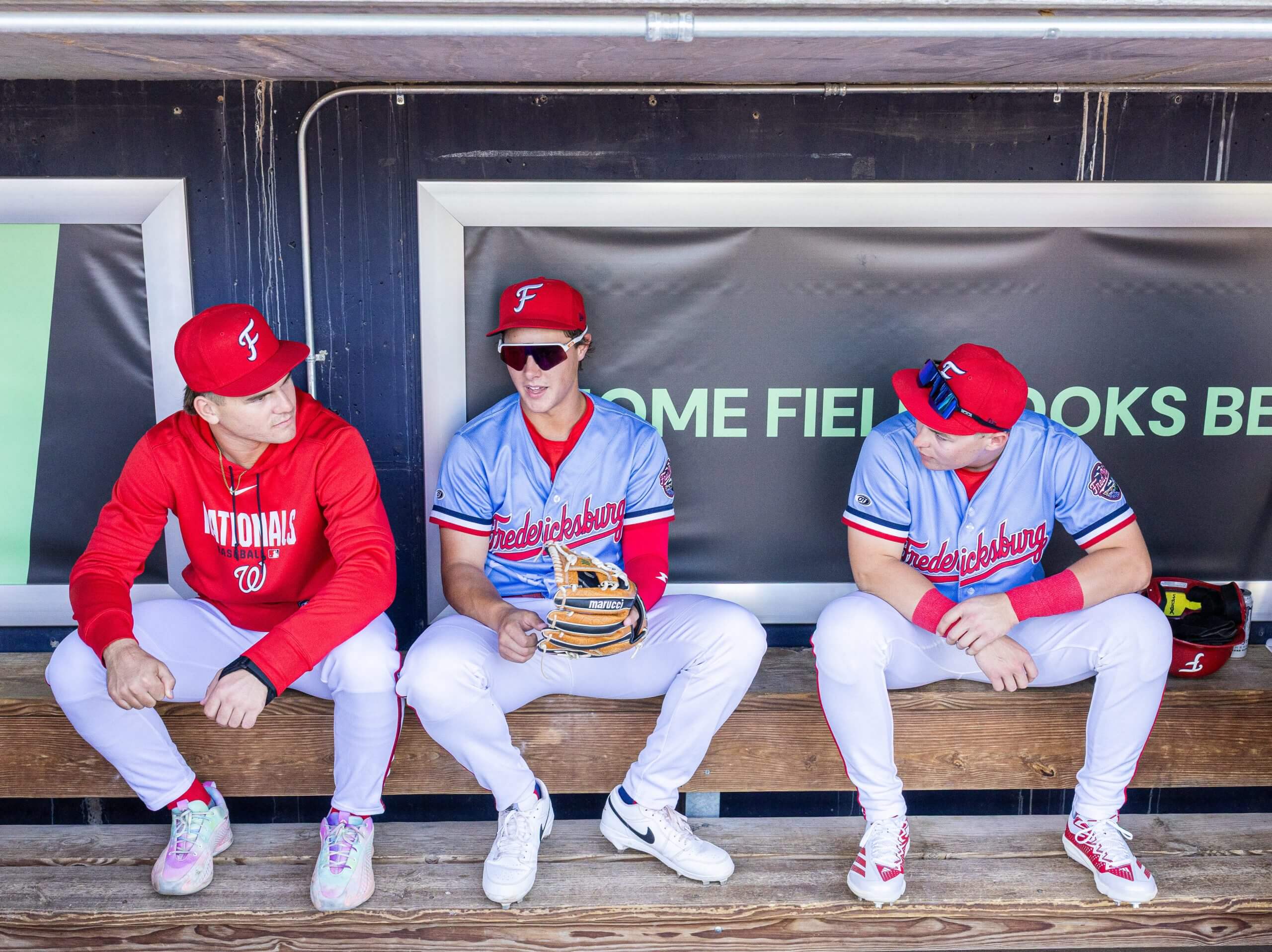
From left, Gavin Fien, Coy James and Eli Willits are among the wave of promising infield prospects making noise in the minors. (Jose Aviles / Fredericksburg Nationals)
At this time last year, Fredericksburg’s infield lacked blue-chip prospects. Between Mike DeBartolo’s draft and trade deadline and Paul Toboni’s moves this winter, the FredNats infield now boasts two of Keith Law’s top 100 prospects in Willits at No. 53, Gavin Fien at No. 76, and two other marquee names in Luke Dickerson and Coy James. Until Monday, it also boasted 19-year-old standout Ronny Cruz, though he was promoted to High-A Wilmington after posting a 1.087 OPS and 15 stolen bases in 14 games.
“We were joking that the hardest decision we were going to have to make all year was who starts in Fredericksburg every day,” first-year farm director Devin Pearson told The Athletic.
The Nationals want to help all of those players become big leaguers. They believe turning the end of BP into a home run derby, for instance, will help them accomplish that. Over the last decade, the Nationals have struggled to develop prospects who could consistently hit the ball in the air. The whole idea is to identify the developmental trait, then create a competition to propel players toward it.
“It pushes you to be better, just kind of drives you when you see all that talent around you,” Fien said. “It’s like, you want to be the best out of them, and they want to be the best out of them.”
Saturday’s derby was just one example. Throughout minor-league camp this spring, the Nats held a tournament in the cages to see who could thwack the most hard-hit baseballs at an optimal angle. During on-field batting practice, the exit velocity and launch angle of every batted ball were displayed on the scoreboard. And when players walk back to the clubhouse, they pass a whiteboard that shows which player has the hardest-hit baseball this month, and which position group currently holds the edge in competitions to see who has hit the most barrels.
Or consider another area where affiliates previously struggled: making better swing decisions.
On most days, the FredNats use pitching machines to train against faster velocities and tougher pitch shapes than they’ll ever see against Class A pitching. When they graduate to better competition at a higher level, the Nationals hope that earlier exposure to nastier pitches will lead to smarter swing decisions. In case that wasn’t enough, every player gets a report in the clubhouse that details their updated chase rate.
In short, the Nationals believe in competition with a specific intention.
“I think it can be easy to get lost in some of the things that you do day-to-day,” first-year Fredericksburg manager Chris O’Neill said. “But when you have the essence of competing at the core, that’s where you really start to see that pre-game work take shape and reinforce how much it matters in their growth and development.”
“It’s something that gets the guys fired up,” Dickerson said. “A little competition never hurt anybody.”
It may not hurt, but it doesn’t make it easy to find playing time for all of these young, premier prospects who entered the system as shortstops.
“This is a unique challenge,” Pearson said. “In Boston, we were very aggressive in trying to give guys positional versatility … In this case, for us, we have a lot of really good infielders, so it’s more about, ‘How do we find at-bats for all of them?’”
The simplest way is through promotions. Before Opening Day, the organization sent Devin Fitz-Gerald and Angel Feliz to High-A Wilmington, though they had just 159 Class-A plate appearances between them, in the hopes that Fitz-Gerald’s bat-to-ball skills and Feliz’s smart swing decisions would translate. On Monday, they promoted Cruz, too.
Fitz-Gerald, who entered Tuesday with a .982 OPS, seems to be on the right track.
Still, that leaves four infielders in Fredericksburg. At the moment, Dickerson is playing third base and center field for the first time in his career. Almost all of Willits’ reps are at shortstop, though he’s spent time at second base. James has spent most of his time in left field, and joked that he probably entered the organization with five total outfield reps in his entire life.
“We can all play different positions, so we’re just challenging each other everywhere,” James said. “When you get in the game, it’s not as stressful because we competed in practice.”
Fredericksburg defensive coach Anthony Ray, who has been tasked with coaching these players from the ground up, said it’s actually been a lot easier than one would anticipate.
“In the outfield, you’re more aggressive. You’re playing fast. You have to have your reaction, prep step, and it’s got to be quick.” Ray said. “They were all already so athletic, so I just get them comfortable with as many reps as possible.”
Then, there’s Fien. The highest-rated prospect in this winter’s MacKenzie Gore trade with the Texas Rangers, the 19-year-old entered the organization after undergoing a November surgery on his throwing hand. Planning his schedule as he recovered was an intensive process. Ultimately, the Nationals decided to try him in the outfield for a few games in Fredericksburg.
The idea was to get his bat in the lineup and have Fien throw from an angle that was more comfortable on his hand than what he’d do at his primary position of third base. But readjusting to a new position after surgery is not easy, and the results were mixed. In one inning, he spiked a throw into the grass. Later that game, he delivered a throw straight to the plate on one hop.
It’s one heck of a learning curve, but these complications will come along the way. When Fien gets back from the injured list — he was placed there as a precautionary measure due to inflammation in his other wrist, Pearson said — they believe he will handle a return to third base.
“Being out for a week or two, (I’ve been able to) watch them and how the lineup is constructed,” Fien said. “And it’s pretty special.”
Special indeed. Willits (.773 OPS) hit his first two professional homers last week and has played a good shortstop after producing softer exit velocities early. James (.826 OPS) has as many walks as strikeouts and hit a thunderclap of a homer on Saturday. Cruz is hitting the ball as hard as almost any teenager, even if the swing decisions remain a work in progress. Dickerson (.923 OPS) is striking out more, but also making better early-count swing decisions, elevating more baseballs and playing a great outfield.
And yet, in Fredericksburg, there is a sense that none of this is enough. Not when, even during the calmest part of batting practice, before the derby, there’s still a need for them to rib their top prospect.
“Hey Eli,” a teammate yelled after softly placing a bunt inside the third-base line. “Take notes.”
Note: Right-hander Alejandro Rosario, whom the team acquired in the Gore deal this winter, underwent Tommy John surgery last month. He missed all of 2025 and will miss all of 2026 as he recovers.