
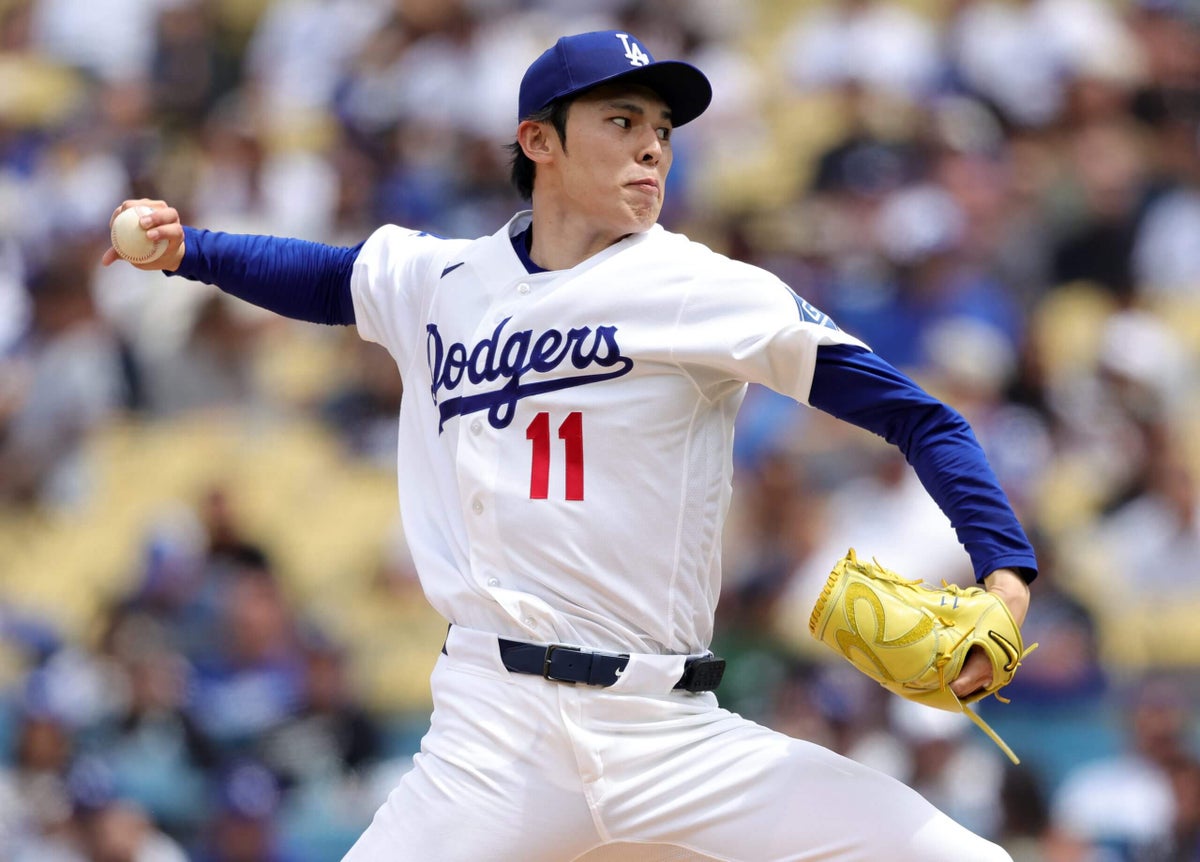
The first real turbulence of the Los Angeles Dodgers’ season arrived this week, when the club’s new high-priced closer slipped into an MRI tube and ended the day scheduled for elbow surgery on Wednesday in Los Angeles. It’s hardly the way anyone envisioned Edwin Díaz starting his Dodgers tenure.
Now, the ninth inning is one of several questions surrounding the two-time reigning World Series champions. Their 16-7 start has largely been a smooth ride.
There are other topics, as well. Thanks to all who submitted questions, some of which were edited for length and clarity.
How much of a runway do the Dodgers give to Roki Sasaki? I know the standard answer is that they didn’t sign him long-term for him to be a reliever. — Willie A.
Sasaki will continue to start until the Dodgers no longer believe he is a viable option there long-term. Emphasis on long-term. I don’t think anyone thinks the Sasaki experience as a starter has gone well. But it has been 12 career big-league starts, and the Dodgers have the luxury of rolling him out there in hopes something clicks without it affecting their ability to compete for a spot in October.
It’s not clear that Sasaki would be any better in the short-term as a reliever. His stuff got a boost in a short burst last fall, but the bloom was off the rose a bit from the NLDS on in October. It’s not as if he’s able to miss a ton of bats with his fastball. If you pull the plug on him as a starter now, you’re admitting defeat on your ability to get the most out of him.
Sasaki has an expectations problem, which didn’t get any help when general manager Brandon Gomes compared him to Paul Skenes during his introductory press conference with the Dodgers. “If he continues to develop, it’s Cy Young contender. I mean, I’ve seen the Paul Skenes comp. I think it’s definitely Cy Young caliber,” he said then. “To have done what he was able to do in Japan at this age and there’s room to get better, it’s really exciting and impressive.”
Instead, Sasaki has shown he is not the same guy he was at his peak in Japan. The fastball shape can’t support any dip in velocity. Sasaki averages 97 mph on the pitch, and opposing hitters are hitting .400 with a .686 slugging percentage against it. He isn’t in the strike zone enough to maximize his signature forkball. Sasaki’s new slider might be the best development of his season, but that hasn’t been enough.
There were major questions about Sasaki even when he first came over stateside. Much of the frenzy around him was because he was a known name and cost a relative pittance compared to other similarly talented pitchers on the open market. It wasn’t because he looked dominant in his final season in Japan.
The Dodgers have essentially treated Sasaki, 24, like a pitching prospect because he is one. He was not the same finished product Yoshinobu Yamamoto was when he came over, which has made all comparisons to Yamamoto difficult to square.
Viewing Sasaki through the lens of a pitching prospect buys him some grace. But really, he is possibly the most talented and still has the highest ceiling of their pitching prospects as they try to extend this window. Each start he makes in April is more about beyond this season than it is about Sasaki suddenly sprouting into an All-Star.
What is the latest with Mookie Betts? Do we have any timeline for him, even a broad one? For example, should we expect him back in the lineup by May 15? — Michael B.
Broadly, it will still be a bit before Betts is back in game action. The Dodgers have taken this slowly; they don’t want this to linger and (as you’ll see is a repeated trend in these answers) the team can afford to play the long game.
There has been progress. Betts started his hitting progression on Saturday in Los Angeles. That was the biggest hurdle for him, as it is for any player coming off an oblique injury. So much of Betts’ swing depends on quick-twitch ability and rotation while keeping his body in sync, which means it’s paramount that his oblique is at 100 percent. The Dodgers have succeeded without him, and there is a benefit to getting an extended look at guys like Hyeseong Kim and Alex Freeland at the big-league level with big decisions ahead.
How do you see the roster shaking out when Mookie, Tommy Edman, and Kiké Hernández come back? Will there be room for Kim or Freeland? — Phil D.
Has Kim’s stock grown in the team’s eyes now that he looks like a competent hitter and has surprisingly been able to play shortstop at a high level? That sounds like a future starting shortstop to me. — bluegoon82 on X
Let’s project a world where Betts is the first of these three to return. That scenario would essentially spark the same position battle the Dodgers sorted out in spring training between Kim and Freeland. It was telling that Freeland essentially got the everyday at-bats when Betts hit the injured list, but not surprising; the Dodgers don’t seem that comfortable with Kim facing left-handed pitching.
Freeland has had some moments at the plate and flashes a good glove, but his poor spring hasn’t given way to a productive April. He is chasing more and making less contact than he did during his unproductive first big-league stint last season.
Kim has looked better, but still had just 32 plate appearances in the big leagues this year, entering play on Tuesday. It’s a small sample. The eye test shows that his swing is a little more consistent than it was in spring training. Kim isn’t chasing as often, though that hasn’t resulted in more contact.
If I were constructing a postseason roster on April 22, Kim would likely be a better fit. But I would also understand the argument that Kim would be better served than Freeland to see everyday at-bats in the minors.
Whoever wins that “battle” likely gets to hold on until either Kiké Hernández or Tommy Edman returns. Hernández, in particular, would fill the same right-handed utility role that Santiago Espinal has played this season.
It would be uncharacteristic for the Dodgers to offer an extension this early, but should the front office consider it for Andy Pages? — Jay O.
This is a subject I touched upon last month. The short answer: the Dodgers haven’t broached extension talks with Pages and his camp.
His arbitration status has a wrinkle. Pages is super-two eligible, meaning the 25-year-old will essentially get four cracks at arbitration (starting this offseason) instead of three and has a better chance to make some real money before he hits free agency. The Dodgers have discussed extensions for homegrown players during this era, but the biggest deal they’ve gotten done was the 10-year, $140 million deal for Will Smith just a couple of years before he was set to hit free agency.
The argument for extending Pages is simple. The organization has a bevy of talented outfield prospects, but the hope is that at least one or two of those names turn into a player as productive as Pages can be. Unlike most of that group, Pages has already proven he can play center field.
A Pages extension would make some sense. I also would be surprised if it happened, at least this far removed from free agency. The Dodgers can afford to let things play out and see how Pages develops. If it costs them a little money on the back end because Pages plays himself above the type of pay he’d get now, it’s a trade-off the Dodgers are probably willing to absorb.
Will the Dodgers make a run at Skubal before the trade deadline? — Anonymous U.
I’m going to address this now in the futile hope I won’t get this question in the future.
The Tigers entered Tuesday with a 71.2 percent chance of making the postseason and 52.2 percent chance of winning the AL Central, according to FanGraphs’ playoff odds. Those odds have the Tigers with a better chance of winning the World Series (5.9 percent) than the following clubs, among others: the Toronto Blue Jays, Philadelphia Phillies, New York Mets and Chicago Cubs.
It would be a stunning slap in the fans’ face to see the Tigers entertain moving Skubal in the middle of a season in which they appear to be in contention, even if they believe Skubal would walk in free agency.