
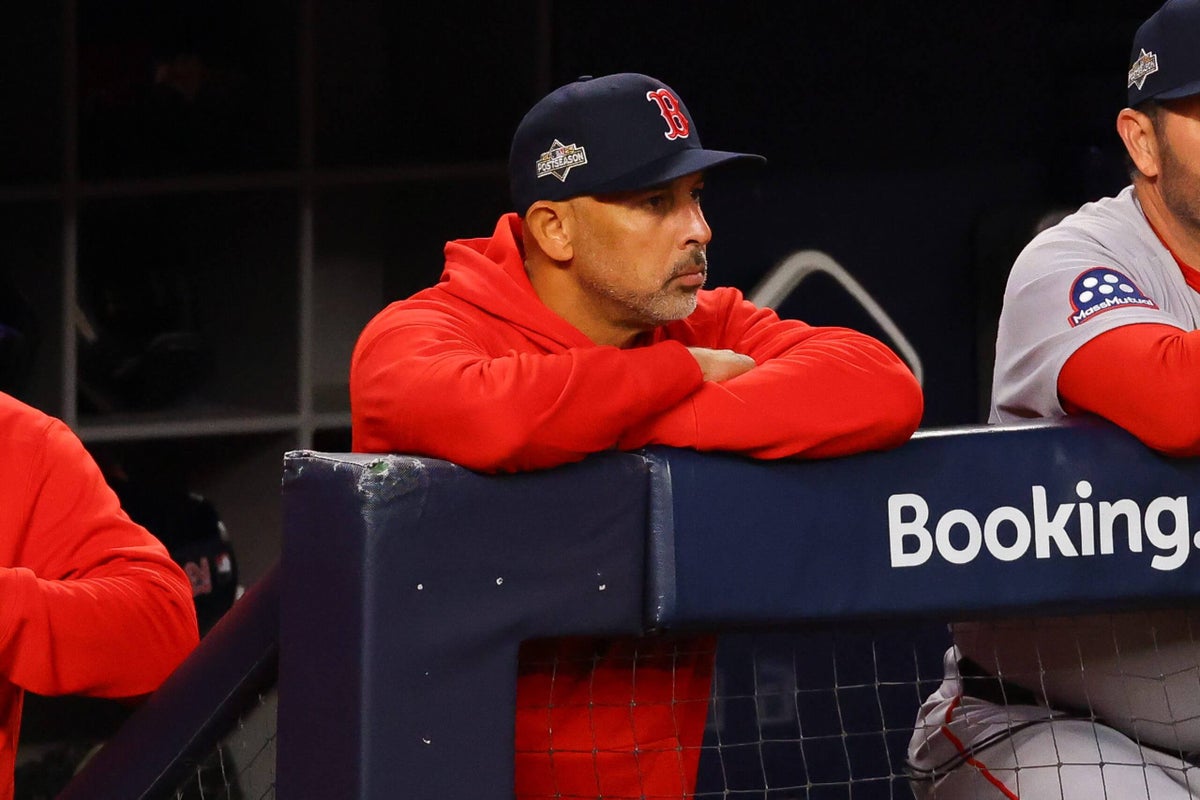
Hours after the Boston Red Sox walloped the Baltimore Orioles 17-1, the team’s most lopsided win in an otherwise dreadful season, Alex Cora returned on Saturday night to the Four Seasons Hotel Baltimore. Awaiting him there, a league source told The Athletic, were principal owner John Henry, CEO Sam Kennedy and chief baseball officer Craig Breslow. They soon informed the manager that he had been fired, along with several members of his coaching staff.
Despite the team’s awful 10-17 start, the moves were swift and unexpected.
Around 6:30 p.m., as two members of the coaching staff headed out to dinner, they passed another team employee. The coaches told their colleague that they’d see each other again on Sunday. About 30 minutes later, both coaches were among those who were dismissed.
In addition to Cora, the Red Sox fired five members of the coaching staff: hitting coach Peter Fatse, third-base coach Kyle Hudson, bench coach Ramón Vázquez, assistant hitting coach Dillon Lawson and major-league hitting strategy coach Joe Cronin.
Spared in the firings were pitching coach Andrew Bailey (a close friend of Breslow’s from his playing days), as well as first-base coach Jose David Flores, bullpen coach Chris Holt, catching instructor Parker Guinn and assistant hitting coach John Soteropulos. Jason Varitek, the former game-planning coordinator, will have a new role with the team.
Triple-A Worcester manager Chad Tracy — son of former big-league manager Jim Tracy — will take over as Boston’s interim manager. Double-A Portland manager Chad Epperson will serve as third-base coach. Both Tracy and Epperson managed top prospects Marcelo Mayer, Roman Anthony, Payton Tolle and Connelly Early as they came up through the system the past few seasons. Former Triple-A hitting coach Collin Hetzler will serve as a hitting coach on the major-league staff.
Tracy, 40, was managing Triple-A Worcester on Saturday evening when he left the dugout in the third inning to head to the clubhouse, according to a league source. That’s where he received news he’d been named the Red Sox’s interim manager. Defense coach Iggy Suarez took over in-game as acting manager while Tracy processed the news, eventually leaving the ballpark to head to his home right behind Polar Park and pack his bags for Baltimore.
On Friday, coming off a three-game sweep by the New York Yankees as the team began a six-game road trip, Cora did not explain why he was roughly 45 minutes late to his media availability session. While Cora can sometimes be late for his media sessions, the excessive tardiness was odd, perhaps the first indication that something more than the record was amiss.
While Cora and the coaching staff are taking the fall for the immensely disappointing start to the season, there is no denying that Breslow created a disjointed roster for Cora entering this season.
Breslow’s public pivot this offseason from needing to add more to the offense to doubling down on pitching came after a failure to re-sign Alex Bregman in January. Bregman unified and stabilized a young clubhouse in 2025 and was also close with Cora, dating back to their days together in Houston.
Through the early part of 2026, the Red Sox have appeared to miss Bregman’s presence and leadership as they’ve flailed at the plate and in the standings. Veteran Trevor Story offers more of a lead-by-example model, and newcomer Willson Contreras, while a leader in his own right, missed most of spring training while away at the World Baseball Classic. Some in the industry have speculated that Breslow miscalculated on how big a presence Bregman offered the young club, leaving Cora to figure out how to handle it all.
Cora toed the company line all offseason and into spring, saying he would find a way to make things work with the roster, particularly in rotating five players — Jarren Duran, Ceddanne Rafaela, Wilyer Abreu, Masataka Yoshida and Anthony — through three outfield spots and designated hitter.
Some within the coaching staff this offseason felt an outfielder needed to be moved to clear up the logjam. A move never materialized despite the Red Sox seeking trade partners for Yoshida as late as the final weekend of spring training.
Before the season even began, Cora began to acknowledge the strain the outfield situation could cause.
“It’s not easy,” he said on Opening Day in Cincinnati. “Whoever thinks that this is easy to move them around, they’re wrong. I’m going to say it like that. It’s not that easy, but I’ll make it work.”
Red Sox ownership had remained staunchly loyal to Cora after hiring him in 2018 and watching him steer the organization to a World Series championship. The Red Sox even re-hired him in 2021 after he was fired in 2020 for his involvement in the 2017 Houston Astros sign-stealing scandal.
From 2021 through his abrupt departure Saturday evening, the Red Sox heavily supported Cora despite the team making just two postseason appearances during that span. Coinciding with their playoff drought was a scaling back of payroll relative to the rest of the league’s big-market teams. Cora was tasked with doing more with less, in a sense. For that, ownership rewarded him in 2025 with a new three-year deal.
Throughout his tenure in Boston, Cora was lauded for his communication skills in his first big-league managerial job — not only because he is bilingual, but because he understood the unique grind of the Boston market as a former player.
When asked in spring training how Cora might manage a complex roster situation, Breslow was complimentary.
“I think Alex is masterful at using the entirety of a roster,” Breslow said Feb. 11. “I think he’s at his best when there’s flexibility, when he can find the right matchups for players. And he’s such a strong communicator that everyone understands the way that they fit into the bigger picture. And so I suppose there’s the possibility that too much optionality can be difficult to manage, but I don’t see that being an issue with Alex.”
Breslow, who’s in his third season on the job, was also keenly aware entering the 2026 season that his own job status would be under more scrutiny. That was especially so given the truncated timelines of his three predecessors — Ben Cherington, Dave Dombrowski and Chaim Bloom — who were each fired within their first four years as leaders of baseball operations.
“As soon as you start thinking about (the end), you’re probably defeated,” Breslow said this spring. “The obligation I have to the organization and to our fan base is to try to build the most competitive team we possibly can, and that is completely independent of what or for how long I have this job. That’s firmly where my focus is.”
Rather than wait to be fired, Breslow, with ownership’s blessing, did the job first.