
1914
Joe “The Butcher Boy” Benz, (so named because he worked as a butcher in the offseason) fired a no-hitter, beating Cleveland 6-1 at Comiskey Park. The lone Naps run, scored in the fourth inning, came out of three consecutive White Sox errors. Benz walked two and struck out three on the day.
It was the second time in 17 days a White Sox pitcher had thrown nine no-hit innings. On May 14, Jim Scott went nine frames without a hit, then lost his no-hitter (and the game, 1-0) on two hits in the 10th at Washington.
1950
White Sox GM Frank Lane made a six-player deal with the Senators that included former All- Star second baseman Cass Michaels (real name Casimir Kwietniewski). The move was important, because it cleared the way for a youngster named Nellie Fox to take over full-time at the position; that year, Fox would play in 130 games and register 497 at-bats.
1970
The torpid White Sox, on their way to the worst single season in franchise history, annihilated the Red Sox in Boston, 22-13. The South Siders banged out 24 hits, with Luis Aparicio and Walt Williams collecting five apiece. Williams scored five times, and Bill Melton knocked in four runs. Chicago had innings where they scored seven, six, four and three runs.
The victim that afternoon? None other than former White Sox star pitcher Gary Peters, who was knocked out of the box in the first inning. It was the second-most runs ever scored in a single game by the White Sox.
1971
In the nightcap of a doubleheader with the Orioles at Comiskey Park, former White Sox infielder Don Buford charged pitcher Bart Johnson with his bat after Johnson drilled him with a pitch that hit him in his behind in the eighth inning. When Buford went out to left field in the last of the eighth inning, Sox fans pelted him with garbage and vocally let him know what they thought of his actions.
Cooler heads prevailed, but in the ninth inning while standing in the on-deck circle lecturing a fan, Buford was attacked from behind by a second fan, who escaped … onto the field! Buford was alerted by White Sox players yelling from the field, because they could see what was unfolding. Buford knocked the fan out with one punch, then his Oriole teammates charged out of the dugout and did a bloody number on the trespasser before security could lead him away.
Buford was ejected from the game by umpire Nestor Chylak for going to the screen to warn fan in the first place, antagonizing the situation.
The teams split the doubleheader that afternoon.
1973
It was an inauspicious debut for a player who’d make himself into a fine big-league hitter. In a game at Chicago that the Sox won, 10-2, Brian Downing entered the game in the seventh inning to make his big-league debut at third base.
On his first play in the big leagues, in fact on the first pitch, Downing caught a foul pop off the bat of Detroit’s Dick McAuliffe, diving to make the catch. On the play, though, Downing ripped up his knee and was placed on the injured list.
Downing would collect his first big league hit in August, an inside-the-park home run off of Mickey Lolich in Detroit.
1978
The White Sox trounced California, 17-2, with a 22-hit attack.
The game turned into a rout in the fifth inning, when the Sox turned a 1-1 game on its head and exploded for 11 runs. Fifteen White Sox came to the plate, with Greg Pryor singling and doubling, Jorge Orta singling twice — and Lamar Johnson making two of the inning’s outs. Three Angels pitchers were victimized by the ex-Hit Men, none worse than recent White Sox hurler Ken Brett, who relieved in the frame but was knocked out of the box having retired just one Chicagoan. The hurlers were done no favors by two errors in the inning.
On the White Sox side, Steve Stone somehow weathered that endless fifth to complete the game and improve to 4-3 on the year.
That run output ties for 38th-most ever by the White Sox, and the 22 hits rank tied for 24th.
The rout zeroed out a 5-2 homestand and marked a fifth straight win. The South Siders would win two more on the road, stretching the win streak to seven, before losing again. However, the White Sox were floundering, stuck in sixth place even after the win streak and improving to just 17-28 with this romp.
2000
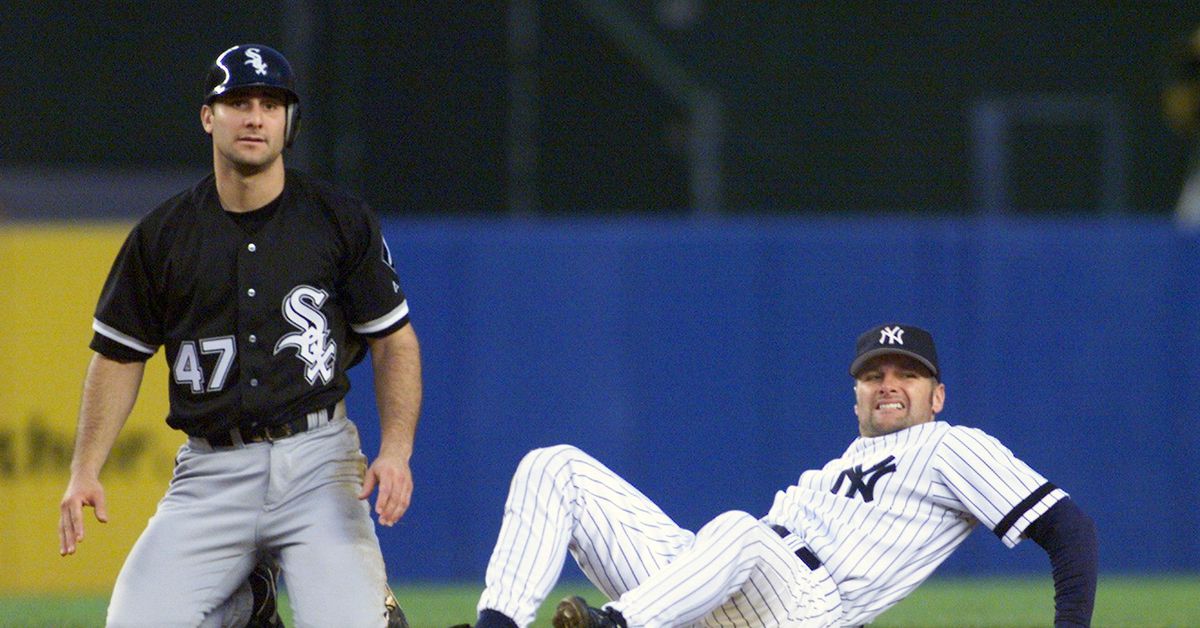
The White Sox swapped relief pitcher Tanyon Sturtze to Tampa Bay for infielder Tony Graffanino. Graffanino was excellent in 2000 and over the next three seasons, increasing his WAR each year and serving as a superb utilityman covering shortstop, second base and third. Sturtze was having a horrific (-0.8 WAR) season in Chicago but recovered for a 1.6 WAR and 2.56 ERA as a swingman in Florida; in the next season (2001), Sturtze was outstanding, garnering 3.3 WAR primarily as a starter, pitching almost 200 innings to a 4.42 ERA.
Graffanino even gave the White Sox assist later in his career, committing a key error for the Red Sox in Game 2 of the ALDS in Chicago.
2007
Mark Buehrle lost to Toronto, 2-0, giving up solo home runs to Aaron Hill and Frank Thomas. That’s it: No other hits, walks, or Sox errors in the game. Thus the Blue Jays became the first team ever to win a game without a single baserunner.
The White Sox only twice even had runners reach third base, with one, Rob Mackowiak, thrown out at home.
Despite the loss, Buehrle also became the first White Sox pitcher since Joe Horlen in 1967 to throw a no-hitter and a complete game of only two hits or less in the same season.