
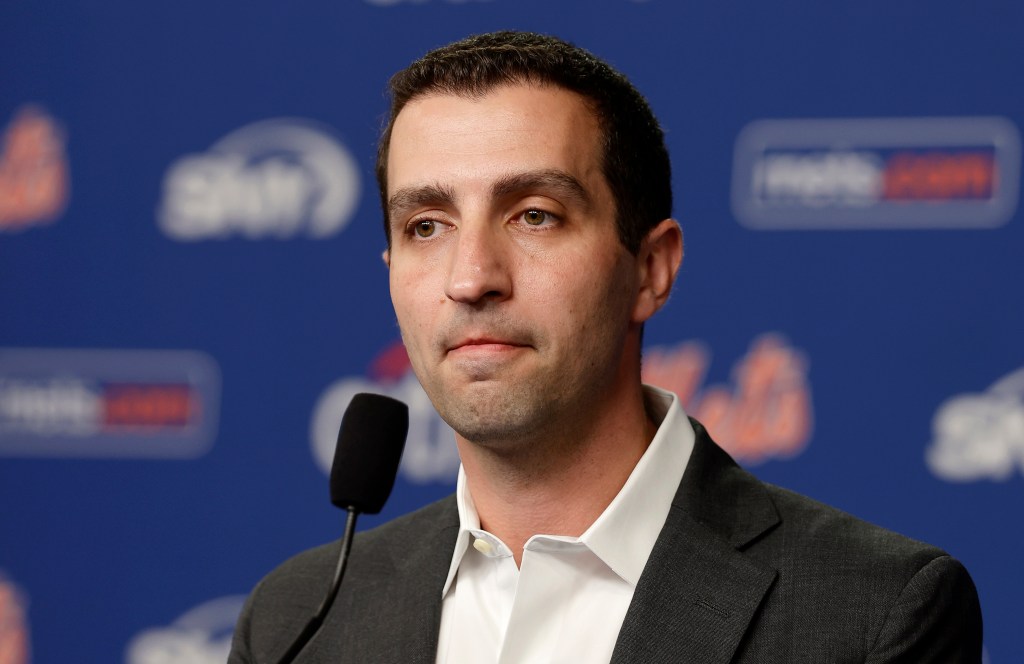
Hours after firing his handpicked manager, Carlos Mendoza, the Mets’ handpicked president of baseball operations, David Stearns, stated that the team’s shortcomings fell squarely on his shoulders.
“I have not felt we have an accountability problem,” Stearns said Friday at Citi Field. “We have an execution problem. We haven’t played good enough baseball.”
The Mets might be one of the most expensive teams in baseball, but talk is cheap.
A team with World Series aspirations and a World Series payroll is crumbling under the weight of the expectations this season, currently sitting in last place in the NL East with a 34-47 record, the third-worst in the NL and the seventh-worst in baseball.
Stearns might be too.
He didn’t exactly back up his words as he fielded questions about the direction of the organization, and he didn’t even inform most of the players himself. Some received a text from Stearns, but many saw the news on social media before receiving calls from other front office staffers.
Francisco Lindor did what any team leader is supposed to do in that situation by saying the team’s failure to execute this season is what cost Mendoza his job. Considering he’s only played 25 games this season, it almost felt unfair for him to be the team spokesman. Lindor only returned to the team Wednesday after missing the last two months of the season with a calf strain.
“We failed Mendy,” Lindor said. “I failed Mendy. I didn’t play up to my capabilities to help the team win as many games as we could, and this one is on us as well.”
Juan Soto, the team’s highest-paid player who signed a $15-year, $716 million contract before the 2025 season, was nowhere to be found. In the past, fans could reliably count on hearing from long-tenured homegrown Mets, like Brandon Nimmo, Pete Alonso, or even Jeff McNeil. But Stearns rid the Mets of all of them, plus others, in an attempt to dismantle a core that he didn’t think could win.
In their places are talented players who haven’t been posted the kind of numbers they have with other teams, and who have little connection to the team, the city, or the fans. Bo Bichette looked shellshocked when asked for his thoughts on the managerial change.
“If we were playing better, he’d still be here,” Bichette said. “So yeah, it’s just unfortunate he had to take the fall.”
Bichette is one of those underperforming players, though he has looked more like the player he’s been throughout his career as of late. The former Toronto Blue Jays shortstop signed a three-year contract worth $126 million as a free agent in January, with the caveat that he would play third base for the first time in his professional career. That meant Brett Baty had to play elsewhere. Jorge Polanco, an injury-prone veteran, was signed to play a new position as well, and made it two games before he was injured again.
The one switch that has worked out is moving Soto to left field from right.
The team has been hit hard by injuries this season, something Stearns has repeatedly cited as a reason for the team’s struggles, but he shouldn’t be surprised since he was the one who acquired them. The Harvard-educated analytics wiz put together a team that, on paper, was projected to win more than enough games to reach the playoffs.
What he failed to account for is the human element of the game. Any human who has watched the Mets this season can tell you there is a lack of chemistry, cohesion, fundamentals and personality.
He sidestepped questions about the players he brought in this season, and he sidestepped questions about where Mendoza failed. All of those fancy formulas and the Mets still haven’t been able to identify, or at least articulate, any tangible reasons as to why they have played so poorly.
“I believe in the talent that’s in our room,” Stearns said. “But belief on its own does not lead to results.”
What he did communicate clearly was that Andy Green will only be an interim manager. The Mets’ farm director since 2024 and a former manager of the San Diego Padres, Green willl return to the front office after the season concludes to be able to spend more time with his family.
“This felt more like a responsibility than an opportunity,” he said.
Stearns, a 41-year-old New York City native and lifelong Mets fan, still thinks he is the best person to lead the Mets, and he said he has owner Steve Cohen’s full support. It’s not clear who decided to fire Mendoza, but Stearns said the two were “aligned” on it.
That didn’t make it any easier to fire a well-liked manager.
“I think sometimes a new voice, a new perspective, a new view helps,” Stearns said. “Sometimes it’s really difficult to explain why or how, but at this point it was time to try.”
No one can argue with that.
Stearns sets the tone for the baseball side of the organization as the chief executive. The Mets have many problems at the moment, but if they aren’t the players, the coaches or the preparation — he insists it’s not the preparation — then maybe he’s one of them.