
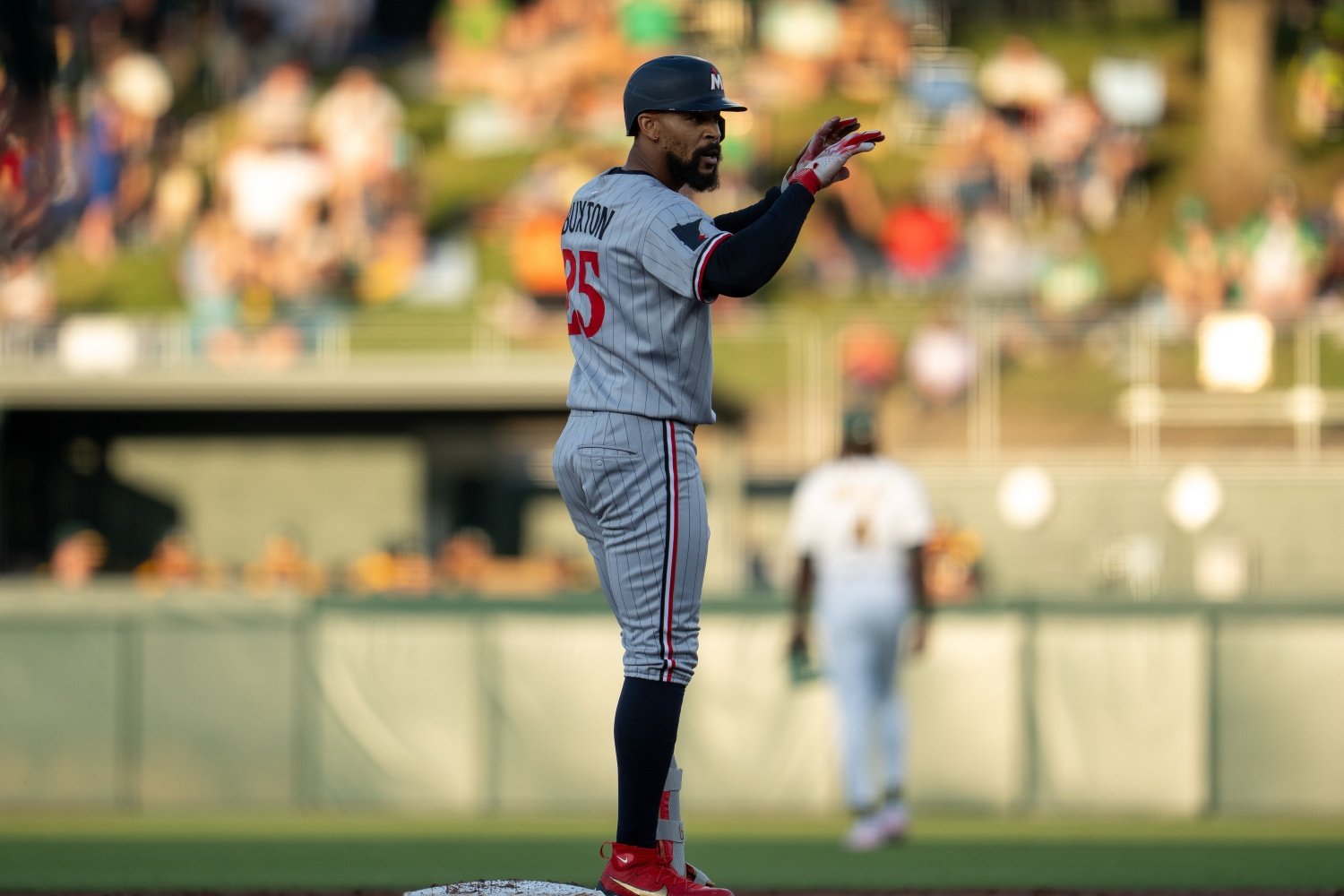
The game was, in a hidden sort of way, very much on the line when Byron Buxton stepped to the plate for the fourth time against Luis Severino Monday night. Yes, the Twins led 6-4, but they’d been stuck on their tally since the second inning, when the Athletics had gifted them about half of their sextet of runs. Meanwhile, the home team had responded with four runs against Joe Ryan, and the Twins starter had narrowly escaped big trouble in the bottom of the fifth. Momentum was flowing the A’s way, and Ryan (though not officially removed, yet) was done for the night.
A Kody Clemens single, a Ty France double and a Christian Vázquez walk had loaded the bases, with the last event proving especially clearly that Severino was vulnerable. He’d taken the early punch in the mouth from the Twins and outboxed them for the following few rounds, but now, he was set to face the top of the order for the fourth time. To extend the analogy, he was very much on the ropes—but the round was nearly over, and the Twins were running out of time to land the knockout blow. Even one more run would be huge, and probably decisive, but there were two outs. Severino was just one good pitch from getting back to his corner, and the rest of the fight would be between fresher combatants.
Buxton smelled that. He knew his opponent very well, by then, not only having seen Severino several times before but having gotten three previous looks at him in that game. He didn’t have many pitches in his memory bank, because he’d quickly put the ball in play each of the three previous times up; Severino had only thrown him seven total pitches. In fact, but for a misplay in left field, Buxton would have gotten himself out all three times, in quick at-bats. He’d spent the night playing into Severino’s hands. The big righty knew Buxton as one of the league’s most extreme pull hitters, and he’d teased him with stuff that could only end in lousy contact if one tried to pull it.
Broadly, the scouting report is still accurate. In fact, Buxton is pulling the ball as often as ever, and of 255 qualifying batters throughout the league, only seven have a higher pull rate than he does this year. Not this time, though. Severino went right back to his work, with teasing stuff moving away from the turn-and-burn burner. On 1-0, he reached back for 97 miles per hour, with a fastball on the outside corner. Buxton flipped the script, and brought the game to an early resolution.
ZFh6bEtfWGw0TUFRPT1fVlZkWUJWVlNVd01BQUZSWEF3QUhWRlZmQUZrRlVWTUFBd05XVWdNTUIxRUhCQWRV.mp4
That’s a great piece of hitting, but on its own, it wouldn’t be worth this article. To understand why it’s so valuable and meaningful, you have to fully contextualize what Buxton can do at the plate—and, historically, what he has not been able to do. That was Buxton’s fourth truly opposite-field hit this season. He had about that many last year, including one that was struck about as sharply as this ball was. Want to see it?
dzcwdzVfWGw0TUFRPT1fQXdKUVVWMVhWRlFBQ1ZFSFVnQUFBd2NGQUZsUlZnVUFCZ2NFQlFvTkNWVmNCRmRX.mp4
Sometimes, in the midst of an 11-0 blowout and when the only thing at stake is an arcane scrap of team pride, you just try something strange. Yes, Buxton hit that one ball hard to the opposite field for a hit. On the very rare other occasions on which he did come up with a wrong-way hit, though, they tended to look much more like this.
OGdZNndfWGw0TUFRPT1fRGxOWFVGTldCUWNBWFFaV1VBQUFVd0JTQUFOVFYxUUFBbEFFQUFRRlZ3cFdCQVZY.mp4
You can see all the difference in the world, not even in the resulting batted ball, but in Buxton’s body language—the story of his movements through the swing. He was trying to whip through this 2-0 sinker and pull it on a rising line to left-center. Instead, fooled by a pitch a bit farther out over the plate than he expected, his mishit it off the top/outside half of the bat. The result was a twisting blooper, and while he did turn that into a double, it’s the very definition of a non-repeatable action. If what he needed and wanted to do in that moment was to hit the ball to right field with any authority, this would have been exactly the wrong way to do it. It’s an outcome, but not a process that he could port into a clutch, runners-in-scoring-position type of situation. He didn’t have that club in his bag at all, not just last year, but since becoming the style of hitter he is, back in 2019.
This year, when he goes the other way, it’s purposeful and repeatable. He’s still dead-set on being a dead pull hitter most of the time, but in some cases, he anticipates what a pitcher intends to do or adjusts dramatically to suit a situation—and it works.
You know how, in the NFL, teams often script their first 15 offensive plays, taking advantage of the information they have about the other team and the relative lack of situational game pressure to do a particular thing so they can operate an optimized version of their offense to suit their opponent? In a game against the Giants last month, Buxton put a scripted swing on the first pitch of the game. He had conviction in what he’d be thrown and where (something that gets vanishingly hard to guess once you get beyond the first handful of pitches of any game), and he knew his typical swing might not get him around on a Jordan Hicks fastball in time. This one, however, did just fine.
NXkyNmVfV0ZRVkV3dEdEUT09X0JBSlRWZ0JWQXdBQUQxQlVVZ0FIQTFOUUFGa01CVmdBQzFVQUJGY0ZDQWRVQlZCWA==.mp4
A first-pitch swing is an ambush, and a first-pitch swing in the first inning is especially so. Pitchers are much more ready, and are calibrating their plan against you much more closely, Buxton isn’t letting them really make this part of the book on him, though, and as long as the book says he’s looking to pull everything, he can sneak in the occasional wrong-way slash. Here he is going with a 1-1 sinker to take advantage of runners being on in front of him, way back in the first week of April:
MnJWanhfWGw0TUFRPT1fQUFSWFVsWUhWbFFBQUFaVUJBQUhCUVVGQUZnQ0FsSUFCQU1DQ1ZBR1ZBdGRCVkZW.mp4
And here he is getting a sinker much like the one he half-missed for a hustle double last year, only this time, he was planning on that offering. He’s created a swing that can reliably generate hits that way, even for extra bases.
d2VXcTNfWGw0TUFRPT1fQWxRREJWSUVBMU1BWGdZRFV3QUhDUUlDQUFBQVdsWUFBVmNFQ1FCWEExQlFVd1Jl.mp4
Buxton is still a pull hitter, who knows his home-run power is in left field and that that’s the most valuable play in baseball. This season, though, he’s evolved. He’s using an opposite-field version of his swing to get the barrel on some balls he would have never turned into hits before—or at least, that he couldn’t have turned into such reliable hits. And it’s not just about the opposite field, itself.
In the second half of 2023, when Buxton swung at pitches over the inner third of the plate, just 1.3% of those swings had an attack direction that was even or oriented toward the opposite field. Last season, that number climbed to 24.4%. This season, it’s a whopping 39.4%. This is the swing baseball people call “inside-out”, willing to stay behind the ball inside and work it back through the middle of the field. Buxton only had 35 tracked swings of that type before Opening Day. This season, he already has 28 of them—including another huge, clutch swing from this very road trip.
YkI5eTRfWGw0TUFRPT1fVlZOUUFWSURWbGNBQ0FZQ1ZBQUhDUUlGQUZrQVYxa0FWMVVHQkFGVUExY0RDUUJY.mp4
That zone will never be where Buxton is most dangerous, but if he can make solid contact and use the middle of the field by staying behind the ball (dragging the barrel just enough that he’s more likely to make squared-up contact) without sacrificing swing speed (his average bat speed on swings like these before 2025 was under 70 mph; this year, it’s over 73), Buxton becomes a more multi-dimensional hitter—and yes, a more dangerous one in the clutch.
Pitchers can’t plan around this, because it’s just one end of the spectrum toward which he can situationally push his swing. Under the instruction of Matt Borgschulte (whom Rocco Baldelli has praised for treating the big-league swing as a “living, breathing thing”), Buxton really does seem to have found more ways to subtly vary his swing and his mode of attack, without having to guess and switch between two distinct and rigid operations.
Even at 31 years old, Buxton is pretty clearly the best all-around hitter he’s ever been. There was an adjustment period early in the season, as (perhaps) he was adapting to Borgschulte’s style and (for certain) he was dealing with the impending family tragedy that took him away from the team for two days in mid-April. Since he came back from that brief absence, though, Buxton is batting .301/.345/.579, with nine home runs, 16 total extra-base hits, eight stolen bases, 31 RBIs and a 1.06 WPA, all in 148 plate appearances. He’s had a hot streak or two this torrid before, but he’s never truly posed such a threat. Short of intentionally walking him, teams don’t have a good way around him in a big spot. He occasionally expands the zone, but can hurt you even when he does—and if he doesn’t, or if you make a mistake over the plate anyway, he can use the whole field to do whatever form of damage the situation demands. It’s a huge step forward from the player he’s been even at his previous best, and as long as he keeps making sound adjustments and stays healthy, the Twins have a championship-caliber all-purpose lineup centerpiece.