
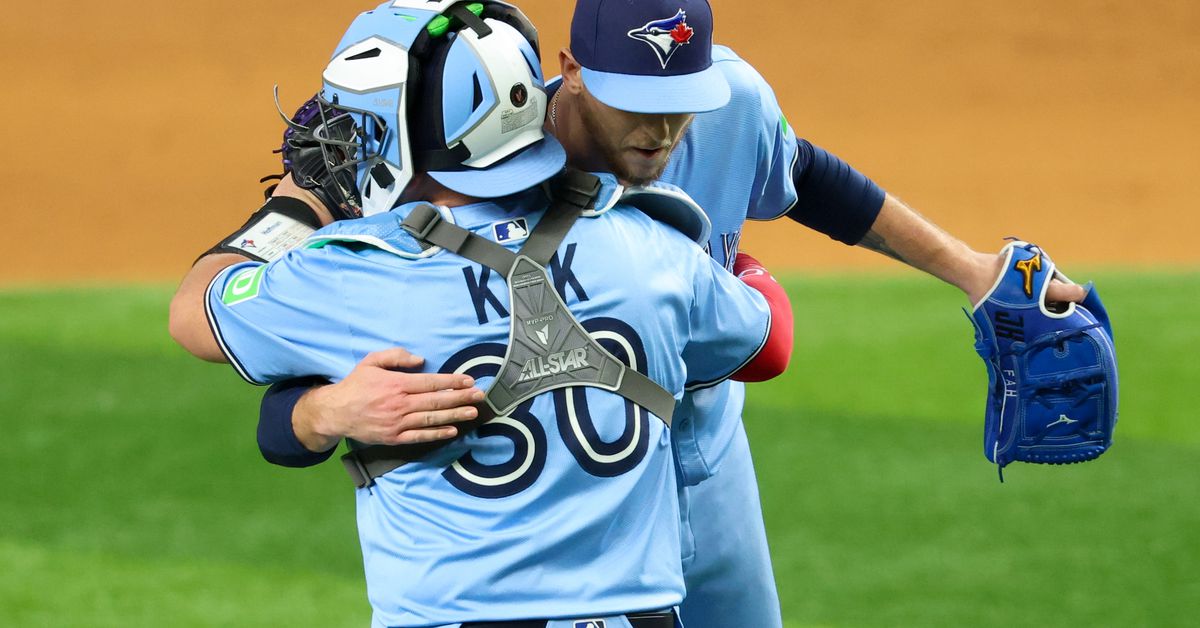
We’re now as close to the midpoint of the season as the quarter point. Look, I have a day job. But I did want to finish setting up the series, because there are interesting things happening in the Blue Jays bullpen. In stark contrast to last season, the bullpen is the one component of the team that doesn’t really deserve any blame for a somewhat disappointing start. They’re 7th in Fangraphs WAR, 8th in ERA and 7th in innings pitched. Working behind a shaky rotation and opposite a frequently scuffling lineup, they’re getting their job done admirably.
Rankings are among all pitchers who had thrown 20+ innings through Tuesday night unless otherwise specified.
Nick Sandlin: 28.4% fastball usage (sinker plus four seam). Sandlin has lost 0.8mph off his already unimposing fastball this season. He’s responded by de-emphasizing his two heaters, dialling his slider rate back up to his pre-2024 level of 47%. He’s also retained last year’s big jump in splitter use to the mid 20s%. It’s worked out for him so far. He has yet to be barrelled up (granted, in a small eight inning sample) and hitters are whiffing on 40% of their swings. Sandlin has been down with a lat injury but has begun his rehab assignment, so hopefully he’ll resume his hot start soon.
Braydon Fisher: 21.9 inches of vertical separation between his slider and curveball, with just 4.5mph velocity separation. Like Sandlin, Fisher pitches backwards, throwing breaking balls around three quarters of the time. They come out from near identical release points but end up in vastly different places. That allows him to play games like drawing chases on low curves that hitters misread as sliders or locating sliders in the middle of the zone that freeze hitters who expect them to drop off the table as curves. Then, if they look like they’re getting wise, he can ambush them with his third option, a 96mph four seamer with plus ride. His 4.22 ERA thus far is nothing special, but his underlying numbers suggest the Jays might have something in their return for Cavan Biggio.
Yimi Garcia: 12% walk rate. Yimi is issuing free passes at double his career rate so far in 2025. That’s mostly a reflection of a stretch in early May when he gave up five in three appearances, but all season his usually sharp command hasn’t quite been on point. His ERA sits at a solid 3.15, primarily on the strength of a .213 BABIP against. When some balls start falling in against him, he’ll need to sharpen up his location to keep up his performance.
Mason Fluharty: 25.9% hard hit rate against, 5th lowest in the league. The rookie’s attack is pretty simple but gives an unconventional look. He throws a 90mph cutter that breaks 3.5 inches to his glove side about three times out of five, and a sweepy slider with a massive 17 inches of of glove side run. Nothing breaks straight or left out of his hand. So far it’s fooled both left and right handed hitters, neither of whom can seem to square him up.
Chad Green: 16.7% barrel rate. In contrast, everybody is squaring Green up. Green’s K rate isn’t what it was in his years as the Yankees’ setup man, but it’s OK, and he doesn’t issue too many free passes. His barrel rate is the second worst among all pitchers, and his 54.5% overall hard hit rate is the worse. His stuff’s eroded just a bit, his slider losing depth and his fastball slowing down, and it seems to have hitters all over him. A couple of weeks after his 34th birthday, the Jays are probably happy they didn’t exercise their longer team option and lock in paying him for 2026.
Brendon Little: 53.5% in-zone swing rate, lowest in the league. They also chase 36% of his pitches outside the zone, 11th highest. Fisher has hitters more or less completely guessing. The trick seems to be an absolute bowling ball of a sinker that gets two inches of induced vertical drop (about 97% of ‘sinkers’ actually have induced rise, just less than four seamers). Basically nobody else throws a pitch at 94 with that kind of drop. He pairs it with a hard knuckle curve at 87 that has well below average depth but horizontal movement that’s about 18 inches different. They’re both weird pitches, and he throws them equally often (while occasionally tossing in a cutter). Combined, they seem to have batters mentally flipping a coin. That’s a great place to start an at bat as a pitcher.
Erik Swanson: 2.0 IP. Swanson is just back from an injury that delayed his start. He looks alright, but has now managed to reach the 60 inning mark just once in a seven season MLB career. He’ll turn 32 in September, so the prospects of that improving aren’t great.
Yariel Rodriguez: 96.0mph. Y-Rod is throwing over 2mph harder out of the bullpen than he did as a quasi-starter last year. He seems like the classic case of a guy moving to the pen and benefiting from just airing it out. He’s also getting more ride (still not a lot) on the pitch and has been able to add depth to his slider while shelving his impressive looking but inconsistent and too often hung curveball. The whole package just seems to be working better this season.
Jeff Hoffman: 24% home run per fly ball rate. The Jays weren’t looking for a 5.81 ERA or three blown saves in 16 tries when they paid Hoffman $33m this winter. Under the hood, though, it looks like they’re getting everything they paid for. Hoffman is still bumping 97 with easy plus ride, and still backing it up with a nasty slider and split change. Hitters are either freezing for strikes or whiffing on a third of his pitches, in like with his excellent 2023-24 run and inside the top 15 among 336 pitchers in my sample. He’s still a bad man. It’s just that 6 of the 25 fly balls he’s allowed this year have carried out instead of the 2-3 you’d expect. That should normalize going forward, as he’s not getting hit unusually hard, and his ERA going forward should be in the sub-3 area.
That rounds out the roster. I’ll circle back in a month or so and see how these trends are holding at the mid-point of the season.