
When you buy through links on our articles, Future and its syndication partners may earn a commission.
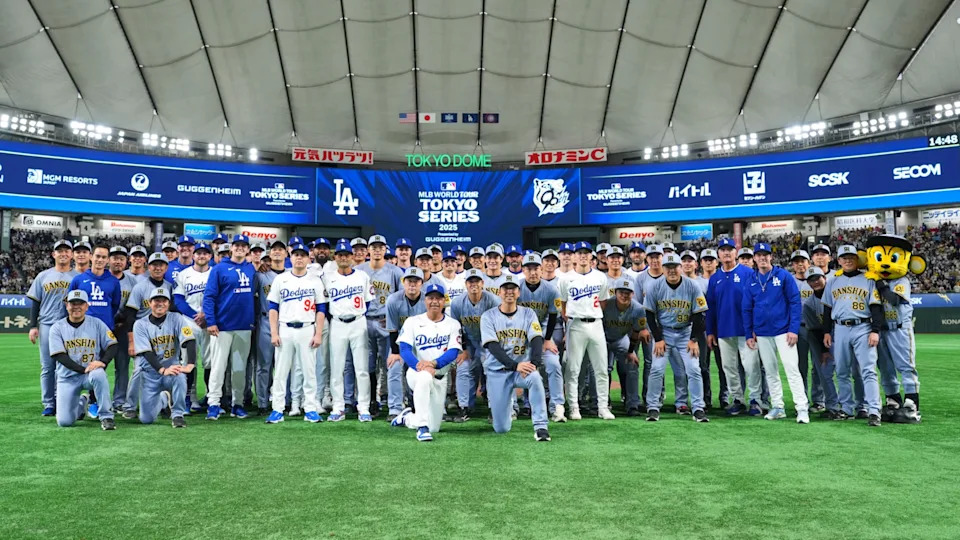
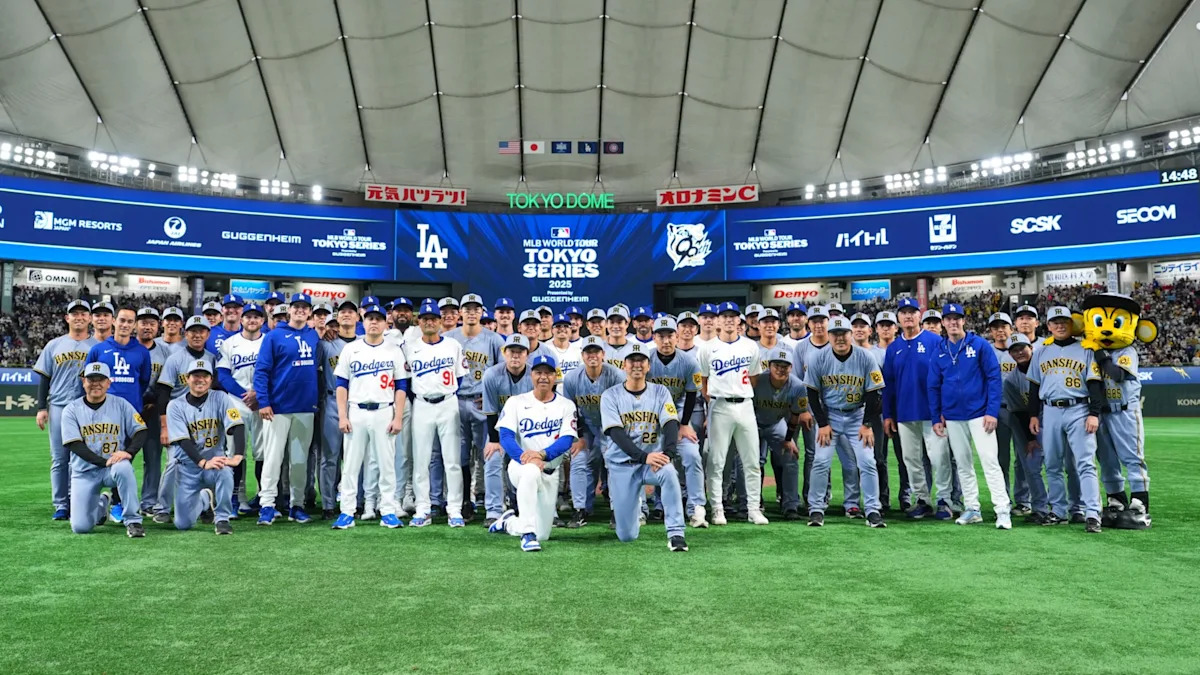
The Los Angeles Dodgers and Hanshin Tigers gather after their game at the Tokyo Dome on March 16, 2025. | Credit: Masterpress/Getty Images
The crack of the bat is almost here with Opening Day for the 2025 Major League Baseball season set for March 27. But while MLB players have become known for their melting pot of backgrounds, this diversity may be putting a strain on the Japanese baseball industry.
Advertisement
Baseball has long been the most popular sport in Japan, with its top league, Nippon Professional Baseball (NPB), drawing nearly 27 million attendees last year. Yet players like Shohei Ohtani have become major stars in the U.S., and others are bypassing NPB entirely. This could mark the beginning of a new trend where Japanese baseball players play in the U.S. straight away.
Why are Japanese players flocking to the US?
The phenomenon of Japanese players moving to MLB is not new. Hideo Nomo’s stellar 1995 season with the Los Angeles Dodgers is credited with the “explosion of Japanese talent in MLB over the last 30 years,” said CNN.
But the emergence of superstars like Ohtani — considered by some to be the best player in baseball history — has “helped revitalize baseball, a sport that some say has experienced waning popularity in the U.S. for some time,” said NBC News. Japanese influence has gotten so popular in MLB that the Chicago Cubs recently played the Dodgers in Tokyo for their season opener. Both teams also played exhibition games against Japan’s Hanshin Tigers.
Advertisement
This popularity has led to some Japanese ballplayers going straight to MLB. Shotaro Morii, 18, and Rintaro Sasaki, 19, “moved directly to American baseball, bypassing [Nippon] restrictions and unwritten societal norms of playing first in Japan,” said The Associated Press. Morii already has a $1.5 million professional contract with the Athletics, while Sasaki plays at Stanford University.
What does this mean for Japanese baseball?
It is unclear whether this trend will continue in the long term. “I don’t know how I will influence Japanese high school baseball players, but I’m just going on my path, my way,” Sasaki, who will be eligible for the MLB draft in 2026, said to the AP. But some experts are worried that this tendency to forego NPB will lead to less of a baseball presence in Japan.
Japanese professional baseball “has been replaced by an obsession with Japanese stars in America,” baseball expert Robert Whiting said to CNN. Japanese baseball is “still an ongoing sport, but people don’t watch their own homegrown game like they used to.” The sport “has sort of disappeared from network television” in Japan. Whiting cited Tokyo’s Yomiuri Giants, Japan’s oldest professional sports club, who “have their own cable channel, which has a limited audience.” People in Japan “don’t see the Giants games on every night.”
Advertisement
Nippon does not seem to be sweating it. The “success of young players has attracted attention, which has led to the popularity of NPB without any loss of interest from fans,” Nippon officials said to the AP. The league “believes that this has maintained the appeal of the league as a whole even after star players have moved to MLB.” And even MLB’s “general philosophy is to have locally born players play in their local professional leagues,” MLB Chief Operations Officer Chris Marinak said to the AP.
For now, the trend remains in full swing. Sasaki “embodies a new era of Japanese ballplayer. And already, one thing is clear: Plenty more are gearing up to take the same path,” said The Wall Street Journal. The “average Japanese baseball player now, they have a dream to play in the big leagues,” Sasaki told the Journal.