
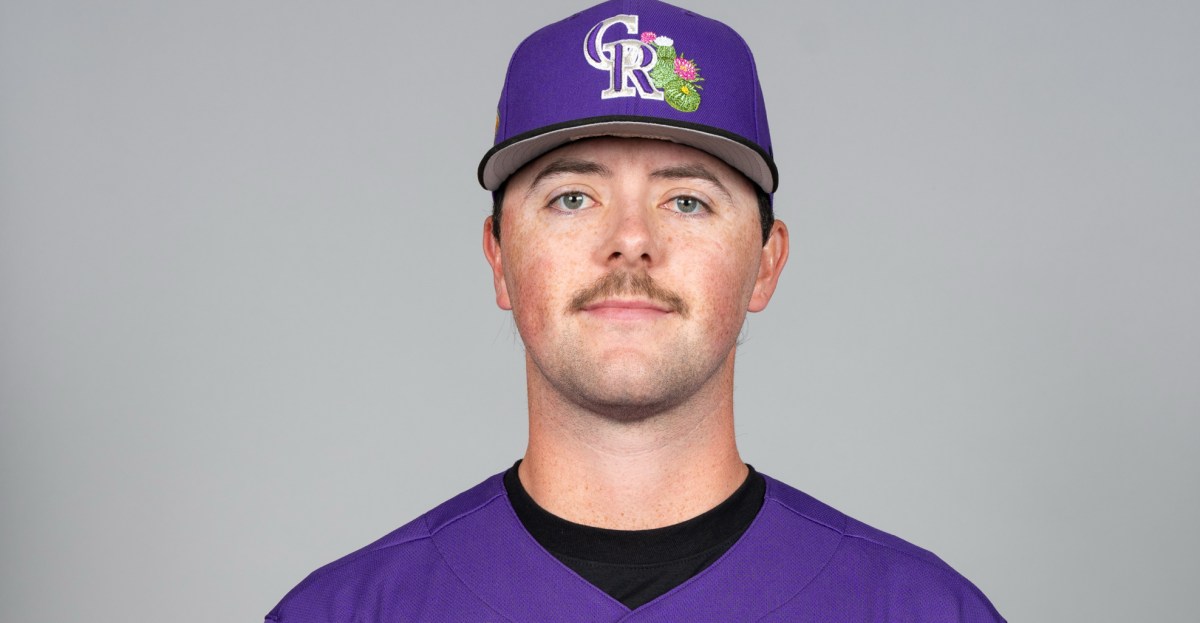
Throughout every MLB organization, from major leaguers to rookie ball prospects, each season brings its own challenges of injury rehab assignments. Whether it’s UCLs, shoulder inflammation, neck stiffness, or other ailments, the Rockies sent their fair share of pitchers to the injured list in 2026.
That’s where Owen Cuffe comes in.
Cuffe started as the Rockies Arizona Complex League pitching and rehab coach in January and just completed his first season with the franchise. On a day-to-day basis, Cuffe works with players who are sent to Arizona to rehab, helps them develop their progression plan back to the game, and then get back to their teams.
“I help facilitate their throwing programs, the return to the mound, being able to help build them like pre-throw routines, and things to work on,” Cuffe said. “ Also, some movement quality skill stuff to allow them to either get to those top-end velos more often, get healthier, sustain the innings that they’re going to log once they’re back in an affiliate and things like that.”
Cuffe’s rise to Major League Baseball happened very quickly. He earned a bachelor’s in biology in 2023 at Saint Mary’s College, where he also earned his Master of Science in Management and Technology in 2024.
“Initially, I thought I was going to go to medical school. I ended up not taking that route, but everything I learned about the body and how it operates, I took that into pitching development,” Cuffe said. “I ended up getting my master’s in management technology, so kind of bridged the technical side with the medical side.”
The education enabled Cuffe to better navigate the injury-laden landscape that defines the MLB pitching world. Every day brings its own challenge of orchestrating recovery plans big and small, working with players who might be there for seven days or nearly the entire season.
“It is cool because no two guys are the same down here,” Cuffe said. “It is kind of having to be a Swiss Army knife. You basically meet every player where they’re at and then use skills to make them better at the act of throwing a baseball.”
Take Chase Dollander, for example. The Rockies first-round draft pick from 2023 started the 2026 season in the bullpen, making seven appearances before returning to the rotation. In his third start (10th appearance), Dollander was pulled in the second inning of a game against the Pirates because of right arm tightness.

PITTSBURGH, PA – MAY 14: Chase Dollander #32 of the Colorado Rockies talks with medical staff in the second inning against the Pittsburgh Pirates at PNC Park on May 14, 2026 in Pittsburgh, Pennsylvania. (Photo by Justin K. Aller/Getty Images) Getty Images
Dollander was moved to the 15-day IL the next day with a right elbow strain. By June 12, it was clear Dollander’s season was done, and he headed to the 60-day IL. On June 23, he had an internal brace procedure, which repairs the ligament and adds support to help avoid a full Tommy John reconstruction.
For Cuffe, the process of helping Dollander didn’t even include throwing a baseball.
“Obviously, Chase hadn’t thrown yet, so we’re more so working in a planning manner, talking through what we want the arsenal to look like when he comes back,” Cuffe said. “We also look at how we can leverage some maybe other modalities, like water balls and med balls, to help him with movement quality on the mound before he’s able to throw baseballs.”
Rehab routines can be monotonous and mundane. Every player would rather be suiting up for their team than recovering from an injury. So while players are at the ACL, Cuffe and the entire staff try to keep it positive by providing mental support. That atmosphere extends to the players, who also cheer each other on.
“We try to be here with good energy and good vibes to help these guys,” Cuffe said. “Luckily, with the group of guys we’ve had down here, they all support each other. They’re all out there supporting each other. We all work together to make sure we’re uplifting and celebrating the guys that are having these milestones back. That’s a big thing because you learn to really celebrate the small things.”
Before coming to the Rockies, Cuffe worked as a pitching strategist and then as the director of pitching development and recruiting for the University of Arizona. That’s where he built up his chops as a pitching coach.
“I knew I wanted to work with pitchers, wanted to work in some form of a role with a lab that was able to access biomechanic work,” said Cuffe, who credits University of Arizona assistant coach Kevin Vance and director of pitching performance and strategy John DeRouin for showing him the ropes. “We went to Omaha with them to the College World Series, won the Big 12, and then I was promoted to director of pitching development.”
When he accepted the job with the Rockies, Cuffe didn’t just want to simply help players return to their healthiest form.
He wants to help them improve.
Cuffe loves combining his medical knowledge with his pitching acumen. He even said so on social media when he joined the team.
Cuffe deploys a large toolbox to help pitchers in the Rockies organization grow their skills.
“I help pitchers build sustainable skills to be major league pitchers. It’s kind of all-encompassing now like being able to help out in arsenal development or helping them gain output,” Cuffe said. “So whether it’s average fastball velo or peak fastball velo, that’s where utilizing the performance lab is big. Being able to get them to gain count control, get ahead in the count, pretty much all those things, is what it takes to be a major league pitcher nowadays.”
At U of A, Cuffe used the same performance lab technology, KinaTrex, that he’s now running with the Rockies. He said it helped make the transition smooth.
So did the Rockies staff.
“Being able to help leverage every technology we have, every department, whether it be strength and conditioning, the PT [physical therapy] room, athletic training room, being able to all collaborate, come together, especially at a place like the complex, helps players build the skills necessary to be major league pitchers,” Cuffe said.
Those conversations between the medical and coaching teams help all staff ensure they aren’t pushing players too hard or moving too fast. Instead, they can target issues at a micro level to reduce any regression. Cuffe used the example of being able to understand a player’s global movement capacities and how he expresses different movements to create a plan.
“That helps me as a pitching coach understand what constraints I’m trying to work around on the mound,” said Cuffe. “Say a guy can’t get into a huge counter-rotation of his torso, then I probably can’t ask him to be doing that on the mound. So, then I’m not trying to fit a square peg in a round hole. Being able to leverage the brains that we have in this building definitely helps me as a pitching coach get to solutions more effectively and more efficiently.”
Now that the offseason is here, Cuffe said it’s education and planning time. He’s exploring and researching delivery ideas, arsenal ideas, how to help pitchers better attack the strike zone and more. It’s another example of a year-round collaboration to help players at every level in the organization succeed.
After the grind of a 162-game season that left a tattered and worn-down rotation and bullpen — one that needs a boost from Colorado’s prospects who can be ready to go in 2027 — Cuffe will certainly have his work cut out for him.
Fewer adsCreate community postsComment on articles, community postsRec comments, community postsNew, improved notifications system!
Please keep in mind our Purple Row Community Guidelines when you’re commenting. Thanks!