
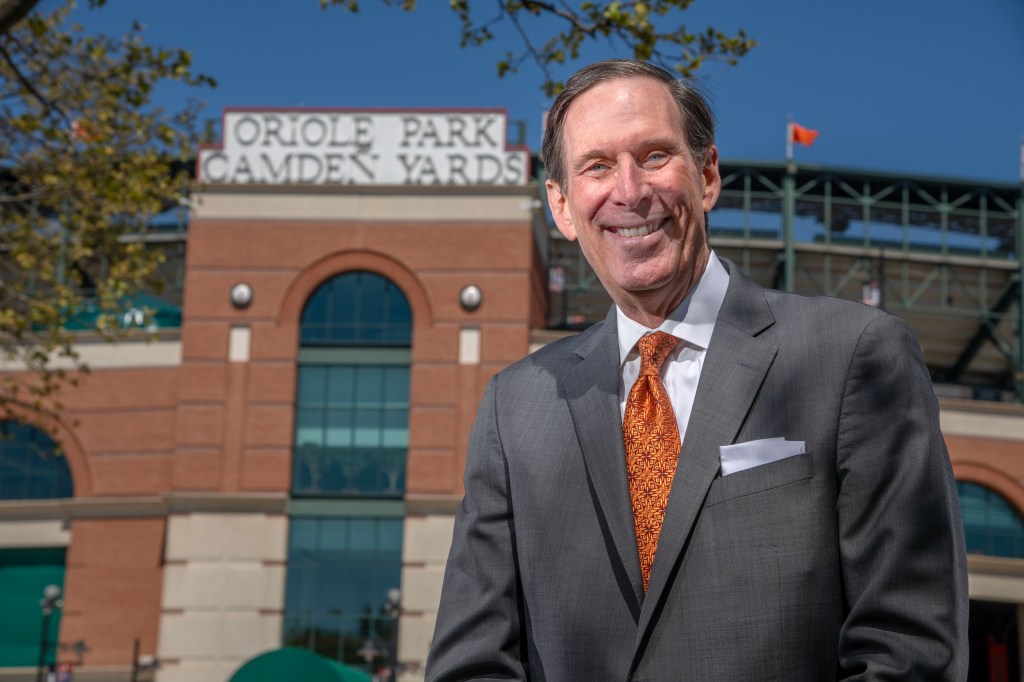
It’s easy these days to see the appeal of Oriole Park at Camden Yards, the 33-year-old Baltimore stadium that was the forerunner of a generation of retro, baseball-only venues in urban areas.
But its existence, funding and carefully calculated downtown location were hardly assured in the late 1980s when then-Gov. William Donald Schaefer — with Alan Rifkin as his chief counsel — sought a new baseball home to ensure the Orioles didn’t leave Baltimore as the Colts had in 1984.
Stadiums, essentially multipurpose clones of one another in size and shape, were being built away from urban centers. There were concerns about Camden Yards’ potential traffic issues and parking, costs and whether it was worth preserving the adjacent warehouse.
Before the stadium could be authorized and funded, Rifkin needed to stitch together consensus among disparate stakeholders.
It’s a feat, say those who know the sports lawyer best, that he has repeated in order to create, preserve or assist iconic Baltimore institutions such as the Orioles’ television network and stadiums in Baltimore and Sarasota, Florida, as well as Pimlico Race Course and the Preakness Stakes. Those at his law firm, Rifkin Weiner Livingston, refer to such maneuvering as “three-dimensional chess.”
“He played such a seminal role in the creation of the legislation that led to the Maryland Stadium Authority, that led to the funding of Camden Yards, both the football and baseball complex,” said Janet Marie Smith, who has overseen stadium improvements in Baltimore, Boston and Los Angeles.
“Because he worked on the government side, it means he’s sympathetic and knowledgeable about the public point of view and the sort-of big picture of doing things so they’re important civically,” said Smith, the Los Angeles Dodgers’ senior vice president of planning and development.
“He has a deep appreciation for the perspective of both the private sector and the public sector,” she said.
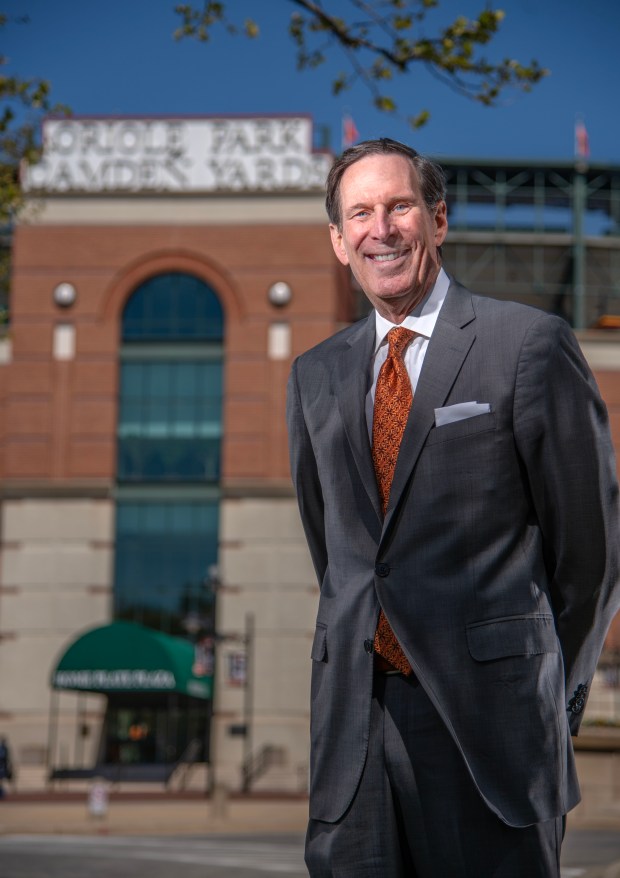 Alan Rifkin, the founder and managing partner of Rifkin Weiner Livingston, was instrumental in the creation of Oriole Park at Camden Yards. (Karl Merton Ferron/Staff)
Rifkin, who was long the Orioles’ outside counsel, has worked with a prominent cast of characters including Schaefer, four generations of Orioles ownership (Edward Bennett Williams, Larry Lucchino, Eli Jacobs and Peter Angelos) and four generations of Maryland Jockey Club ownership (Frank J. De Francis, Joseph A. “Joe” De Francis, Frank Stronach and Belinda Stronach).
“The projects for which we are called upon to provide counsel are generally one of a kind,” Rifkin said. “There is no template, and so teamwork and empowerment of others is critical. As we often say at the firm: ‘One of these days we are going to do the same thing twice, but this is not that day.’ ”
He has represented Hall of Famer Cal Ripken Jr., the iconic Oriole, who lists Rifkin among his mother, father and agent Ron Shapiro as those who helped nurture his charitable interests.
“Their examples shine really bright, and Alan was one of those,” Ripken said. Rifkin is a member of the board of the Cal Ripken Sr. Foundation, which serves at-risk youth.
Under Angelos’ direction, Rifkin was prime negotiator of a 2005 deal with Major League Baseball allowing the Washington Nationals to begin play in what was once exclusively Orioles territory.
To mollify Angelos — who had threatened litigation over another club entering the market — MLB gave the Orioles a large ownership stake in the Mid-Atlantic Sports Network, which has been shared by the two teams, and a proportionately larger share of the profits. While Washington fans railed against Angelos, the owner was “standing up for” the rights of his franchise, Rifkin said.
Angelos, who died last year, was a famously big personality. “Through the force of his personality, Alan was able to have Peter and the commissioner work together more than they would have if anybody else had been guiding,” said Arnold Weiner, his law firm partner.
“He makes sure everyone is heard. He would take a lot of things that seem unrelated to the ordinary person and weave them together into a whole fabric that made sense,” Weiner said.
In 2019, Rifkin was instrumental in an agreement to keep the prestigious Preakness Stakes at Pimlico in Northwest Baltimore. The difficult negotiation followed a suit by the City of Baltimore against officials of The Stronach Group, who had said they were committed to holding the Preakness at Pimlico only through 2020.
The agreement “couldn’t have happened without the Stronach Group being represented by a lawyer of Alan’s caliber,” said Joe De Francis, former CEO of the Maryland Jockey Club, which ran the track for its owner, the Stronach Group.
“The Stronach Group was not a local company,” De Francis said. “Alan was the main voice of reason within the organization that put forth the arguments that carried the day in terms of bringing the leadership — Belinda Stronach — to the table to get the deal done.”
The state is hopeful that a redeveloped Pimlico can be a catalyst for economic activity led by the track, event space and other amenities.
Rifkin is the first person in his family to go to college.
He credits his late father, an ex-Marine, and his mother, who taught in the Baltimore school system for years and was known as “Miss Sally.”
“There is no success nor any award that could ever have happened without them,” he said.
Have a news tip? Contact Jeff Barker at jebarker@baltsun.com.
Alan Rifkin
Age: 68
Hometown: Baltimore
Current residence: Columbia
Education: Randallstown High School; Loyola College of Baltimore, B.S.; University of Maryland Francis King Carey School of Law, J.D.
Career highlights: Founder and managing partner Rifkin Weiner Livingston; primary outside counsel to Orioles; chief counsel and legislative assistant to Gov. William Donald Schaefer; chief counsel to Maryland Senate; primary outside counsel to Maryland Jockey Club and Preakness Stakes; adjunct sports law professor, University of Maryland
Civic and charitable activities: Board member, Cal Ripken Sr. Foundation, the Aspire Foundation and Ripken Enterprises LLC; has served on the board of directors for the Baltimore Symphony Orchestra, Loyola University of Maryland, the Howard County Hospital Foundation and the Cal Ripken Sr. Collegiate Baseball League
Family: Married to Leslie Rifkin; three children; two grandchildren