
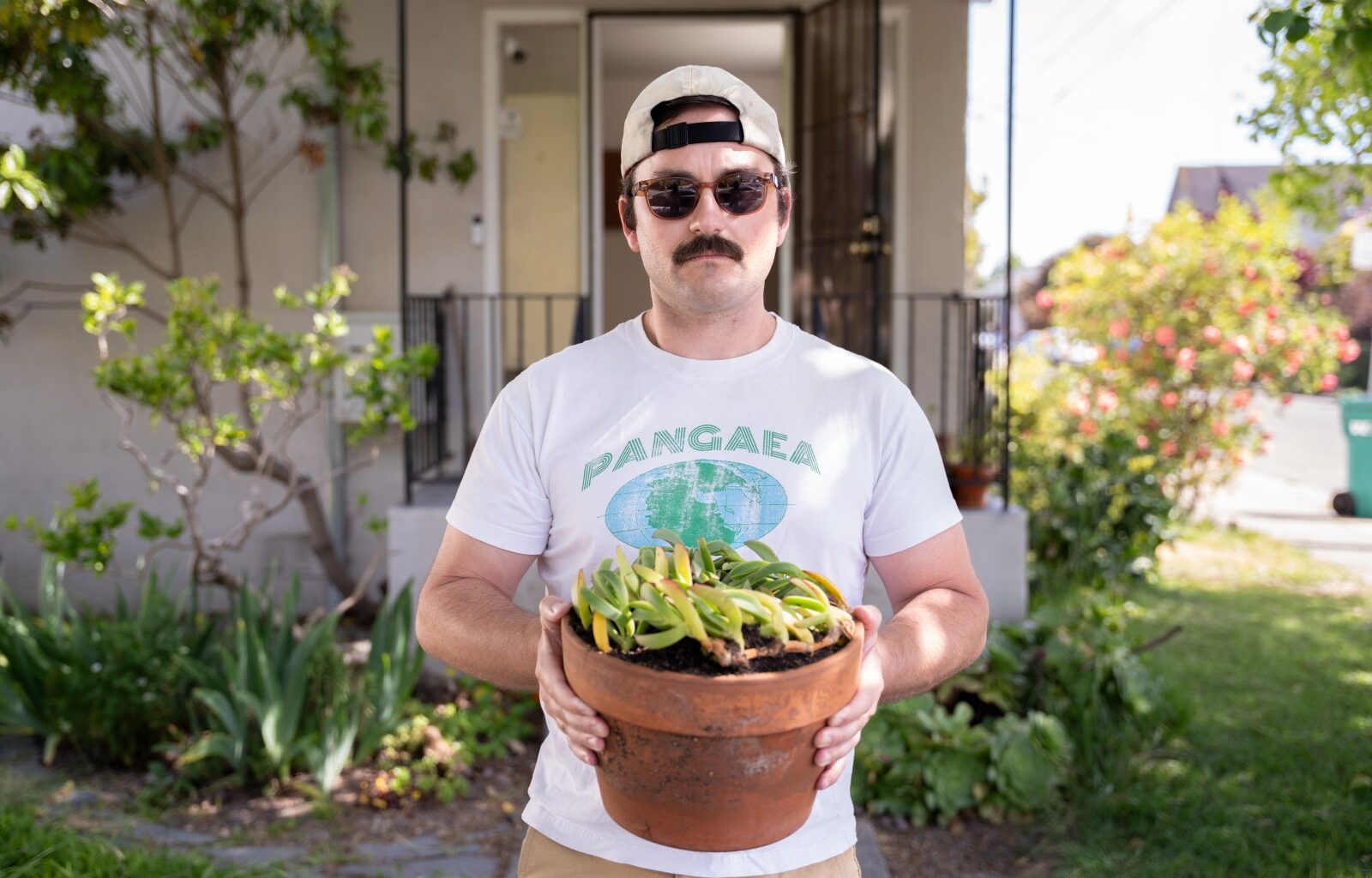
 Greg Friedman took some ice plant after an A’s night game. “I was entering a big gardening era of my life and decided if I couldn’t catch a foul ball that night I was at least going to leave with something to be sentimental over.” (Florence Middleton)
Baseball fans collect souvenirs like squirrels collect acorns. There are the official ones: home run balls, foul balls, baseball cards (and the quest to get them autographed), commemorative pins, bobbleheads, hat-shaped ice cream bowls. Grown men and women exchange hard-earned pay for small scoops of “game-used dirt.” There are, also, the unofficial keepsakes. At the Athletics’ final game in Oakland last September, a smattering of jilted fans attempted to take home anything they could pry loose: hand soap dispensers, exit signs, 15-foot banners, entire seats from the stands. And outside, guerilla gardeners tromped through the banks of succulents between the stadium and the parking lot, pulling ice plant root and branch from the soil.
“Security didn’t care, since they were busy trying to get a sign back from someone,” a 20-year-old Danville resident named Calvin told me, over Reddit DMs. He declined to provide his last name; his botanical souvenirs were technically stolen property.
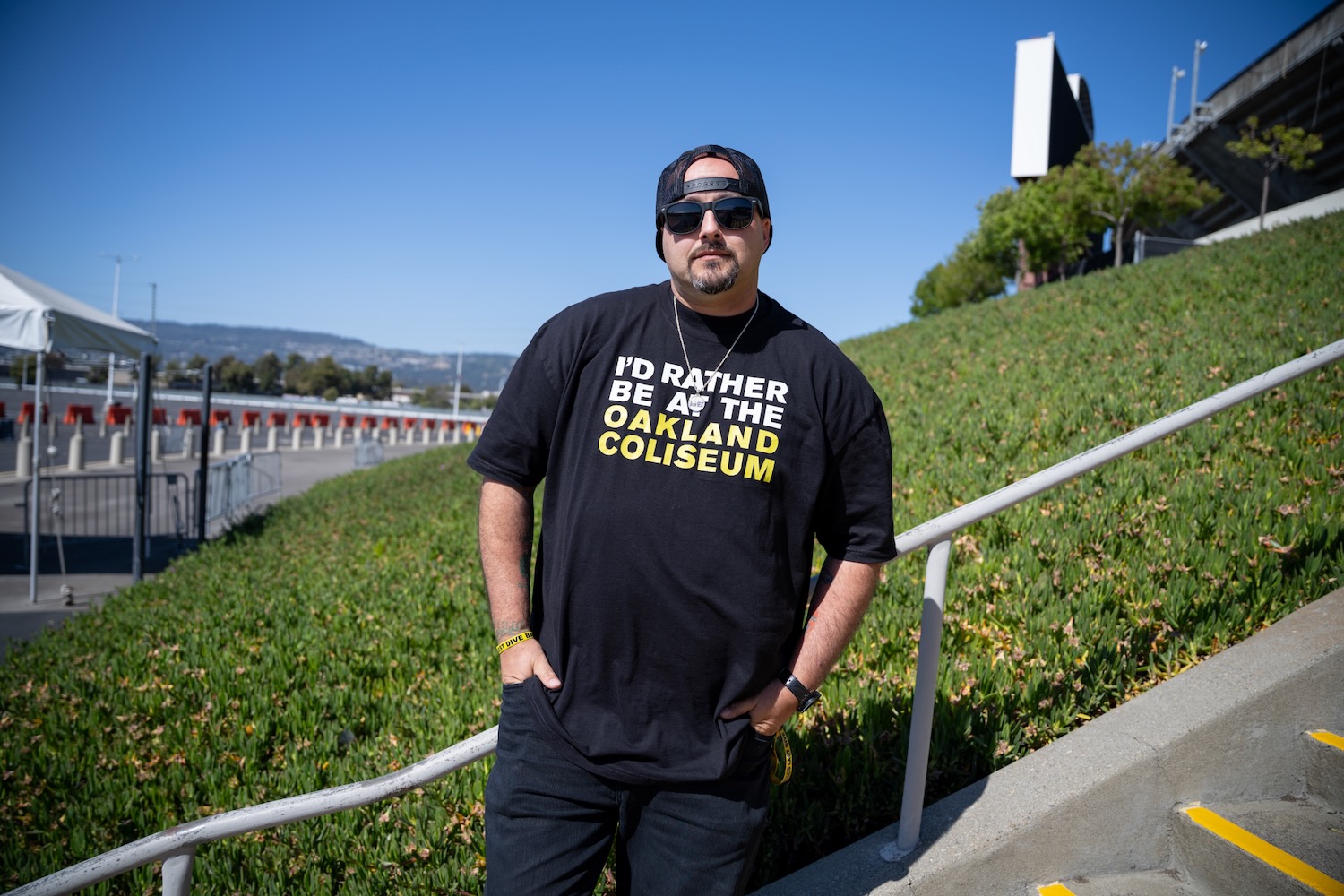
Throughout coastal California, ice plant is ubiquitous, unremarkable, occasionally a pest. In Oakland, however, this humble ground cover is so closely associated with the Coliseum that A’s fans wear it on t-shirts and pins—it’s a shibboleth that separates the diehard fans from the casuals.
When the A’s were still considering a new stadium in Oakland, then-team president Dave Kaval assured fans that there would be ice plant at the new park. “Wouldn’t be the home of the Athletics without it,” he said in 2017. And long before the specter of relocation was even a twinkle in the eye of A’s owner John Fisher, green (and gold)-thumbed fans were transplanting their love of Oakland baseball from the ballpark to their backyards. “You’d be in the parking lot after games, and you’d see random people just walking, and they have in their hand a clipping of the ice plant,” recalls Bryan Johansen, a longtime A’s fan and a founder of Last Dive Bar, a company that sells unofficial Coliseum merch, including a collectible enamel pin on which a trio of brilliant purple ice plant flowers overshadow the stadium. “Years ago when we’d line up early for bobblehead days,” says Steve Tuck of Elk Grove, “kids would run up the slopes and trample the plants, or I’d see someone passed out on the plants after they had a few too many breakfast beers while waiting in line.”
Thus has the ice plant become an unlikely symbol of Oakland pride—at least for A’s fans. But its symbolism is deeply counterintuitive: the plant is neither unique nor native to the Bay Area, not to mention the fact that Oakland is already named after a plant with a much more striking silhouette. Now, as the Earth’s axis tilts Oakland unwillingly into its first baseball season without the A’s since 1968—and its first year without any major-league franchises since the Eisenhower administration—your correspondent has set out, a touch sentimentally, to investigate how this ne’er-do-well of a succulent acquired such a lofty place in the hearts of A’s fans.
 Steve Tuck has sent ice plant clippings through the mail to fellow A’s fans. (Kate Golden)
We shall fight on the beaches
Outside the Coliseum’s grounds, ice plant isn’t always welcome. The California Department of Fish and Wildlife lists it rather unambiguously as an “invasive to avoid” in the “Don’t Plant Me” section of its website.
Several succulent species get called “ice plant,” and the variety growing around the Coliseum is likely a hybrid that combines the larger leaves and flowers of Carpobrotus edulis with the bright magenta petals of Carpobrotus chilensis, according to Carla D’Antonio, a UC Santa Barbara ecologist who wrote her dissertation on C. edulis in the 1980s and still studies how ice plant affects the ecosystems it invades. Both species originate in South Africa, and their scientific names provide a glimpse into their histories. Carpobrotus edulis, for instance, incorporates the Greek for “fruit” (karpos) and the Latin for edible (edulis); C. chilensis arrived in Chile so long ago that it has naturalized into the regional ecology. In South Africa, the indigenous Khoekhoe once included the small, salty-strawberry-like fruit of C. edulis in their diet and medicine. “If it had been introduced in California, say, a few hundred years ago, that big fleshy fruit probably would’ve become really important to indigenous people here,” D’Antonio says. Carpobrotus plants made their way to California sometime in the early 1900s—around the same time that the Athletics franchise was founded in Philadelphia—here, though, it was used not as a food source but to hold down the dirt along railroad tracks and, later, highways, earning it the nickname “highway ice plant.”
While ice plant was introduced intentionally, its subsequent proliferation has posed a grave risk to many native species, and the coastal ecosystem as a whole—particularly sand dune habitats. Among the superpowers of Carpobrotus, notes D’Antonio, are that it grows very fast, and that it acidifies the soil as it goes—depleting calcium and magnesium, and changing the microbial community—making it less hospitable for other plants. “Ice plant just overgrows everything else,” she says. A front in the battle between ice plant and its native competitors is Point Reyes National Seashore, where ice plant (along with a fellow invasive, European beach grass) has claimed vast swaths of the coast. For more than a quarter-century, the National Park Service has been enlisting local volunteers to help limit ice plant’s spread. Since herbicides could harm the native species, much of the removal is done painstakingly by hand. At this point, the plant is too widespread and fast-growing to eradicate from California entirely, but authorities hope at least to keep it at bay, in places—to stop it from driving native species like Tidestrom’s lupine to extinction. Every patch of soil where ice plant is not allowed to spread is a safer, more fertile place for native plants.
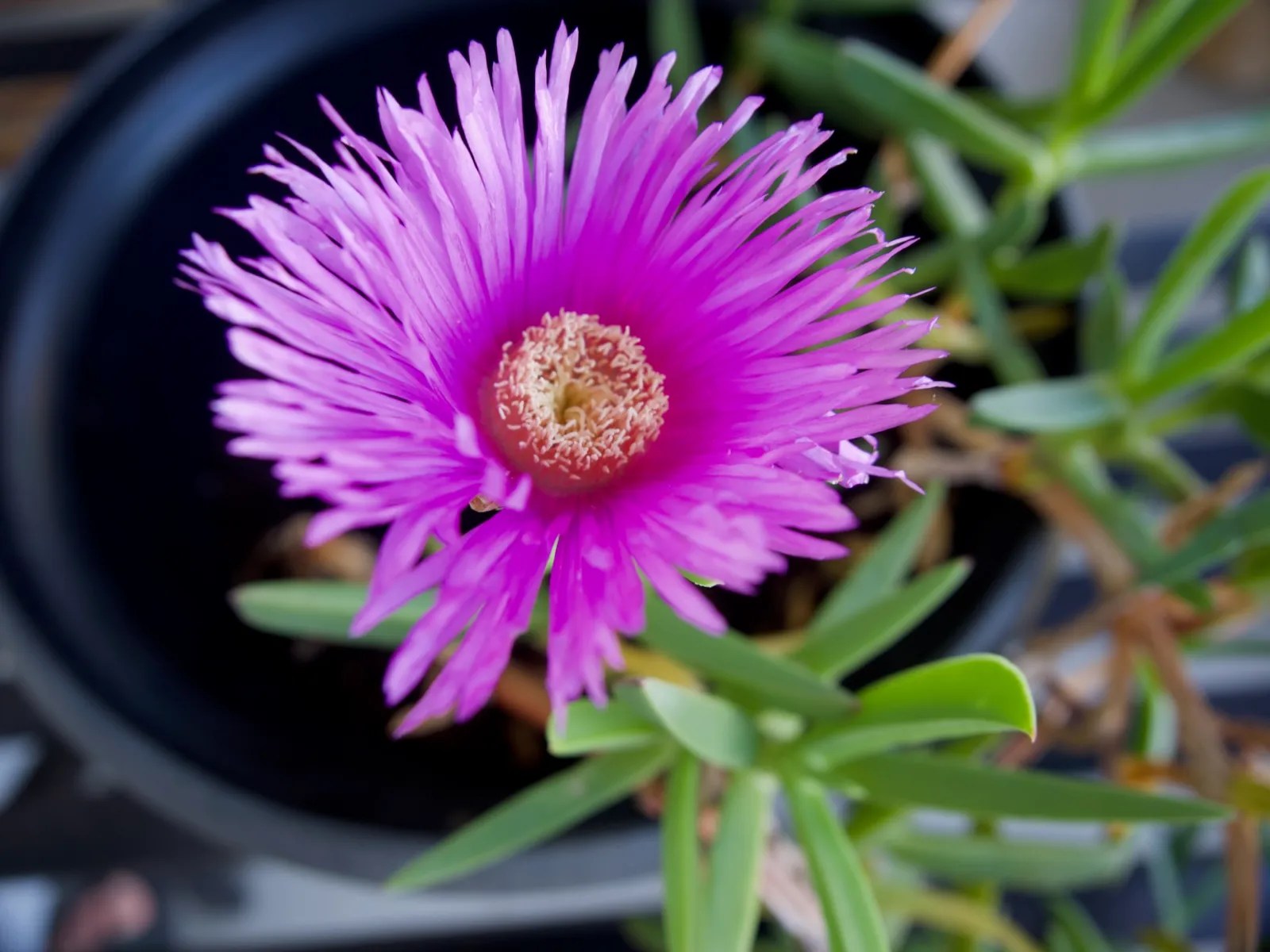
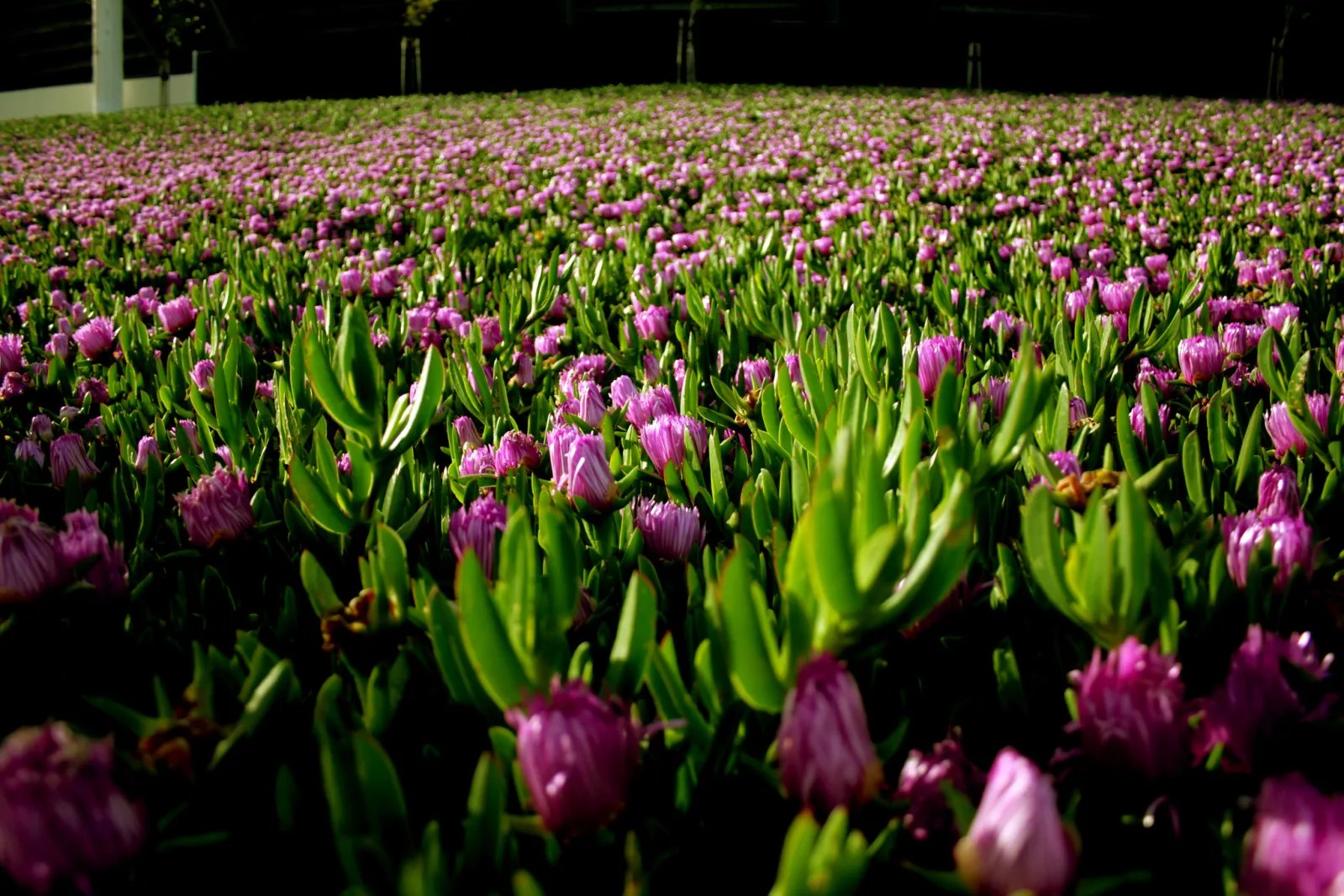
Ice plant is ubiquitous and unremarkable. Hence its charm? (In pot in Elk Grove: Kate Golden; at the Oakland Coliseum: Drew Geraets via Flickr, CC BY-NC 2.0)
Ice plant is nonetheless getting an assist in its spread from unwitting A’s fans. Live souvenirs have found their way from the Coliseum into the backyards and gardens of fans from the East Bay to the East Coast—and the tradition spiked noticeably in the A’s last season, as would-be gardeners realized they might not have another chance. “I took mine after a night game since the A’s were in the ‘they may move at any time’ phase of existence,” says Oakland resident Greg Friedman. “I was entering a big gardening era of my life and decided if I couldn’t catch a foul ball that night I was at least going to leave with something to be sentimental over.” Could this sports-driven dispersal of an invasive plant meaningfully affect the ecology of the communities where these clippings end up?
Probably not. “Compared to a lot of other invasive plants we have around here, they’d be pretty easy to keep in check,” says Berkeley-based botanist Fred Dortort, author of The Timber Press Guide to Succulent Plants of the World. “They won’t burn like eucalyptus, and they don’t seed themselves or spread by root bulbs, like the oxalis we have all over here.” D’Antonio agrees. “The fans who are taking it to their yard in Oakland or Berkeley are not going to create a population explosion,” she says. Ice plant seeds spread best after passing through the digestive system of an animal like deer or rabbit; our local squirrels tend not to eat the fruit. “Will it spread to the neighbor’s yard?” D’Antonio continued. “Yes, through clonal growth. But it won’t spread to the rest of that part of the city.”
Ice plant spreads most exuberantly in salty, sandy places with temperate climates, like we have on the coast. That may keep it from following the Athletics to their future homes, whether the organization wants it or not. The heat in Sacramento is a real concern for players and fans, to such a degree that Major League Baseball has reduced the number of day games the A’s have to play during the hottest months of the year. Ice plant can probably endure the heat of the Sacramento Valley. But it’s not commonly seen there, probably because—ironically—it is much more vulnerable to the cold. “Even Sacramento may have too many frosty days,” D’Antonio says. So transplants to such areas are unlikely to trigger any ice plant apocalypses.
 The ice plant at the Coliseum is probably a hybrid of two closely related species in the genus Carpobrotus. It’s “definitely invasive in the sense that it will take over your yard if left unabated,” says Carla D’Antonio. Given that it can’t reseed itself, it’s unlikely to take over the world. (Florence Middleton)
The living embodiment of ‘nothing special’
The story of who chose to use ice plant inside the Coliseum and why may be lost to history. A spokesperson for the A’s said she was unable to find any record of the decision in the organization’s archives; the question also goes mostly unanswered in the contemporary coverage of the San Francisco Chronicle and other newspapers of the era. “I cannot get into the minds of the grounds folks who planted it back in the 1960s,” D’Antonio says. Though, she acknowledged, the plant has its merits: “It’s pretty when flowering, sort of unusual, covers the ground, and keeps the weeds out.” This last point is key: what makes ice plant such a formidable competitor in the natural world—its ability to push out other plants—is precisely what makes it appealing as an ornamental: it chokes out most weeds, effectively doing your gardening for you.
D’Antonio happens to be an A’s fan herself, having taught at nearby UC Berkeley during the A’s famously cost-efficient “Moneyball” era, but her fandom does not extend to the ice plant. On the contrary: “I’m a bit horrified to think it’s some sort of a symbol of the A’s,” she admits. Since she’s an ecologist who has spent much of her professional life scrutinizing ice plant, part of what horrifies her is the notion of venerating an invasive species that’s known to displace natives and acidify the soil. But that’s not all: “It’s just kind of a stupid symbol,” she clarifies. “Ice plant is all over the highways. It’s nothing special.”
Nonetheless, “nothing special” may actually be an essential part of the ice plant’s appeal. The aging Coliseum is affectionately known as “baseball’s last dive bar,” from which Johansen’s fan group takes its name; the humble ice plant reinforces that dive bar aesthetic. And it’s not even the least pretentious icon of A’s fandom: Last Dive Bar’s second-best-selling design is an artistic rendering of the communal urinal troughs in the men’s rooms. Unlike the few other botanical celebrities in the sports world, such as the Boston ivy that lines the outfield wall of Chicago’s Wrigley Field, Oakland’s ice plant is easily accessible. After the Cubs won the World Series in 2016, the team sold individual leaves of ivy from their ballpark for $200 apiece—shipping and handling not included. The Coliseum’s ice plant, in contrast, is available for free (at least if you’re discreet about it) around the edges of the parking lot.
 Bryan Johansen of Last Dive Bar, which celebrates the Coliseum and sells unofficial A’s merch, including an ice-plant-forward pin. Behind him are the Coliseum’s vast banks of ice plant—with the flowers, fittingly, closed up. (Florence Middleton)
What’s really rooted in Oakland
Today, ice plant is found only outside the Coliseum. But for the ballpark’s first three decades, it was a prominent part of spectators’ view during the games themselves. These interior planters, behind the center-field bleachers, were removed to make way for “Mount Davis,” a 20,000-seat addition completed in 1996 to lure the Raiders back to Oakland from Los Angeles. One could argue that the seeds of the A’s eventual exit from Oakland were sown the day those planters were removed—that A’s fans may have been banished from the Garden of Eden, after ownership banished an actual garden. Mount Davis did successfully bring the Raiders back to Oakland, but the team left again before the City of Oakland and Alameda County had even finished paying for the renovation. So when the A’s began to eye their own move, Oakland had less money and political will to fund another billionaire’s construction project.
Invasive species aren’t inherently bad, but they do absorb resources that might otherwise go to neighbors that have been growing here all along. Sports teams, in that sense, might also be considered an invasive species. They can be as delightful to behold as the ice plant’s purple petals, but they come at the expense of other things that need municipal resources: schools, roads, homeless services. Now that the A’s have left Oakland—along with the NFL’s Raiders and the NBA’s Warriors in recent years—there is room, at least, for something with deeper roots to grow in their place.