
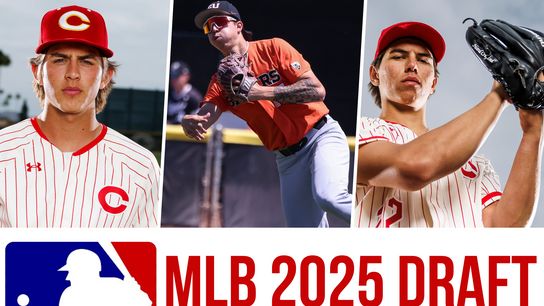
Again, like I did last year, I held out until five weeks to the weekend of the MLB Draft to release the first mock here at The Sporting Tribune.
Information is constantly flowing during the scouting cycle, which is now near its conclusion with most high schools either done with baseball or in state playoffs, while college ball is nearing Omaha and is essentially done for most.
This is where smoke and mirrors really start to come into play, so you have to bank on both old information and new and sort through what information is misinformation and what chatter might be more concrete material.
Clarity still hasn’t come into play much. Bonus factors play just as much importance in the draft as identifying talent does. For most players, bonus demands are still only rumors right now.
Most teams are setting up private workouts and interviews to begin assessing some of the signability demands, finalize their evaluation and determine any makeup questions that were undetermined. Team meetings will follow and carry into the final four weeks before the draft.
The MLB Draft Combine (to be held at Phoenix’s Chase Field from June 17-21) will be a nice final chance for amateur directors to key in on personal conversations with players at the top of the draft. This will also be where most players will turn in their medicals for team doctors to sort through (more on this later). Outside of that, it’s a good place for players to give some excess data and create new peak spin rates, exit velocities, etc. and improve their draft stock from fifth round to third round, roughly. It also allows some freedom for players who would have otherwise been held to development restrictions from their previous school or program.
As for the draft class itself: not great, Bob.
The top of the class is fine for about 10 picks or so with players who would probably go in a generalized top 20 draft picks any given year. After that, it’s filled with depth from college pitchers and high school hitters. The class heavily lacks college hitters (it is a bad year) or projected future stars that should go in the top five picks.
The class could be led by a pair of Oklahoma prep shortstops with MLB bloodlines in Ethan Holliday (Matt’s kid, Jackson’s brother) out of Stillwater HS; and Eli Willits (Reggie’s kid) out of Fort-Cobb Broxton HS.
Oregon State shortstop Aiva Arquette is the top college position player, and by a fair margin, because of his power potential at a premium position. Auburn catcher, Ike Irish, will get some top 10 love for his hitting chops. Texas A&M outfielder Jace LaViolette was originally perceived as the top prospect in the class but had a bad spring where he looked stiff and didn’t perform well with the bat, putting his general draft range from late top 10 to late teen picks.
Corona High School in California has a chance at history with three potential first-round picks, which no prep program has ever done in the same class. Seth Hernandez has been mentioned in the likes of Hunter Greene, Jackson Jobe and others as the “best right-handed prep pitcher” some have seen, though the risk of prep righty demographic has him all over the top 10 picks. Billy Carlson also gets a handful of “best since” or “best ever” from a high schooler comments for his defensive chops at shortstop, while his bat has kept him in top 10 conversation. Brady Ebel, son of Dodgers third base coach Dino, has a chance at the first-round as well, though his spring wasn’t as loud as most expected and has more second-round chatter than first.
Prep shortstops, like the Oklahoma boys and Carlson, are expected to fill up the first-round. Kayson Cunningham (Johnson HS, TX) and JoJo Parker (Purvis HS, MS) are the pair that join top 10 chatter for now.
Oklahoma Sooners ace Kyson Witherspoon is the only right-handed college arm getting much traction near the top of the draft. The rest of the demographic probably doesn’t get popped until the 20’s, with the only potential outlier being UC-Santa Barbara’s Tyler Bremner who was seen as an early pick at the start of spring but didn’t have a great performance year.
A trio of college lefties rounds out the top 10 generalization, with all having realistic chances of being picked in the top three selections, with Kade Anderson (LSU), Jamie Arnold (Florida State), and Liam Doyle (Tennessee).
Hopefully that catches you up on the whole spring, or at least the top of it for now, and you can mentally save this intro for the next mock. If not, I’ll tab it anyways.
As the regular and yearly injunction, this is not a self-reflection of personal rankings or who I think any given team should take, but a gathering of information from across the industry to report what is believed to occur.
Oh, yeah. 41 picks deep so each team gets a pick.
1. Washington Nationals – Ethan Holliday, SS, Stillwater HS (OK)
Five weeks out and it’s still a total mess here. There wasn’t a Bryce Harper, or Stephen Strasburg, or Paul Skenes in this class to start with (which uniquely, Washington almost had all three of them), and no one separated themselves as the guy that needed to be taken first overall.
Holliday, Seth Hernandez, Eli Willits, Kade Anderson and Aiva Arquette are the five I’ve heard enough to believe they’re still in the mix; and in the order I placed them. I wouldn’t full outright Liam Doyle, Jamie Arnold or Kyson Witherspoon yet, but I think the broad group of 7-8 guys is now down to five guys.
I think bonus demands are going to be a part of what holds this pick until the last minute. Someone is going to ask for a record-setting draft bonus of $9.3 million or more, compliments of Vayner Sports doing so for their top pair (Chase Burns, Charlie Condon) in 2024. That would still save the Nats $1.77M in bonus funds, so it’s not a dramatic necessity to avoid.
What does matter, for Washington and all other clubs who may attempt to go under slot, is the 75% guaranteed slot bonus of any player who attends the MLB Draft Combine and turns in their medical records. For Washington, that means a guaranteed $8.3M, which is between fourth and fifth pick slot bonuses. This gives the player(s) and their agencies some leverage on how to become a top selection. It happens each year though; same game, different year, different cast.
This may play into the favor of someone like Hernandez who has a chance at double history — being the first prep right-handed pitcher to go 1-1, and receive the highest bonus among the demographic. Jackson Jobe currently holds the bonus mark at $6.9M and it’s already believed Hernandez’s agency wants — and will get — more than that by some ease. Say they want to go first overall and make some history in the process? Their bonus number could be very well lower than the others. Corona was a frequent stop for Nats’ decision makers this spring.
Now, same could be said for Holliday, who could be part of the first brother-duo to both go first overall (Upton family went 1-1 and 1-2 three years apart). That said, there is probably less incentive to take a discount knowing how coveted he is by the Rockies at pick four, who may be happy to surrender a record-setting bonus for his talents.
It still feels too early to have a strong feeling about who the Nats will take. Generalizing percentages as I usually do with the first pick: Holliday 22%, Hernandez 20%, Willits 18%, Anderson 17%, Arquette 10%, Doyle 8%, Field 5%. Still complicated.
2. Los Angeles Angels – Liam Doyle, LHP, Tennessee
Quick movers and it shouldn’t come as any surprise. The trio of college southpaws lead the rumor mill, followed by Arquette.
Doyle is probably closest to the big leagues with both the largest risk and highest upside. Arnold provides the highest floor. Anderson sits firmly in the middle.
At minimum, each will get another scheduled start during Super Regionals. Doyle against Arkansas. Anderson against West Virginia. Arnold against Arquette and Oregon State in Corvalis. One start won’t, err, shouldn’t, dictate projection and evaluation, but it can act as a separator where the trio is so tightly grouped together.
The hot gossip to start the spring was the Angels finding a quick-moving bat to hit the depth chart quick in lieu of needing a third baseman come 2026 (you do the math here). Arquette stuck heavy with that rumor that originally began with guys like Dean Curley (Tennessee) and Marek Houston (Wake Forest). That “hot gossip” turned into hot rubbish pretty quick; though, Arquette remains a potential option, not for the reason of filling a need at third base.
No one believes the Angels will take a high schooler, though they did deep dives on the Oklahoma boys and were regulars at Seth Hernandez’s starts (he pitched 20 miles from Angel Stadium). If they were to grab a high schooler as high as the second pick, it seems JoJo Parker is just as much in play as Holliday or Hernandez would be, and might be even higher on their board.
Under slot rumors stick here with the Angels, but as mentioned above, even a record-setting bonus would be $952K under slot value. They’re likely the team to least push the boundaries of setting the $9.3M record and will be money savers to some degree for their following picks where they tend to preserve fundage for an over slot 11th rounder. Keep an eye on hard-throwing arms, both on the prep and college side, for their next pick(s).
3. Seattle Mariners – Seth Hernandez, RHP, Corona HS (CA)
The only thing that feels like an absolute lock for this draft is that Holliday will not make it past Colorado and the fourth pick.
Outside of that, it’s sounding more-and-more like the lefty trio will all go in the top four, with a reasonable chance at going 1-2-3.
If one of the trio or Hernandez doesn’t go first overall, that means one of them in bound to start falling with the stronger chance being that of the prep righty. That could mean a pay cut for one of them, so they remain in the bonus pool range that starts with an eight instead of a six, and maybe barter in the sevens.
As noted, Hernandez’s bottom dollar should be $7 million to surpass Jackson Jobe’s $6.9M, and could maneuver him a lot of places. If he falls past this and Colorado, his next landing spot would be anyone’s guess. Teams picking in the early teens who had previously mentioned they had no chance at drafting him have started to pivot and prepped for a situation where he falls.
I don’t think finances will have the impact I’m making it out to be here at the third pick, but it could be the difference maker between Hernandez and Anderson who I believe sit firmly at the top of Seattle’s board. If the pair goes 1-2, Arquette is probably next in line for the M’s.
Parker and Southern California infielder Gavin Fien (Great Oak, CA) are long shot sleeper picks here.
4. Colorado Rockies – Kade Anderson, LHP, LSU
Holliday isn’t making it past here. You probably got that already.
The Rockies could try and sway Holliday with a record-setting bonus and hope the Nationals pass, and Angels and Mariners stick to their original script. That just isn’t the case in this mock.
Same as the three teams ahead of them, they did very deep dives on Hernandez.
If neither preps are available, college lefties continue here with the order of preference being a bit unknown.
Just listing by what I believe is Colorado’s preference in order: Holliday, Hernandez, Anderson, Arnold, Doyle. They’ll get one of those five. Most in the industry don’t see Anderson falling out of the first four picks.
5. St. Louis Cardinals – Jamie Arnold, LHP, Florida State
Again, the lefties have a strong chance of all going top four and if one of them falls it doesn’t seem like it would a big plummet like it would with Hernandez.
Any of the lefties would suffice for St. Louis, though Arnold is probably ahead of Doyle here if both are available. Anderson would top either and has the least likely shot at falling this far with suitors at every pick above.
If the lefties all go ahead of this, as does Holliday, I think Willits is the front runner — and in all honesty, might be ahead of the lefties as well.
After Willits, prep shortstops not from Oklahoma begin coming up here and they should all go quickly in succession. This is also the first spot I’ve heard Marek Houston’s name.
6. Pittsburgh Pirates – Aiva Arquette, SS, Oregon State
This pick is pretty wide open, and kind of a good spot for Pittsburgh. They can sit and wait for an arm to fall their way or just go direct from what they have remaining at the top of their board.
Even if an arm falls, it seems they’ll have their lot of the shortstops with Arquette leading the way, and Carlson and Willits right behind with at least one available.
Carlson is a big topic name from picks 5-8, and in particular, here. With how often decision makers ran in to see Carlson, I wonder if they would pivot if Hernandez was available (Brady Ebel, also Corona, is an option for Pittsburgh’s second pick at No. 50). That said, I don’t know if he’s ahead of Arquette or Willits on their board, or the arms in this scenario.
There is a massive gap between Arquette and the next college position player in terms of projection, so he is an overdraft candidate who has his name all over picks 1-6, and this might be the floor.
7. Miami Marlins – Eli Willits, SS, Fort Cobb-Broxton HS (OK)
If the prep shortstops haven’t started their run already, this is where it should.
In this scenario they’ll have their pick between Willits and Carlson. You can begin adding other prep shortstops to most of the teams picking through the next dozen or so picks, with Parker, Kayson Cunningham (Johnson, TX), Daniel Pierce (Mill Creek, GA), Steele Hall (Hewitt-Trussville, AL).
Gavin Fien gets a lot of run here despite a down spring where most see him as a mid-to-late first-round pick.
8. Toronto Blue Jays – Billy Carlson, SS, Corona HS (CA)
Wait and see for Toronto, and Cincinnati up next, and Chicago after that. Cunningham gets a lot of attention with this pick and it wouldn’t surprise me if they took him over some of the perceived top marker guys who may fall. If given the choice, I believe Toronto would be splitting hairs between Carlson and Cunningham.
This may be the floor for Willits who would just add to the Toronto bloodline phase.
If not a shortstop, they could take an arm in the likes of….
9. Cincinnati Reds – Kyson Witherspoon, RHP, Oklahoma
This is the first place-and-plug for me simply because I found other reasons to put players with teams ahead here, but don’t let that fool you. Witherspoon is mentioned everywhere from picks 1-9, and probably doesn’t fall out of the top 10. He has the best now talent in the class for some with a rare high floor, high upside combination.
Similar to Arquette, there’s a wide gap between him and the next in his demographic of right-handed collegiates — and if we’re being honest, a wide gap between all right-handers excluding Hernandez.
Any of the players already off the board could land here, in particular: Willits or the Corona duo.
This could be the first potential landing spot for Jace LaViolette (Texas A&M). The Reds, and others, still like the athleticism and power upside for a center fielder despite a horrid season at the plate.
10. Chicago White Sox – JoJo Parker, SS, Purvis HS (MS)
Chicago could hold tight and see who falls their way. Carlson seems the most likely, and this seems like his floor.
As mentioned with Miami, a run of prep shortstops is going to start and go pretty quick through about 7-8 guys. I’m playing it fairly down the middle for this first mock, but a name like Ike Irish (Auburn) has plenty of helium towards the top 10 and could be someone who jumps into this range to split the shortstops.
This is the high mark for Tyler Bremner (UC-Santa Barbara) who was seen as the top pitching prospect in the class at the start of spring, but fell off due to some performance markers.
11. Athletics – Ike Irish, C/OF, Auburn
Oakland, or Las Vegas, or North Sacramento, or whatever. The A’s are linked to high-contact hitters, mostly on the college side, not dissimilar to recent draft picks.
The second-tier of college position players consists of Houston, Irish, Wehiwa Aloy (Arkansas), Gavin Kilen and Andrew Fischer (Tennessee), Brendan Summerhill (Arizona) and Luke Stevenson (North Carolina).
Each of that group has a different set of tools that come with a different set of criticisms, i.e.: not enough contact, not enough power, not a great defender, not a great performance, etc.
I’m leaning Irish because I hear his name more consistently in this range than others, but I wouldn’t rule out Houston, Kilen or Summerhill.
One surprise name for the mid-first-round, and this pick in particular is Wake Forest outfielder Ethan Conrad who is getting plenty of attention despite missing most of the season after having shoulder surgery.
12. Texas Rangers – Steele Hall, SS, Hewitt-Trussville HS (AL)
I lied. This is the floor for Carlson.
I’d be curious to see if they even tried to swing him down to this pick with an over slot deal, they seem to like him that much.
Prep shortstops continue their run here regardless of name. Hall has impact tools and is a model-darling because of his age, which separates him for some clubs from his demographic counterparts, which gives him a nod above in the 10-15 range.
13. San Francisco Giants – Daniel Pierce, SS, Mill Creek HS (GA)
San Francisco has been leaning towards physicality in recent high picks, so as much as I think they’d join the prep shortstop spoils, I’m leery. Pierce is the more physical of the bunch, so going a little on a hunch here. Pierce wouldn’t last much longer past this regardless.
14. Tampa Bay Rays – Kayson Cunningham, SS, Johnson HS (TX)
Tampa tends to play things differently than everyone else, so would it surprise you if this was a surprise pick from deeper down on the board? I’m keeping it pretty straight forward in this mock, but things could change in the next.
Prep shortstop run continues. Cunningham has plenty of suitors ahead of this and might be the best pure prep hitter in the class, so feel free to group Hall and Pierce here as well.
15. Boston Red Sox – Gavin Fien, SS, Great Oak HS (CA)
I think in a perfect scenario, Boston would like a shot at either Parker or Cunningham. I haven’t heard much about them on the college scene.
Fien is in my backyard (relatively), and it’s been a weird spring follow cycle. He had a great summer and fall and coming into the spring, some thought he could find a way into the top five picks. His spring just wasn’t very good. Most teams aren’t worried about it and are banking on his summer performance, but it did drop him to the teens.
I have pretty little doubt he goes in this range between Tampa and Arizona. He checks a lot of boxes for Boston who were pretty heavy on him through the spring.
16. Minnesota Twins – Jace LaViolette, OF, Texas A&M
If you would have said LaViolette would be available in the teens in February, many would have looked at you with confusion, as he was perceived as a consensus top five pick. However, it was a bad spring for Lord Tubbington where he hit .258 with a 25.2 K% and looked rigid at the plate.
That said, the tools remain. He is a good athlete who profiles as a center fielder with plus — and maybe 70-grade power. His plate discipline is off the charts and when you do a deep dive on the batted ball and chase data, it’s not horrendous and maybe salvageable. In some ways, he has a lot of similar traits to Max Kepler, who was quietly the Twins best player for about a decade.
Whoever takes him is going to have a plan for what to do with him at the plate, with a focus on freeing up the athleticism and letting him get back to what he looked like as a sophomore.
Minnesota was all over Fien this spring, so if I didn’t have him the pick above, I’d have him here. Same group from 10-15 if not and maybe add in a college slugger like Aloy.
17. Chicago Cubs – Tyler Bremner, RHP, UC-Santa Barbara
Mostly arms here with Chicago. The next group of college arms would be led by Bremner and followed by Riley Quick (Alabama), Zach Root (Arkansas) and Patrick Forbes (Louisville) on the college side; and Kruz Schoolcraft (Sunset, OR) and Jack Bauer (Lincoln-Way East, IL).
Bremner was among the top prospects at the start of the spring who had a “down performance” over the spring, though it really wasn’t all that bad and most scouts attribute to poor defense behind him and death by a thousand cuts (or singles) where he had a .215 BAA and .104 ISOa while still striking out 13 per nine with a 5.8 K/BB ratio. Bremner also has teams exploring him above this.
Bauer is a hot topic local(ish) prep arm who was up to 102 this spring about 40 miles from Wrigley, a very rare feat for any arm let alone a high school lefty. His range is more comp round territory, while Schoolcraft jumps ahead with suitors in the teens.
A little uncertainty on my end, but I’d lean Bremner, then Forbes, then Schoolcraft, then college bats. I haven’t heard much about prep position players here.
Hot names for Cubs pick No. 56 are Southern California prep arm Angel Cervantes and Las Vegas prep shortstop Tate Southisene (Cubs selected his brother, Ty, in 4th round last year)
18. Arizona Diamondbacks – Brendan Summerhill, OF, Arizona
Arizona has ties to a lot of athletic preps and high-contact college hitters, pretty similar to the groupings of picks 11, 12, 14.
If I were a betting man, Hall would be at the top of their priority list from the group that may find their range.
Oregon prep outfielder Slater de Brun (Summit) has many similar traits to previous Arizona draftees and fits this range, so just out of mental concept, he would be an easy place-and-plus. Summerhill also has those same similar traits, though from the college end, and his range starts well above this.
19. Baltimore Orioles – Marek Houston, SS, Wake Forest
Hitters. Baltimore would probably love a crack at LaViolette for power with positional value. Aloy is a similar mold, while Mike Elias isn’t afraid of some swing-and-miss.
Houston has too many landing spots ahead of this to let him keep falling, while his budding power (still fringy) could carry him towards the top 10. It’s a value get from this mock.
This might be the floor for Hall or Pierce, and high mark for Washington prep infielder Xavier Neyens (Mount Vernon).
20. Milwaukee Brewers – Ethan Conrad, OF, Wake Forest
Despite the surgery, Conrad has a massive range that starts at 11 and has no real end mark. He’s young for his class and has some of the best five-tool projection. He’s going to look very pretty on data sheets.
Andrew Fischer is a flashy name with this pick.
The previous shortstops would lead the prep scene, followed by de Brun and Florida prep Sean Gamble (IMG Academy).
After what Milwaukee did last year though, it could be anyone’s guess. They aren’t afraid to go away from the industry standard.
21. Houston Astros – Gavin Kilen, 2B, Tennessee
Partly due to punishments from the sign-stealing scandal, and partly due to signing big name free agents, the Astros have gotten used to not having multiple early picks. This year, compliments of Christian Walker, their pick after this comes at 95.
It’s a reasonably new group on the amateur side, but I don’t see things changing dramatically and Houston should keep tradition: Offensive-minded collegiates for the first pick to save money for the lack of picks later.
Kilen has a lot of similar traits to previous Astros picks and put on a power display early in the year at Minute Maid Park, or Daikin, or whatever they’re calling it now.
22. Atlanta Braves – Riley Quick, RHP, Alabama
Let’s kick the extra point and make it seven straight years of first-round pitchers for the Braves.
Quick leads the next charge of college arms, while Schoolcraft is definitely a fit as well. Root and his Arkansas teammate Gage Wood are both frequently mentioned in the 20’s.
I’m not ruling out college bats (without realizing I went four consecutive and five-of-six) with the previously mentioned as options. Houston and Stevenson (who is still available) would probably front run that group for this pick.
23. Kansas City Royals – Kruz Schoolcraft, LHP, Summit HS (OR)
Kansas City is not afraid of high school pitchers and Schoolcraft offers some of the most enticing upside of any of them. I’m pretty confident Schoolcraft is plucked somewhere between 22-25.
24. Detroit Tigers – Tate Southisene, SS, Basic HS (NV)
Detroit is in on all the prep shortstops already off the board. Keep them on the back burner though because it’s a mock draft and a lot of things can alter day of, so any of them could easily fall here.
A lot of talks about preps still, so going with next on the board in Southisene who most teams would like in the second round, which means he may be more coveted towards the back of the first round than previously expected.
25. San Diego Padres – Xavier Neyens, 3B, Mount Vernon HS (WA)
More high schoolers, and again, hopes of those already off the board. Schoolcraft in particular is the obvious one and this is seemingly his floor.
Neyens has a lot of similar tools to Holliday, but a few too many whiffs this spring — as well as questions about his future defensive home — have dropped him down. His range is all over the teens and 20’s.
26. Philadelphia Phillies – Wahiwa Aloy, SS, Arkansas
Full transparency, this is a place-and-plug. Aloy is too good to fall this far, but I just never found a home for him.
He has the rare combination of being a legitimate shortstop with serious power output projection. Swing-and-miss is the only real flaw (maybe he’s not the best runner in the world, too).
Other than place-and-plus, hearing the Phillies with a lot of prep names. de Brun would make a lot of sense.
27. Cleveland Guardians – Caden Bodine, C, Coastal Carolina
Back to the model. Young for class, high-contact mark for hitters (especially with a strong wood bat track record), good breaking ball for pitchers.
de Brun probably fits the mold the best, while a pitcher like Angel Cervantes really stands out from the model perspective that Cleveland hangs tight too.
On the college front, it may be hard to pass on Fischer who is the most complete hitter in this class, or Bodine who is one of the best pure hitters while offering some positional value. Conrad is probably a perfect fit.
Forbes and Anthony Eyanson (LSU) are also alluring candidates based on the model.
Prospect Promotion Incentive Picks:
28. Kansas City Royals – Andrew Fischer, 3B, Tennessee
The Royals have just over $7.1M to play with between picks 24-28. That’s more than enough to sway someone down, but with the risk of losing a prized prep arm to teams 24-27, I had them taking Schoolcraft.
That still leaves room financially for one of the falling college bats like Aloy, Conrad, Stevenson, Kilen, Fischer; or even one of the preps expected to go in the teens and early 20’s like de Brun, Gamble or Josh Hammond.
Compensation Picks:
29. Arizona Diamondbacks – Slater de Brun, OF, Summit HS (OR)
Remember when I said de Brun fits Arizona’s style? You should. It was only 11 picks ago. I suppose I created the perfect scenario for myself and Arizona. Instead of placing de Brun at No. 18, I’ll place him here.
30-31. Baltimore Orioles – Max Belyeu, OF, Texas and Josh Hammond, 3B, Wesleyan Christian HS (NC)
Baltimore gets a nice little $6.1561M in bonus at picks 30 and 31, thanks to Corbin Burnes and Anthony Santander. Sticking with hitters on both picks.
32. Milwaukee Brewers – Sean Gamble, 2B/OF, IMG Academy (FL)
I still have Gamble available and mentioned him pretty directly with Milwaukee at 20. Seems easy.
Competitive Balance Round A
Let’s just make a note, quickly. There is information for these picks but a lot of it blends as “this guy fits the 30-40 range” or something similar. I’ll give a sentence at most about each pick, but it’s generalized for the most part.
I’ll give the full note for those still holding tight to keep tabs on the Mets, Yankees and Dodgers.
33. Boston Red Sox – Brady Ebel, SS, Corona HS (CA)
If Corona High School is going to set a record as a prep program with three first-round picks in the same class, I think it happens here or the pick before. Ebel didn’t have the spring most expected, but he still projects as an impact bat from the left side.
34. Detroit Tigers – Cam Appenzeller, LHP, Glenwood HS (IL)
35. Seattle Mariners – Gage Wood, RHP, Arkansas
College arms here for Seattle.
36. Minnesota Twins – Ethan Petry, OF, South Carolina
37. Tampa Bay Rays – Briggs McKenzie, LHP, Corinth Holders HS (NC)
(For picks 34 and 37) Appenzeller and fellow Illinois prep southpaw Jack Bauer get a lot of run here, as does McKenzie.
38. New York Mets – Alex Lodise, SS, Florida State
The Mets are rumored with a lot of toolsy college performers, which is fitting with where the select in the draft. Lodise was the best draft-eligible hitter in the ACC this year, landing him as a Golden Spikes Award finalist.
39. New York Yankees – Mason Neville, OF, Oregon
Picking late in the first has never been an issue for Damon Oppenheimer who always tends to find value in players who he can hand over the Yankees development staff with a baseline for that development already in place. Athleticism and strength are the focus here, and Neville provides both with ease as the national home run leader who also projects as a center fielder.
40-41. Los Angeles Dodgers – Cam Canarella, OF, Clemson and Patrick Forbes, RHP, Louisville
In a reverse cycle, Canarella had a slot start and hot end; Forbes had a hot start and a slow end.
Canarella fought the injury bug for the latter half of his sophomore year and start of junior year, and kind of saw his star fall from potential top 10 pick to late first-round.
Forbes rose from a second or third-round type, to a sure-fire first rounder, and then back to late first/early second.
The Dodgers have a strong tendency of picking up falling talent, and this is a case where they can do so in back-to-back selections.
One hot topic locally in Southern California is whether the Dodgers would pull the plug on Dino Ebel’s son, Brady, at a discount. That’s all rubbish.
Will Gasparino, the son of Dodgers amateur director Billy, was a touted draft prospect two years ago. Billy was pretty adamant about treating his son just as any other draft prospect in the class, and Will went undrafted and unsigned. It’s a similar item to Brady. The Dodgers are treating him just like any other draft prospect. That doesn’t mean they like or dislike him enough to take or not take him, but he’s just another fish in a big ocean for the Dodgers who happens to be the son of an important figure of their organization.
Just had to get that out of the way for the locals.
I suppose that’s a wrap. Next mock is estimated for two weeks out from draft. See you then.