
While reading Keith Law’s mid-season top 50 prospect update last week, I was unsurprised to see that Arjun Nimmala had jumped up into the top 40, and only mildly surprised to see Trey Yesavage on the list 10 spots behind him. I didn’t expect, though, to see Khal Stephen among the dozen names also receiving consideration. That’s a significant jump for a second round pick who wasn’t really perceived as an upside guy when he was drafted last summer.
His results certainly back up the elevation. Through 12 games and 59.1 innings, Stephen has struck out 73 (30.7% of batters faced) while walking only 17 (5.0%). Those are actually better rates than he posted in his junior season at Mississippi State. his 2.12 ERA is also a step forward.
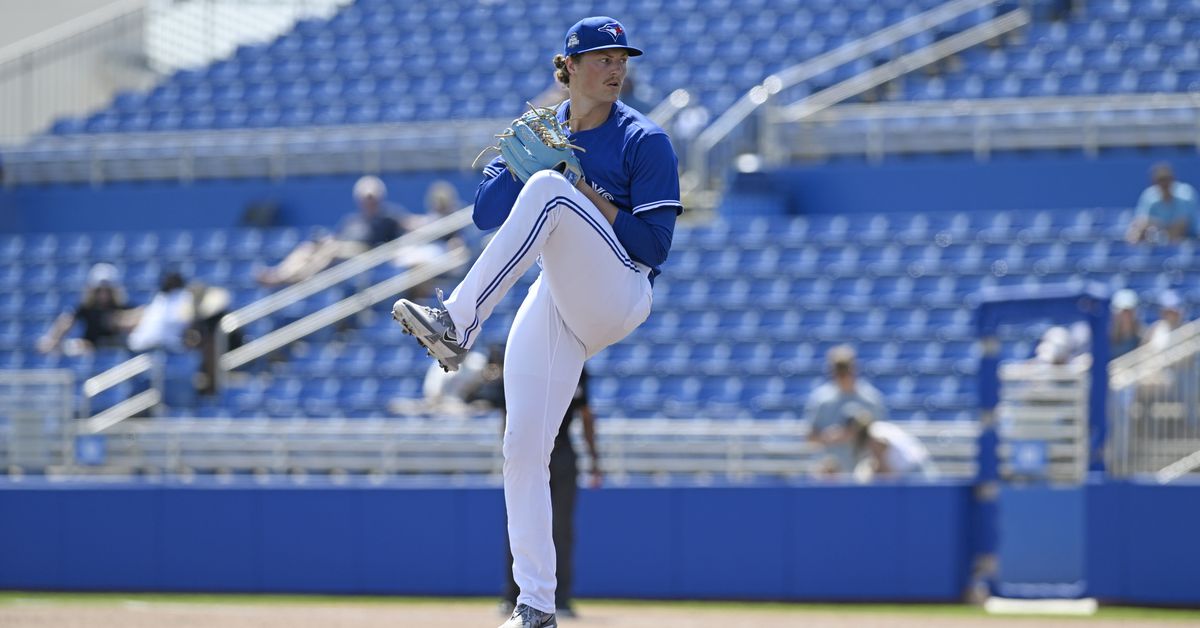
Stephen looks like a pitcher. He’s a broad-shouldered 6’4” and 215lbs. He’s athletic on the mound, with a smooth delivery that he repeats well. He pitches from a high three quarters arm slot with his foot on the far first base side of the rubber, so the ball comes out high and over the middle. It’s a setup that’s more conducive to working up and down in the zone than left to right. He has a big stride and uses his height to get a long ways down the mound, with almost seven feet of extension that adds almost a mile per hour to the perceived velocity of his pitches for batters.
Stephen pitches primarily off his fastball, which sits in the 91-94 range but touches 96. He gets a massive 20 inches of vertical ride on the pitch, which would be among the highest for comparable MLB fastballs. The pitch also has solid arm side run. It’s his best pitch, one he can also locate very reliably, and he throws it about 56% of the time.
His main secondary is a slider (StatCast sometimes thinks it’s a cutter but I think they’re one pitch). It comes in around 84, without much depth but solid glove side sweep. He spins it hard, at almost 2,600 RPM, so a tweak might unlock more movement. It’s a solid pitch as-is, though, allowing just a 62% contact rate against. He’ll also occasionally drop in a curve at 79, but it doesn’t have great movement and batters mostly either lay off it or hit it.
Rounding out his arsenal is a change up at 84. It’s pretty straight, without the big drop or arm side run that are in vogue right now, but it’s got good velocity separation from his fastball and gets him a lot of swinging strikes (15 on just 61 pitches thrown in his time in Dunedin). That’s a development from his time in college, where scouts noted that the change flashed some promise but that he didn’t use it often.
None of these pitches are clearly plus by MLB standards, although his fastball should play above average due to the vertical movement it gets. All three of the fastball, slider, and change look solid, though, and have the potential to play up because he can locate all of them at an above average rate. He’s just too advanced for A and A+ hitters right now. As he moves up the ladder, he likely won’t be able to blow advanced hitters away but the arsenal depth and command should help him keep his walks low and prevent him from getting hit hard.
It’s the profile of a #4 starter who, if he can keep missing enough bats as he faces better hitters, should be able to provide an MLB team with a lot of quality innings. His jump in the prospect standings represents not a breakout, but a solidification of what was already expected to be his upside. He’s tracking towards becoming the player the Jays hoped he would be when they took him, and getting there quickly. It wouldn’t surprise me if he joins draft-mate Trey Yesavage in New Hampshire in fairly short order, and if he’s in MLB consideration by next season.