
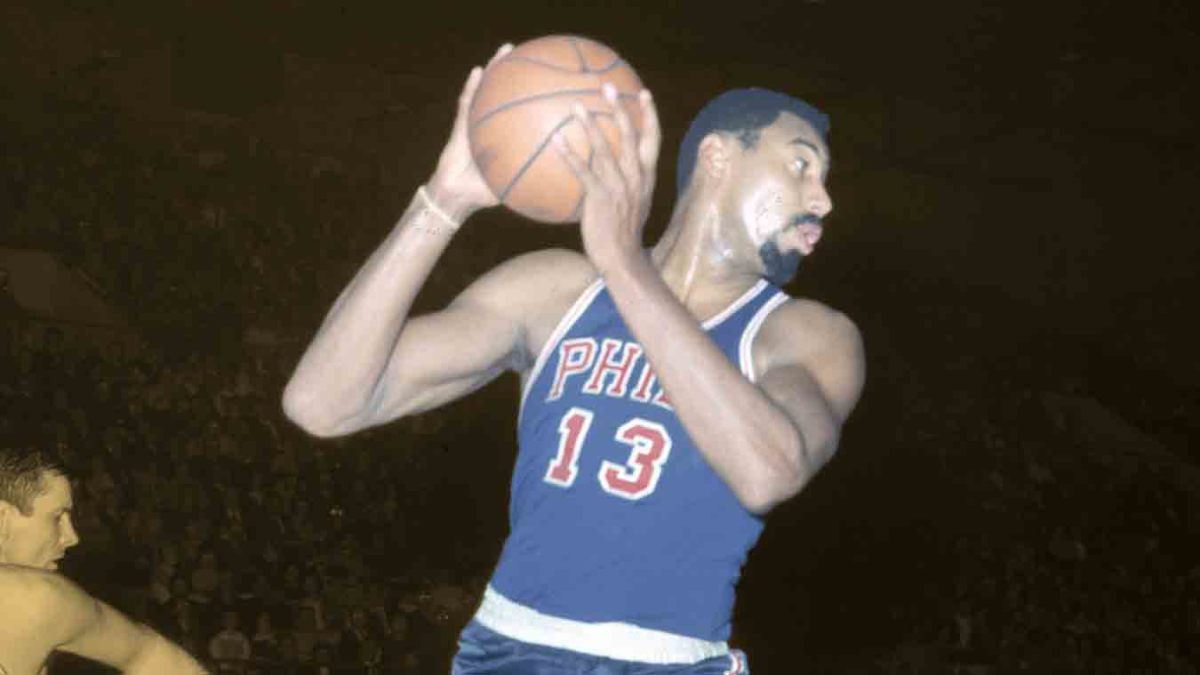
“Wilt is not only a great basketball player but a fine businessman” – Jackie Robinson on Wilt Chamberlain’s brief retirement originally appeared on Basketball Network.
Wilt Chamberlain took the NBA by storm when he entered the league in the 1959-60 season. Not only did he lead the Philadelphia Warriors to the Eastern Division Finals, but he also dominated statistically, leading the league in both scoring and rebounding.
Advertisement
However, his impact wasn’t just that of a typical rookie phenom – he completely overwhelmed the competition. The 13-time All-Star averaged 37.6 points and 27 rebounds per game while also leading the league in minutes played — deservingly winning the ROY and MVP honors.
Despite such unmatched dominance, Wilt felt he was unfairly treated on the court every night. So, after the Boston Celtics ended his rookie campaign, Chamberlain didn’t shy away from announcing his retirement, citing his frustration with racial injustice and the unnecessary physicality he faced on the court.
At the time, America was going through a critical period regarding civil rights, and Black athletes were under immense scrutiny regarding how they carried themselves. As a result, the 7’1″ center feared that retaliation against excessive contact would reflect poorly on the Black community.
However, Jackie Robinson knew these threats were more from an individual standpoint than a social one.
Jackie Robinson’s on Wilt’s decision to retire
Robinson was the first Afro-American to play in the MLB. He broke the color line when he took the first base for the Brooklyn Dodgers in 1947. So, he understood the prejudice ‘blacks’ had to face across all major sports. But when he heard about Chamberlain’s decision, he subtly suggested how “The Big Dipper” was making this decision for personal and financial gain.
Advertisement
According to the MLB legend, Chamberlain had realized his value after emerging as the best player in his first season on basketball’s grandest stage, so he developed his own way to carve out the maximum financial benefit using social prejudice.
“If Wilt is worrying about the effect on anyone other than himself, I’d suggest that he forget about it.” Robinson wrote in a newspaper column. “Great numbers of Negro athletes have had good years and bad years in their fields, and the race has continued to progress. There have been fights before, and there will be fights again,”
“I look for him to change his mind…I have a hunch that Wilt is not only a great basketball player but a fine businessman as well. He is certainly in a position to use his tremendous draw as a means to exact more favorable terms for next season from the Warriors,” he added.
Chamberlain did return to the NBA
Robinson’s theory proved right. Wilt retired long enough to tour Europe with the Harlem Globetrotters. However, he returned just in time for the 1960-61 NBA season to sign a lucrative three-year deal with the Warriors that rivaled the largest deals in professional sports — potentially matching Willie Mays’ $85,000-a-year contract with the San Francisco Giants.
Advertisement
Even though the two-time NBA Champion later admitted that a heartfelt conversation with friends and family helped him understand the situation and change his mind, figures like Robinson, who had risked everything in the fight for equality, took no time to realize that some athletes only leveraged the situation to gain the maximum financial benefit.
This story was originally reported by Basketball Network on Jun 15, 2025, where it first appeared.