
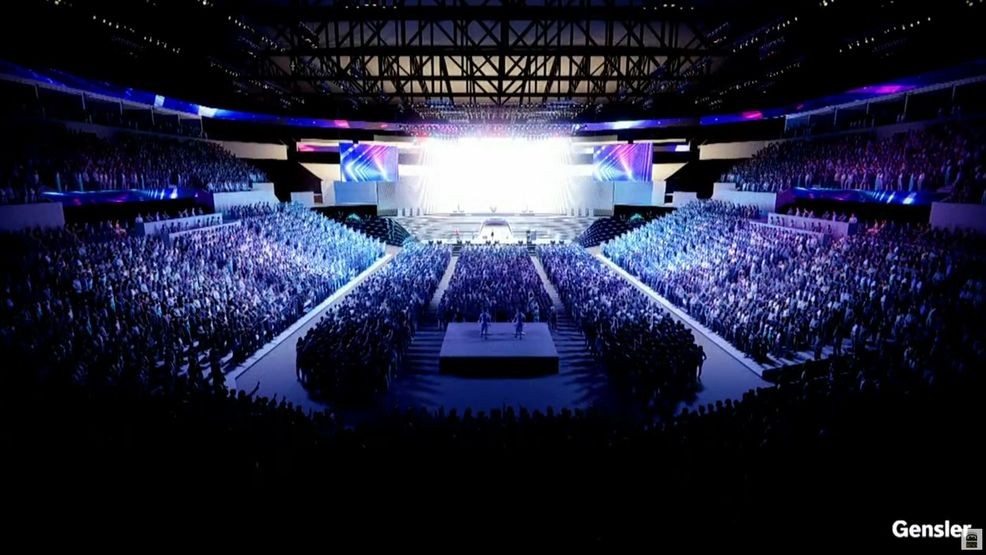
While it’s not the sexiest part of the construction process, ground has been broken at the Grand Sierra Resort as the 20-month process to build a $435 million arena is underway.
The first steps of the process will come underground as utility and sewer work is completed before the arena’s footprint is graded. Then, things will move vertically with the arena and an adjacent eight-story parking garage.
“We’re already doing work,” said Andrew Diss, the chief strategy officer and senior vice president of Meruelo Gaming. “We’re already doing some underground utilities. You’ve probably seen portions of the parking lot being worked on. We’ve got a sewer line that runs across that we’ve got to deal with. You can see that right in front of the building. That’s all the stuff we’ve got do before we can go vertical.”
Diss said the GSR and city will hold a ceremonial groundbreaking once the property begins to level the pad for the arena and garage, with that coming in August or September once the bulldozers are on site to push the heavy dirt.
“It just depending on how quickly we get all the underground stuff wrapped,” Diss said of the ceremonial groundbreaking. “In a few weeks, people will also start to see some demolition of the little mini golf course and the go-kart track that we have on the north end of the property. That’s basically to make room. That whole area is where construction material staging is going to take place. All the workers, they’re coming to the property, they’re going to have to park somewhere, and it’ll be making way for all that.”
Additionally, members of the GSR and Nevada Wolf Pack recently spoke with representatives from the NCAA to ensure the state-of-the-art arena would be in the mix to host NCAA Tournament basketball games. One condition of submitting a bid is the arena must hold at least 10,000 fans, which GSR Arena will hit with a projected capacity of 10,500 fans for basketball games.
“Their biggest issue is seating capacity,” Diss said. “They block off a lot of seats with their broadcasting stuff, their camera crews and different things. We just need to make sure that we stay above that 10,000-seat threshold even when they block a lot those seats, which we do. That’s not an issue where we’ve got go back to the architects and say, ‘Hey, we need you to change some substantial things.’ We’re all good. We feel confident. With the NCAA, some of the feedback we got is they like playing in new facilities No. 1, but they also like playing in destinations where it’s easy for people to find a hotel room. We check both those boxes.”
First- and second-round sites for the NCAA men’s basketball tournament have already been awarded for the 2026, 2027 and 2028 tournaments, so the earliest GSR Arena could host games would be the 2028-29 season. Mountain West teams UNLV, San Diego State and San Jose State are on the schedule to host NCAA Tournament games in the coming years — Las Vegas’ Allegiant Stadium is hosting the 2028 Final Four — with Nevada looking to join that party.
Part of its confidence in an NCAA Tournament bid stems from the copious hotel rooms in the region as well as its use of Gensler, the global architecture and design firm that planned GSR Arena in addition to other arenas that have hosted NCAA Tournament games like Crypto.com Arena in Los Angeles, Chase Center in San Francisco, Lenovo Center in Raleigh, N.C., and Moody Center in Austin, Texas.
“It’s my understanding that next summer is when the official bid process is going to start for the tournament years beginning in 2029,” Diss said. “Our first year in 2027 is already going to be spoken for when we open the arena. They do it in three-year blocks. The first year we would actually be eligible, the bidding process for that starts next summer. So, we’re just making sure that we’re going to have all the specifications that they need us to have. It turns out we do because Gensler has done this before. They know what’s required, and that’s what we’ve been planning on all along. Basically, the NCAA confirmed that. That’s good news for us. We don’t have to go back and change anything major.”
Diss said the build should start moving vertical in late summer or early fall with the arena and parking garage being raised at the same time. Overall, the project is expected to take a maximum of 20 months with the facility based on the 11,000-seat Acrisure Arena in Thousand Palms, Calif., which cost $290 million and took a little longer than 18 months from start to finish, although that project didn’t have to deal with the winter months in Northern Nevada.
“We’re penciling in 20 months, and that’s conservative,” Diss said. “We’re looking at late summer of ’27 to get it open.”