
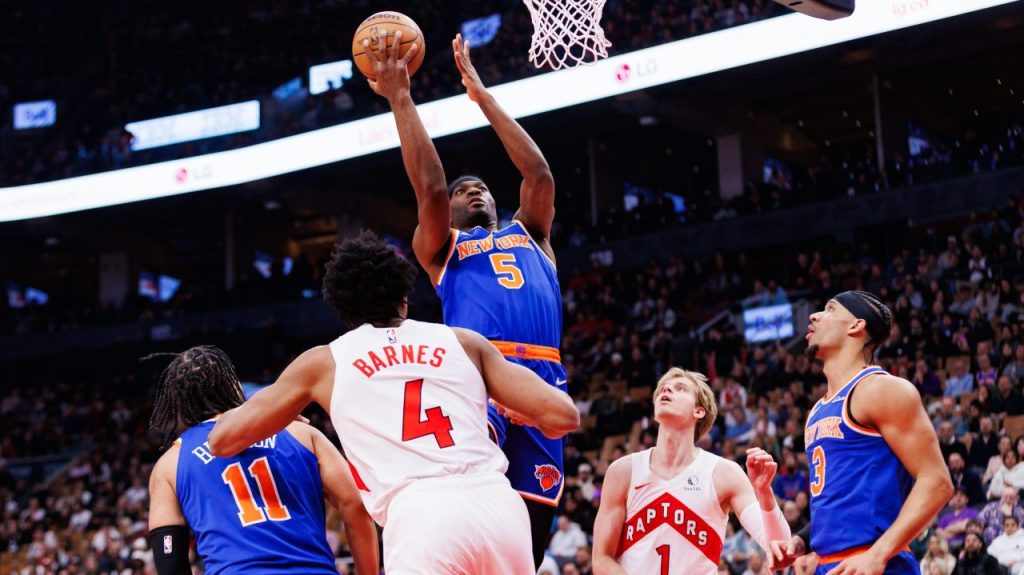
Attorneys for the New York Knicks and Toronto Raptors on Saturday jointly filed a letter with U.S. District Judge Jessica Clarke stating they and the NBA have scheduled an arbitration hearing for the week of July 21 to address the Knicks’ allegation the Raptors illicitly received trade secrets from former Knicks analytics staffer Ikechukwu Azotam.
The Knicks sued the Raptors in the Southern District of New York in 2023 for misappropriation of trade secrets. As the Knicks tell it, Azotam shared confidential scouting reports, play frequency data and analytics materials with Raptors contacts and the information was shared with other defendants, including Raptors head coach Darko Rajaković. The Knicks contend Azotam was a mole or spy who the Raptors hired in a video and player development assistant role.
The Raptors denied the allegations and rebuked them as a “publicity stunt.” The Raptors also argued that regardless of the accusations’ merits, the Knicks’ lawsuit is preempted by contractual language governing the legal relationship between NBA teams and the league.
Most crucially, the NBA constitution—which all teams contractually assent to follow—states that NBA commissioner Adam Silver has “exclusive, full, complete and final jurisdiction of any dispute” involving two or more teams and his decision is “final, binding and conclusive.” The commissioner has a duty to address tampering and related transgressions that attempt to give a team an unfair advantage over rivals and that undermine league assurances of fair play for all.
To those points and like other major pro leagues, the NBA requires that teams resolve their grievances against one another in a private arbitration forum overseen by the commissioner. In that forum, the NBA not only can ensure confidentiality of the proceedings but also lend subject matter expertise. Silver and other league executives are extremely knowledgeable about the business and law of the NBA and can draw from past team disputes in crafting an equitable and consistent resolution.
Contrastingly, in litigation, a team’s dispute with another team is a public controversy since litigation is fundamentally public. That means fans and journalists gain access to documents, including those with financial information and other sensitive materials, as well as transcripts of sworn testimony on sometimes controversial topics. The league would obviously prefer those materials, which can be of interest to the players’ association and league media and broadcast partners, remain confidential. Litigation is also heard by a judge who may be extremely knowledgeable about the law but less conversant regarding the customs and practices of what makes a sports league unique and profitable.
The Knicks, however, believe that Silver should be viewed as conflicted out of handling this dispute. In court documents, the Knicks assert Silver has too “close” of a relationship with Raptors co-owner Larry Tanenbaum, who is chairman of the NBA board of governors, to equitably address accusations against the Raptors.
But in dismissing the lawsuit to arbitration last December, Clarke wasn’t moved by the Knicks’ arguments. She stressed that “scouting reports, play frequency data, opposition research, opposing play tendencies, lists and diagrams of opponents’ key plays and the Knicks’ prep book”—all of which are at issue in the Azotam dispute—are subjects that fall within the purview of the commissioner and the arbitration provision.
Clarke also reasoned that case precedent in the Southern District of New York is clear. Even if a party to an arbitration believes the arbitrator isn’t fair, if the party contractually accepted the arbitrator, it will be bound by its pledge. To that point, Clarke cited Tom Brady who, through the NFLPA’s labor agreement with the NFL, agreed to NFL commissioner Roger Goodell serving as the arbitrator for disputes. Even though Brady may have had persuasive objections to Goodell serving in that capacity in Deflategate, those objections fell short legally because Goodell was contractually authorized to serve as the arbitrator.
The letter jointly filed on Saturday indicated that the Knicks and Raptors are following an “agreed-upon pre-hearing process and schedule” for the arbitration. The letter was authored by attorney Jim Walden of Walden Macht Haran & Williams (for the Knicks) and attorney Jeffrey A. Rosenthal of Cleary Gottlieb Steen & Hamilton (for the Raptors and other defendants).
In a statement shared with Sportico, a spokesperson for MSG said, “we continue to remain skeptical of this process as the NBA has consistently demonstrated that it has no desire to address this blatant theft of proprietary information, likely because the Chairman of the NBA is the defendant. It’s been 18 months since our original complaint was lodged and even after the court ordered the NBA to schedule a hearing, the NBA neglected to do so and only took action after the last filed joint status report in December.”
Sportico also reached out to the Raptors, who declined to comment, and the NBA.
Although the Knicks would prefer to litigate their case and are skeptical of league arbitration for this dispute, they could still prevail in arbitration. If the league finds the Knicks’ arguments are supported by evidence and testimony, the league could fine or take away draft picks from the Raptors, among other potential remedies.
The “losing” team in the NBA arbitration would also have the right to petition a federal court to vacate Silver’s arbitration award (decision). The odds of that petition succeeding would be very low as courts are obligated under the law to accord high deference to arbitration decisions. As a seasoned commissioner and a longtime attorney, Silver would likely also be viewed by courts as especially credible and authoritative.
Still, very difficult odds are not the same as impossible. The losing team would need to offer a valid reason to vacate the arbitration decision. One could be that the arbitration didn’t follow set procedures or was wrongly swayed by inadmissible evidence or testimony. Another would be if the decision so irrationally follows the evidence and testimony presented that it suggests the arbitrator was too biased or incapable.
The Knicks-Raptors arbitration is not the only one involving NBA teams. As Sportico detailed, a three-person arbitration panel last month ruled in favor of Alex Rodriguez and Marc Lore in their dispute with Glen Taylor for controlling ownership of the Minnesota Timberwolves and Minnesota Lynx.