
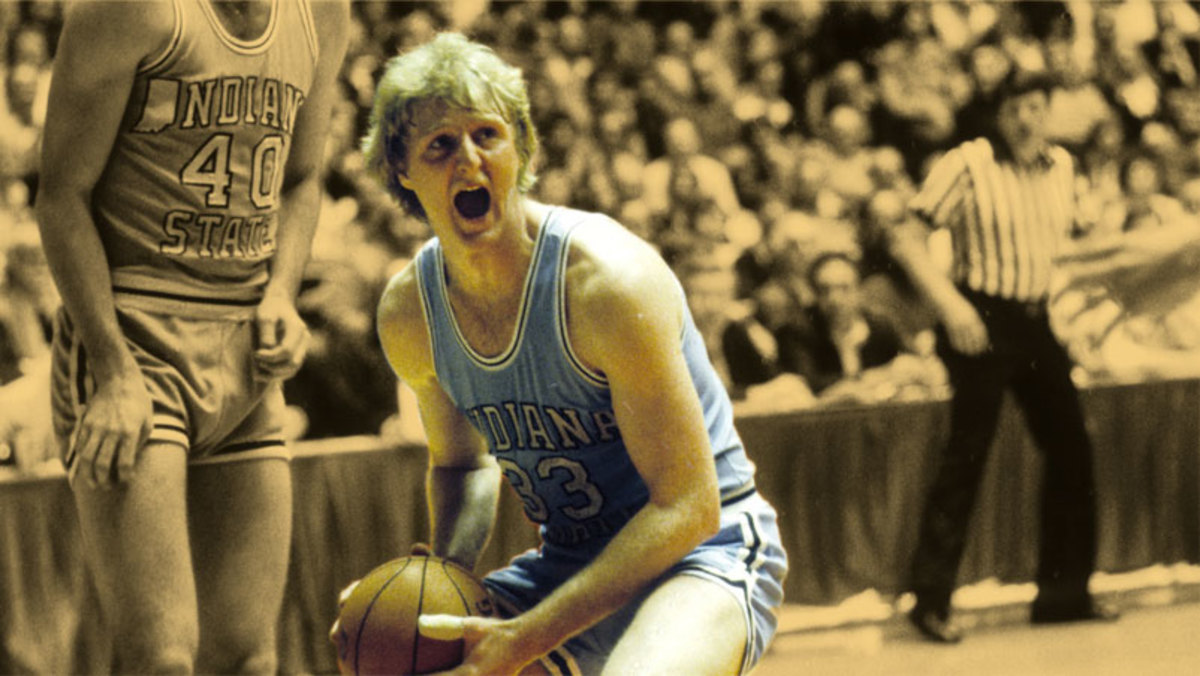
“Three days after rookie camp, I found out, this league is nothing” – Larry Bird on when he felt the NBA would be no challenge for him originally appeared on Basketball Network.
The summer of 1979 was significant for many different players.
Advertisement
Magic Johnson was rising and the Boston Celtics were a franchise in transition. But for Larry Bird, freshly minted from Indiana State University and carrying the weight of small-town expectations on his back, it marked the beginning of something that would tilt the league’s balance for over a decade.
While the rest of the basketball world debated how his rural game would translate, Bird showed up to rookie camp and quietly rewrote the terms of engagement.
Bird’s confidence
The spotlight was blinding even before he dribbled a ball in green and white.
Boston had signed him to a then-record $3.25 million rookie deal, a figure that turned heads not just for its size but because it was handed to a player who had chosen to stay in school another year.
Advertisement
That decision only magnified the scrutiny. Some saw potential; others saw hype. And as the whispers circulated, the sinewy kid from French Lick walked into rookie camp — and didn’t take long to discover his game.
“Once I got out of college, I came to the pros and well, ‘How’s he gonna do? He won’t be able to get his jumpshot off in the pros, or he won’t be quick enough, or he won’t be able to rebound,” Bird once said, recalling the initial doubts on him.
“And I think it took me probably 3 days after rookie camp, I found out, this league is nothing. I could play in this league and I would dominate this league.”
It didn’t take long for that internal realization to become visible to everyone else.
Advertisement
In his rookie year, Bird averaged 21.3 points, 10.4 rebounds and 4.5 assists per game. The Celtics, who had stumbled to 29 wins the previous season, finished 61–21 under their new star player’s watch — a 32-game swing that remains one of the most dramatic single-season turnarounds in NBA history.
This wasn’t just about stats. It was the way he carried himself on the court, like he’d seen the game a beat before everyone else and was already planning the next two moves. Bird played the game with a stubborn rhythm. He was methodical, precise, unapologetically confident. He wasn’t out-jumping opponents; he was out-thinking them. His jump shot, released from a slightly elevated set position, proved unbothered by NBA defenders.
His footwork, though never flashy, carved space where none should have existed. And his vision, court vision so sharp it bordered on clairvoyant, turned the Celtics’ offense into a study in movement and misdirection. The real revelation was how Larry Legend casually dismantled the notion that he wouldn’t.
Earning dominance
Bird wasn’t interested in easing into the league or deferring to veterans. He dropped 30 points in his fifth NBA game. By midseason, the questions about his ability had vanished. He led the Celtics to the Eastern Conference finals and edged out Magic, his NCAA rival and future co-anchor of the 1980 NBA for Rookie of the Year race.
Advertisement
That rookie camp epiphany wasn’t arrogance. Bird’s path to dominance was built on angles, anticipation and a burning desire to outwork everyone on the floor. What made his early assessment of the league so accurate wasn’t a lack of respect for his peers; it was a mastery of his own limitations and how to overcome them.
By the time his second season rolled around, the NBA had stopped wondering if Bird could play and started wondering how anyone would stop him. His numbers continued to climb, averaging 21.2 points, 10.9 rebounds and 5.5 assists in 1980–81. More importantly, Boston clinched the championship and Bird added “NBA champion” to his résumé after just two years of being removed from Terre Haute.
Over the next decade, the C’s icon would claim three MVP awards (1984, 1985, 1986), notch three championships and redefine what it meant to be both a team player and a killer competitor.
And it all traces back to those first three days at rookie camp when the murmurs still hung in the air.
Advertisement
And the only person truly sure of Bird’s future was himself.
This story was originally reported by Basketball Network on Jun 20, 2025, where it first appeared.