
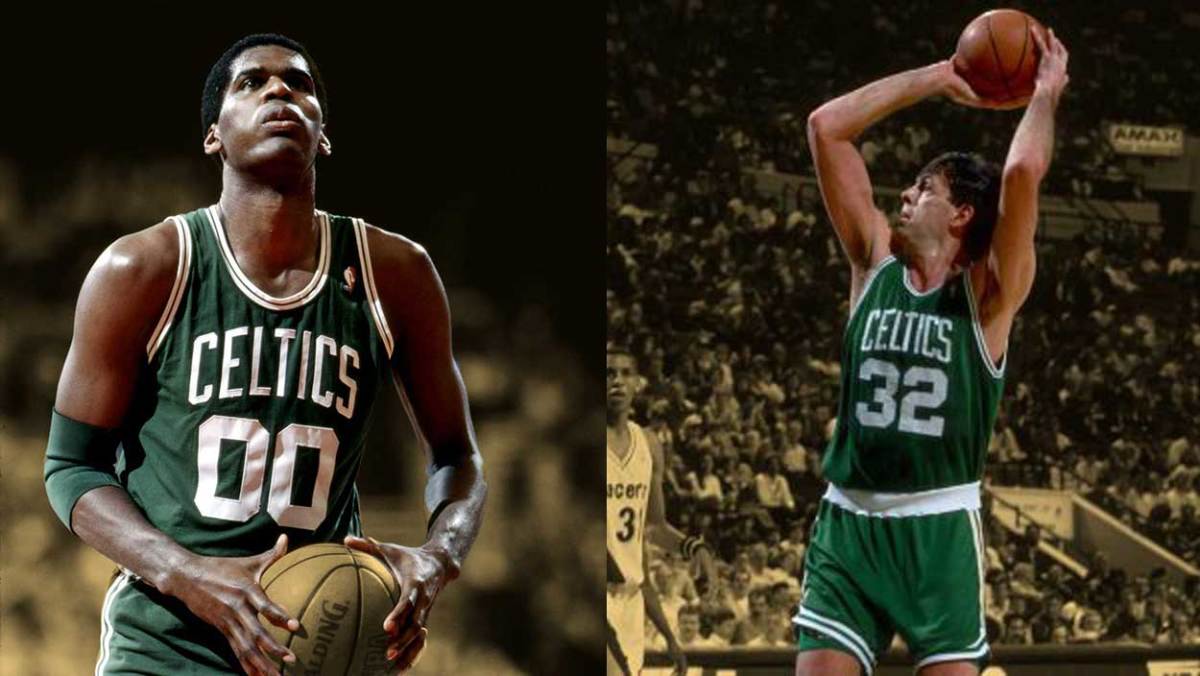
“I played with the guy for 12 years, I never blocked his shot once” – Kevin McHale revealed practicing against Robert Parish used to wear him out originally appeared on Basketball Network.
No battles were as quietly brutal as the ones that never made it past practice, especially for the ’80s Boston Celtics.
Advertisement
Kevin McHale, himself a Hall of Famer and one of the most gifted low-post scorers the game has seen spent the majority of his career matched daily against Robert Parish, a man whose stoic presence and towering frame masked a mechanical relentlessness that was nightmarish to guard, even in scrimmages.
While the world saw their cohesion and chemistry on hardwood stages from the Boston Garden to the Forum, McHale was getting worn down behind the scenes.
Blocking Parish’s jumper
The frontcourt trio of McHale, Parish and Larry Bird dominated the decade with a blend of brains, bruises and basketball IQ that overwhelmed opponents.
Advertisement
They formed the heart of a Celtics team that reached five NBA Finals in the ’80s and won three championships. But in practice, it was the 7-foot Parish who gave McHale all he could handle.
“Robert had that damn pterodactyl shot,” McHale recalled with a mix of frustration and admiration. “I started blocking that. I used to always say, ‘I’m gonna get it today.’ And I would jump; I never blocked his jumper ever. I played with the guy for 12 years. I never blocked his shot once.”
Parish’s release point was unorthodox. He was high over his head and flicked with wrist speed that defied his methodical demeanor. He didn’t need flash; he needed inches — and he had more than enough.
Advertisement
That jumper — soft off the glass or clean through the net — became part of the Celtics’ offensive backbone. Defenders tried to read it, reach it, guess it. McHale tried for over a decade. Never once got a piece of it.
Parish came to Boston in 1980 as part of one of the most lopsided trades in NBA history. The Celtics acquired him from the Golden State Warriors along with the draft pick that would become McHale. Boston ended up with two Hall of Famers and the foundation of a dynasty.
What he lacked in charisma, he delivered in availability and efficiency. Parish played all 82 games in a season 10 different times and finished his career with 1,611 games played — still the most in NBA history. But those stats barely captured his true edge, which was his ability to grind down his opponents, including his own teammates.
That quiet stamina was a killer. Opponents who didn’t study tape would be fooled by Parish’s unassuming gait and emotionless stare. Those who played against him, especially day in and day out, knew the truth. The Chief was surgical. And that smooth 15-footer was his scalpel.
Advertisement
Forming a partnership
In practice, McHale would try to time Parish’s shot. Get physical. Guess early. None of it mattered. Robert, with elbows high and his right wrist cocked back, simply elevated, flicked and landed.
Bird had his shooting rituals. McHale had his footwork. And Parish had that jumper and the cardio of a marathon runner. Their contrast added texture to their greatness as the Big Three. Bird was focused and competitive, and McHale was animated on the court — expressive with his footwork, head-fakes, and soft finishes. Parish, on the other hand, played like a statue that had learned to move. There was no trash talk, no wasted motion, just relentless reps.
Advertisement
Yet, while that same robotic rhythm made him predictable, they’re consistently hard to interrupt. McHale tried for years to find the beat and break it and never got there. Those practice duels made up the bones of Boston’s interior dominance.
McHale might not have blocked that jumper, but he sharpened his own game trying to. And in the long arc of Celtic history, that matters just as much. It was in those hidden matchups that the margins of championship teams were carved out — through frustration, familiarity and repetition.
By the time Parish left Boston in 1994, he had played more than 1,100 games in a Celtics uniform, logged over 18,000 points, and had helped anchor one of the most disciplined eras in franchise history. McHale had retired three years earlier, but the imprint of their battles lingered.ade
This story was originally reported by Basketball Network on Jun 20, 2025, where it first appeared.