
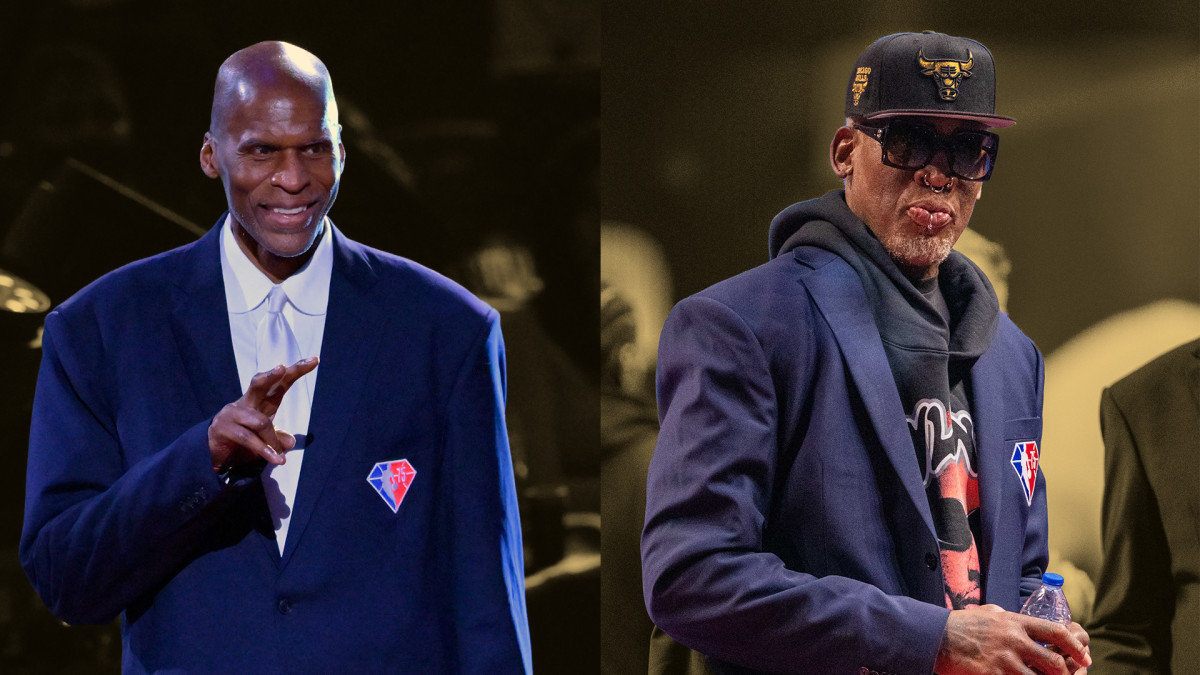
“One of the most interesting personalities” – Robert Parish on how playing with Dennis Rodman made the Chicago dynasty feel a lot different than Boston’s originally appeared on Basketball Network.
Robert Parish witnessed two dynasties from the inside out.
Advertisement
He was a cornerstone of the Boston Celtics’ frontcourt in the 1980s, anchoring a team that captured three NBA titles with a blend of size, precision and Hall of Fame synergy.
Years later, in the twilight of his career, he laced up once more with a Chicago Bulls squad that was closing in on its second three-peat of the decade. He witnessed, from a unique vantage point, how two different dynasties operated and succeeded in their own ways.
Rodman’s personality
In 1996, at 43 years old and fresh off a short stint in the Charlotte Hornets, Parish joined a team already soaked in champagne — the defending champion Bulls. They had the coach in Phil Jackson, had the leader in Michael Jordan and his deputy in Scottie Pippen.
Advertisement
However, the Dennis Rodman factor was a different kind of machine for their success.
“Speaking of personalities,” Parish said, “one of the most interesting personalities [was] Dennis Rodman. Definitely.”
Rodman was one of the most unpredictable figures in the league. He was also one of the best hustlers. He had already earned two Defensive Player of the Year awards and built a reputation as an elite rebounder with the Detroit Pistons and the San Antonio Spurs. He brought his eccentricity and unmatched motor to a Bulls locker room already brimming with competitive fire.
But for Parish, who had spent years alongside Larry Bird, one of the most relentless competitors the league had ever seen, Rodman’s energy was unlike anything he had encountered in Boston. His years with the Celtics were defined by heavy minutes and heavier expectations. Between 1980 and 1994, Parish started over 1,100 games, formed the most formidable frontcourt in NBA history alongside Kevin McHale and Bird and became a bedrock of Red Auerbach’s blueprint.
Advertisement
Rodman’s presence symbolized the contrast.
The Celtics’ success had been a cold-blooded march built on structure, repetition and execution. Practices were grueling, the offense was deliberate and the locker room, while not without tension, operated within a traditional framework of veteran hierarchy.
In contrast, Chicago’s dominance in the mid-90s thrived within organized chaos. Under Jackson’s triangle system and his psychological approach to coaching, the Bulls were freer, looser and yet just as precise when it mattered.
Being a veteran
When Parish arrived in Chicago on Sept. 25, 1996, signing as a free agent after his release from the Hornets, he wasn’t expected to log major minutes. He played in just 43 games that season and averaged 9.4 minutes per contest. But he didn’t need to chase stats, he had scored over 23,000 career points and grabbed more than 14,000 rebounds by that point.
Advertisement
What the Bulls needed was maturity and Parish, even in limited action, became a quiet north star for younger players navigating the edges of greatness. Chicago went on to win 69 games that season, finishing with a 69–13 record before steamrolling through the playoffs.
For Parish, it was ring number four, a final chapter added to a Hall of Fame story and a unique glimpse into how another dynasty handled its business.
He was the oldest in the dressing room, and while Jordan was the leader, he mentored the younger players as a veteran and let Rodman be himself because he knew that was how he operated.
“That’s the best way to roll with Dennis, let Dennis be Dennis,” Parish said. “But the other young players — Jason Kaffee, Derrick Dickey — they gravitated towards me because they want to pick my brain about what it took to be a professional.”
Advertisement
Parish didn’t come to Chicago to reinvent himself; he came to reinforce what he had always stood for: longevity, discipline, and presence.
The younger players on that Bulls team looked up to him not for what he could still do on the floor but for what he had already done. His 21 years in the league were marked by a near-religious dedication to conditioning, consistency and mental toughness.
He played more games than anyone in NBA history and remained injury-free through eras defined by physicality.
While names like Jordan and Pippen dominated headlines, Parish operated in the background with the same quiet demeanor he’d always carried.
Advertisement
In Boston, he was the silent enforcer, often letting his play speak louder than any pregame quotes. In Chicago, he became something else entirely, a living link between dynasties.
This story was originally reported by Basketball Network on Jun 20, 2025, where it first appeared.