
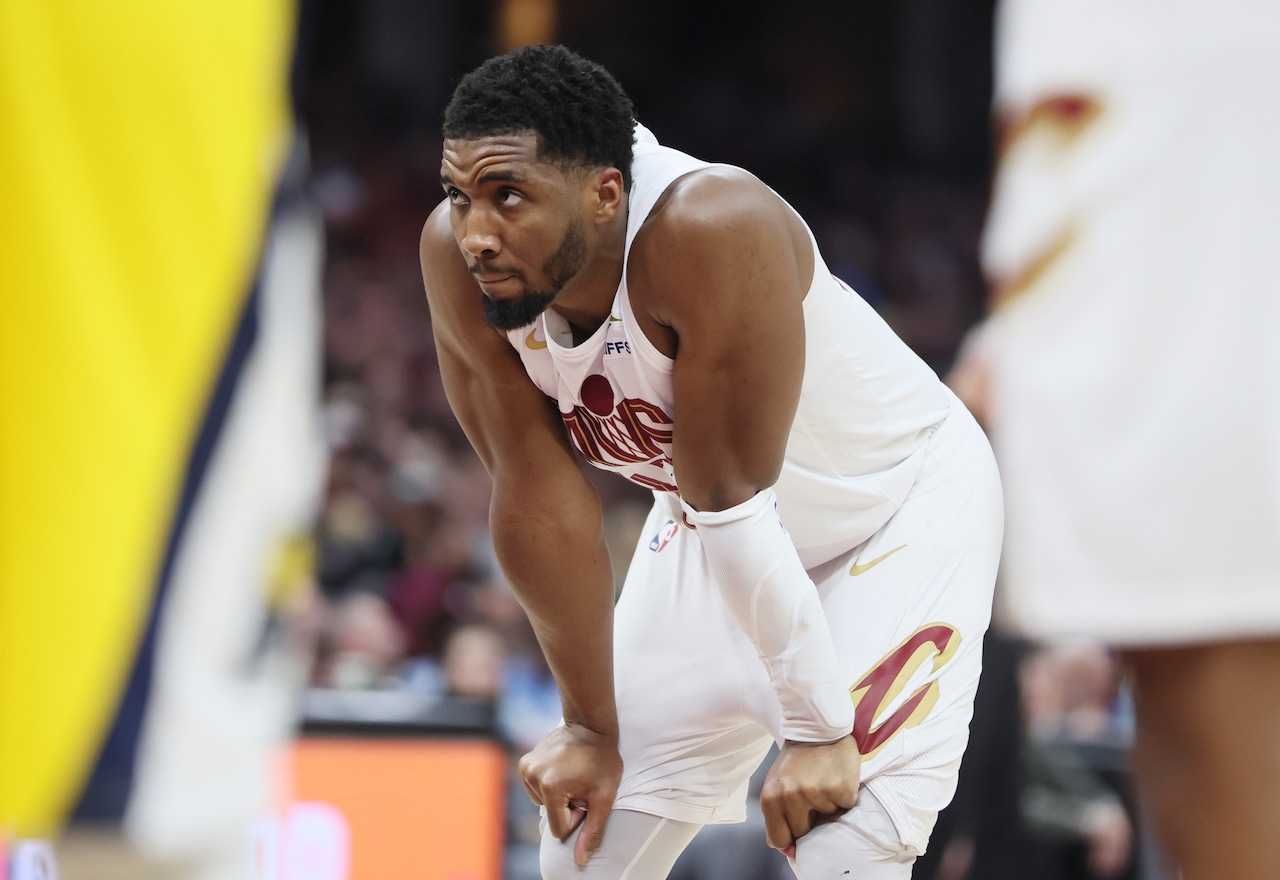
CLEVELAND, Ohio — Donovan Mitchell has spent this entire season walking the line between savior and system player, oscillating between controlled bursts of isolation brilliance and committed buy-in to a more democratic, ball-sharing offense under Kenny Atkinson.
On Sunday, in Game 1 of the Eastern Conference semifinals against the Pacers, that balance shattered.
Mitchell’s 30-shot performance — a heavy-handed 33-point effort — wasn’t just a statistical outlier. It was a flashing red warning light.
The six-time All-Star has been the Cavs’ emergency exit all season long, but when the playoffs hit, he shouldn’t feel like he has to be in constant takeover mode for Cleveland to win.
Thirteen-for-30 from the field. One-for-11 from three – tells a story louder than Mitchell’s postgame presser. Yes, he was aggressive. Yes, Darius Garland’s absence left a ball-handling void. But the Pacers’ defense didn’t force this. The Cavaliers’ own lack of offensive flow did.
The Cavs shot just 9-of-38 from deep, their fewest number of triples made over the entire season and the second-worst 3-point percentage (23.7%) of the year. That kind of cold night can rattle a team’s confidence, but it shouldn’t dismantle its structure.
“Right now? My answer is probably like, damn that’s a lot of shots,” Mitchell said when asked about his shooting splits after the loss.
“We missed shots we make. We missed open looks and nothing to hang our head about. We’ve missed shots before and we’ve lost games before from not making shots. But we’re not going to sit here and say, oh, if we make shots, we win games. We gotta find a way to still win this game even though we don’t make shots.”
The Cavaliers attempted 98 shots in Game 1. Mitchell and Ty Jerome took 50 of them. Indiana, as a team, attempted just 83. Pascal Siakam and Tyrese Haliburton, Indiana’s two All-Stars, took 15 shots apiece — half of Mitchell’s total. That disparity isn’t just about volume; it’s about how Cleveland was playing. Or more specifically, how they weren’t.
The Cavs offense thrives when it hums — when it ping-pongs around the perimeter, attacks closeouts, and keeps defenses in constant motion. But on Sunday, the ball stuck. Possessions stalled. The extra pass died on the vine.
Cleveland registered 25 assists, a number that would suggest more ball movement than there actually was. The shot diet leaned heavily on self-created looks, early-clock jumpers, and isolation drives that Indiana’s help defense was more than prepared for.
“I think [Mitchell] kind of felt the moment, felt he needed to with Darius [Garland] out. And not just on him, I thought it was a general, didn’t distribute the ball like we normally do, didn’t move it like we normally do,” Cavs head coach Kenny Atkinson said. “And you got to get off the ball. They pack the paint. There’s going to be a lot of clips where it was, one more pass or swing, swing, pass. We didn’t get into any of that.”
How to watch the Cavs: See how to watch the Cavs games with this handy game-by-game TV schedule.
Belief in the system is supposed to be the payoff for everything Cleveland has built toward this season. Atkinson wasn’t hired just to unlock spacing — he was hired to unearth balance.
But that balance evaporated in Game 1, and it zapped the star’s energy.
After dropping 12 points in the third quarter to pull Cleveland within two, Mitchell faded in the fourth. He was visibly grabbing his knee on multiple possessions. He lagged in transition, not out of laziness, but self-preservation. He was conserving energy, because 30-shot nights in May don’t come cheap — especially when you’re chasing pace and creating every shot on the other end.
This is the scenario the Cavs spent all season trying to avoid.
Mitchell played the fewest minutes per game of his career during the regular season. The team mapped out a rest and load-management strategy with one clear goal: keep him fresh for moments like this.
But if the plan ends with him reverting to overextension and overcompensation — then what was the point?
A similar movie was on full display last postseason.
A banged-up Mitchell, putting out fires with a leaky bucket, eventually succumbing to a calf injury that sidelined him during the final two games of the Boston series. Game 1 against Indiana didn’t just echo those memories. It screamed them.
Evan Mobley’s improved shooting is part of that solution. His confidence from the perimeter has opened up spacing in a way that finally allows him to be more than a screen-and-roll big. His floor game is evolving, and he’s no longer a liability beyond the arc. He has to be treated like a scoring threat — but only if he’s given the opportunity to play like one.
Same goes for De’Andre Hunter, whose addition was supposed to provide the kind of two-way stability that could alleviate pressure on Mitchell and Garland alike. His defensive versatility is elite, but his offensive impact — especially as a catch-and-shoot option or a secondary creator — is where he can tilt matchups. Hunter didn’t touch the ball nearly enough on Sunday, a microcosm of a larger issue.
The trust is real. The belief is real. The pieces are in place. But if the Cavaliers are going to make the leap — not just out of this series, but into real contention — that trust can’t live in theory. It has to live in action.
That means moving the ball, not watching the clock. That means letting the offense breathe, not holding it hostage. That means using Mitchell as the weapon he is. Not the crutch he’s had to become.
This isn’t about whether the Cavs can win when the shots fall. It’s about whether they can win when they don’t. That’s the difference between a team that survives the playoffs and one that defines them.
Cleveland has the system. They have the personnel. They’ve done the hard part of becoming more than a one-man show. Now, they just have to prove it — when it matters most.